Event submissions
EventsThe 2nd International Electronic Conference on Plant Sciences—10th Anniversary of Journal Plants
Published

This submission belongs to the session D. Phytochemistry and Phytoremediation, Plants in Urban Ecosystems of the event The 2nd International Electronic Conference on Plant Sciences—10th Anniversary of Journal Plants
Published date
30 Nov, 2021
Academic Editor
'%3e%3cpath%20d='M12.6657%2010.9104C12.4185%2010.325%2012.0599%209.79327%2011.6097%209.34482C11.1609%208.89508%2010.6293%208.5365%2010.0442%208.28888C10.0389%208.28626%2010.0337%208.28495%2010.0285%208.28233C10.8446%207.69279%2011.3752%206.73249%2011.3752%205.64904C11.3752%203.8542%209.92103%202.39999%208.1262%202.39999C6.33136%202.39999%204.87715%203.8542%204.87715%205.64904C4.87715%206.73249%205.40774%207.69279%206.22393%208.28364C6.21869%208.28626%206.21345%208.28757%206.20821%208.29019C5.62129%208.5378%205.09463%208.89284%204.64265%209.34613C4.1929%209.79493%203.83432%2010.3266%203.58671%2010.9117C3.34345%2011.4845%203.21226%2012.0987%203.20023%2012.7209C3.19988%2012.7349%203.20233%2012.7488%203.20744%2012.7619C3.21255%2012.7749%203.22022%2012.7867%203.22998%2012.7968C3.23975%2012.8068%203.25142%2012.8147%203.26431%2012.8202C3.2772%2012.8256%203.29105%2012.8284%203.30504%2012.8284H4.09109C4.14874%2012.8284%204.19459%2012.7825%204.1959%2012.7262C4.2221%2011.7148%204.62823%2010.7676%205.34617%2010.0497C6.08899%209.30683%207.0755%208.89808%208.1262%208.89808C9.17689%208.89808%2010.1634%209.30683%2010.9062%2010.0497C11.6242%2010.7676%2012.0303%2011.7148%2012.0565%2012.7262C12.0578%2012.7838%2012.1037%2012.8284%2012.1613%2012.8284H12.9474C12.9613%2012.8284%2012.9752%2012.8256%2012.9881%2012.8202C13.001%2012.8147%2013.0126%2012.8068%2013.0224%2012.7968C13.0322%2012.7867%2013.0398%2012.7749%2013.0449%2012.7619C13.0501%2012.7488%2013.0525%2012.7349%2013.0522%2012.7209C13.0391%2012.0947%2012.9094%2011.4855%2012.6657%2010.9104ZM8.1262%207.9024C7.52486%207.9024%206.9589%207.6679%206.53312%207.24211C6.10733%206.81633%205.87283%206.25037%205.87283%205.64904C5.87283%205.0477%206.10733%204.48174%206.53312%204.05596C6.9589%203.63018%207.52486%203.39567%208.1262%203.39567C8.72753%203.39567%209.29349%203.63018%209.71927%204.05596C10.1451%204.48174%2010.3796%205.0477%2010.3796%205.64904C10.3796%206.25037%2010.1451%206.81633%209.71927%207.24211C9.29349%207.6679%208.72753%207.9024%208.1262%207.9024Z'%20fill='%235D1EE1'/%3e%3c/g%3e%3c/svg%3e) Giedre Samuoliene
Giedre SamuolieneCitation
Sofija Kilibarda, Sandra Z. Vuković, Danijel D. Milinčić, Marina P. Mačukanović-Jocić, Snežana Jarić, Aleksandar Ž. Kostić, Phytochemical and Antioxidant Properties of Athamanta turbith (L.) Brot Collected from Serbia, in Proceedings of The 2nd International Electronic Conference on Plant Sciences—10th Anniversary of Journal Plants, 1 December–15 December 2021, MDPI: Basel, Switzerland, doi: 10.3390/IECPS2021-11947
Share
Email
Facebook
Twitter
LinkedIn
Phytochemical and Antioxidant Properties of Athamanta turbith (L.) Brot Collected from Serbia
'%3e%3cpath%20d='M12.6647%2010.9104C12.4176%2010.325%2012.0589%209.7933%2011.6088%209.34485C11.16%208.89511%2010.6283%208.53653%2010.0432%208.28891C10.038%208.28629%2010.0327%208.28498%2010.0275%208.28236C10.8437%207.69282%2011.3743%206.73252%2011.3743%205.64907C11.3743%203.85423%209.92005%202.40002%208.12522%202.40002C6.33038%202.40002%204.87618%203.85423%204.87618%205.64907C4.87618%206.73252%205.40677%207.69282%206.22296%208.28367C6.21772%208.28629%206.21248%208.2876%206.20724%208.29022C5.62031%208.53783%205.09365%208.89287%204.64167%209.34616C4.19192%209.79496%203.83334%2010.3266%203.58573%2010.9117C3.34247%2011.4846%203.21128%2012.0987%203.19925%2012.721C3.1989%2012.735%203.20135%2012.7489%203.20646%2012.7619C3.21157%2012.7749%203.21924%2012.7868%203.22901%2012.7968C3.23877%2012.8068%203.25045%2012.8148%203.26334%2012.8202C3.27623%2012.8256%203.29007%2012.8284%203.30406%2012.8284H4.09012C4.14776%2012.8284%204.19362%2012.7825%204.19493%2012.7262C4.22113%2011.7148%204.62726%2010.7676%205.34519%2010.0497C6.08802%209.30686%207.07452%208.89811%208.12522%208.89811C9.17592%208.89811%2010.1624%209.30686%2010.9052%2010.0497C11.6232%2010.7676%2012.0293%2011.7148%2012.0555%2012.7262C12.0568%2012.7839%2012.1027%2012.8284%2012.1603%2012.8284H12.9464C12.9604%2012.8284%2012.9742%2012.8256%2012.9871%2012.8202C13%2012.8148%2013.0117%2012.8068%2013.0214%2012.7968C13.0312%2012.7868%2013.0389%2012.7749%2013.044%2012.7619C13.0491%2012.7489%2013.0515%2012.735%2013.0512%2012.721C13.0381%2012.0947%2012.9084%2011.4856%2012.6647%2010.9104ZM8.12522%207.90243C7.52388%207.90243%206.95792%207.66793%206.53214%207.24215C6.10636%206.81636%205.87185%206.2504%205.87185%205.64907C5.87185%205.04773%206.10636%204.48177%206.53214%204.05599C6.95792%203.63021%207.52388%203.3957%208.12522%203.3957C8.72655%203.3957%209.29252%203.63021%209.7183%204.05599C10.1441%204.48177%2010.3786%205.04773%2010.3786%205.64907C10.3786%206.2504%2010.1441%206.81636%209.7183%207.24215C9.29252%207.66793%208.72655%207.90243%208.12522%207.90243Z'%20fill='%235D1EE1'/%3e%3c/g%3e%3c/svg%3e)
Sofija Kilibarda 1
Sandra Z. Vuković 1
Danijel D. Milinčić 1
Marina P. Mačukanović-Jocić 1
Snežana Jarić 2

Aleksandar Ž. Kostić 1
1. University of Belgrade-Faculty of Agriculture
2. Institute for biological research "Siniša Stanković", University of Belgrade
Abstract
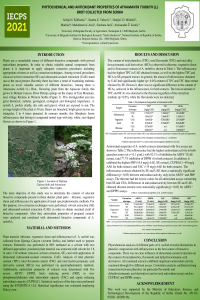
Đetinja Canyon is located in the western Serbia, in the vicinity of Tara Mountain and it represents habitat of the numerous endemic species. Among them is Athamanta turbith (L.) Brot., the flowering plant from the Apiaceae family. The aim of this study was to determine content of selected plant bioactive compounds presented in three plant parts – rhizome, vegetative shoot and inflorescence. Extraction was performed in 80% methanol as solvent with two different approaches: powdered plant material was extracted with solvent for 3 h in ratio 1:10 without (classical solvent extraction,SE,) and with application of ultrasound (ultrasound-assisted extraction, UAE). Analysis of total phenolic content (TPC), total flavonoid content (TFC) and total hydroxycinnamic acid derivative content (HCA) was performed via spectrophotometric methods. The inflorescence had the highest TPC in UAE obtained-extract (2.73±0.13 mg GAE/g), as well as the highest TFC (1.56±0.02 mg/g QE) and HCA (1.45±0.11 mg/g CGAE) in SE-prepared extract where GAE, QE and CGAE are gallic acid equivalents, quercetin equivalents and chlorogenic acid equivalents respectively. The lowest amount of TPC, TFC and HCA was detected in the rhizome regardless extraction methods. Additionally, antioxidant properties of extracts were determined with five assays: ABTS·+, DPPH·, ferric reducing power (FRP), in vitro phosphomolybdenum total antioxidant capacity (TAC) and cupric reducing antioxidant capacity (CUPRAC). The inflorescence had the highest antioxidant activity in both quenchers assays (at γ= 0.1 g/mL) with 92.1% of inhibition for ABTS·+ (UAE extract,) and 77.7% inhibition of DPPH· (for both extracts). In addition, it exhibited the highest FRP (18.4 mg/g AAE, SE extract and CUPRAC (~40 mg/g AAE for both extracts) values where AAE stands for ascorbic acid equivalents. On the contrary, the rhizome had the lowest values for all antioxidant assays concerning both SE and UEA. In conclusion, exhibited antioxidant properties are mostly in line with determined content of selected bioactive compounds. Further statistical analysis will be applied to confirm/oppose this.
Keywords
antioxidant activity
Athamanta turbith
bioactive compounds
Đetinja Canyon
Manuscript
sciforum-050549-Kilibarda et al final Manuscript 1_final.pdf
Poster
POSTER - Phytochemical and antioxidant properties of Athamanta turbith (L.) Brot collected from Serbia.pdf
Sulfur Application Amends Detoxification Processes in Eggplant in Response to Excessive Doses of Thiacloprid
Identification and Characterization of PHT1 Transporters Family and Differential Expression Patterns in Control and Blindness Broccoli Plants