Event submissions
EventsThe 2nd International Electronic Conference on Plant Sciences—10th Anniversary of Journal Plants
Published
 10.3390/IECPS2021-11973 (registering DOI)
 This submission belongs to the session C. Plant Response to Stresses and Changing Environment of the event The 2nd International Electronic Conference on Plant Sciences—10th Anniversary of Journal Plants
Published date
30 Nov, 2021
Academic Editor
'%3e%3cpath%20d='M12.6657%2010.9104C12.4185%2010.325%2012.0599%209.79327%2011.6097%209.34482C11.1609%208.89508%2010.6293%208.5365%2010.0442%208.28888C10.0389%208.28626%2010.0337%208.28495%2010.0285%208.28233C10.8446%207.69279%2011.3752%206.73249%2011.3752%205.64904C11.3752%203.8542%209.92103%202.39999%208.1262%202.39999C6.33136%202.39999%204.87715%203.8542%204.87715%205.64904C4.87715%206.73249%205.40774%207.69279%206.22393%208.28364C6.21869%208.28626%206.21345%208.28757%206.20821%208.29019C5.62129%208.5378%205.09463%208.89284%204.64265%209.34613C4.1929%209.79493%203.83432%2010.3266%203.58671%2010.9117C3.34345%2011.4845%203.21226%2012.0987%203.20023%2012.7209C3.19988%2012.7349%203.20233%2012.7488%203.20744%2012.7619C3.21255%2012.7749%203.22022%2012.7867%203.22998%2012.7968C3.23975%2012.8068%203.25142%2012.8147%203.26431%2012.8202C3.2772%2012.8256%203.29105%2012.8284%203.30504%2012.8284H4.09109C4.14874%2012.8284%204.19459%2012.7825%204.1959%2012.7262C4.2221%2011.7148%204.62823%2010.7676%205.34617%2010.0497C6.08899%209.30683%207.0755%208.89808%208.1262%208.89808C9.17689%208.89808%2010.1634%209.30683%2010.9062%2010.0497C11.6242%2010.7676%2012.0303%2011.7148%2012.0565%2012.7262C12.0578%2012.7838%2012.1037%2012.8284%2012.1613%2012.8284H12.9474C12.9613%2012.8284%2012.9752%2012.8256%2012.9881%2012.8202C13.001%2012.8147%2013.0126%2012.8068%2013.0224%2012.7968C13.0322%2012.7867%2013.0398%2012.7749%2013.0449%2012.7619C13.0501%2012.7488%2013.0525%2012.7349%2013.0522%2012.7209C13.0391%2012.0947%2012.9094%2011.4855%2012.6657%2010.9104ZM8.1262%207.9024C7.52486%207.9024%206.9589%207.6679%206.53312%207.24211C6.10733%206.81633%205.87283%206.25037%205.87283%205.64904C5.87283%205.0477%206.10733%204.48174%206.53312%204.05596C6.9589%203.63018%207.52486%203.39567%208.1262%203.39567C8.72753%203.39567%209.29349%203.63018%209.71927%204.05596C10.1451%204.48174%2010.3796%205.0477%2010.3796%205.64904C10.3796%206.25037%2010.1451%206.81633%209.71927%207.24211C9.29349%207.6679%208.72753%207.9024%208.1262%207.9024Z'%20fill='%235D1EE1'/%3e%3c/g%3e%3c/svg%3e) Iker Aranjuelo
Iker AranjueloCitation
Bhanu Malhotra, Pawan Kumar, Naveen C. Bisht, Never-Ending Battle between Defense Metabolites of Indian Oilseed Mustard and the Necrotrophic Fungal Pathogen, in Proceedings of The 2nd International Electronic Conference on Plant Sciences—10th Anniversary of Journal Plants, 1 December–15 December 2021, MDPI: Basel, Switzerland, doi: 10.3390/IECPS2021-11973
Share
Email
Facebook
Twitter
LinkedIn
Never-Ending Battle between Defense Metabolites of Indian Oilseed Mustard and the Necrotrophic Fungal Pathogen
'%3e%3cpath%20d='M12.6647%2010.9104C12.4176%2010.325%2012.0589%209.7933%2011.6088%209.34485C11.16%208.89511%2010.6283%208.53653%2010.0432%208.28891C10.038%208.28629%2010.0327%208.28498%2010.0275%208.28236C10.8437%207.69282%2011.3743%206.73252%2011.3743%205.64907C11.3743%203.85423%209.92005%202.40002%208.12522%202.40002C6.33038%202.40002%204.87618%203.85423%204.87618%205.64907C4.87618%206.73252%205.40677%207.69282%206.22296%208.28367C6.21772%208.28629%206.21248%208.2876%206.20724%208.29022C5.62031%208.53783%205.09365%208.89287%204.64167%209.34616C4.19192%209.79496%203.83334%2010.3266%203.58573%2010.9117C3.34247%2011.4846%203.21128%2012.0987%203.19925%2012.721C3.1989%2012.735%203.20135%2012.7489%203.20646%2012.7619C3.21157%2012.7749%203.21924%2012.7868%203.22901%2012.7968C3.23877%2012.8068%203.25045%2012.8148%203.26334%2012.8202C3.27623%2012.8256%203.29007%2012.8284%203.30406%2012.8284H4.09012C4.14776%2012.8284%204.19362%2012.7825%204.19493%2012.7262C4.22113%2011.7148%204.62726%2010.7676%205.34519%2010.0497C6.08802%209.30686%207.07452%208.89811%208.12522%208.89811C9.17592%208.89811%2010.1624%209.30686%2010.9052%2010.0497C11.6232%2010.7676%2012.0293%2011.7148%2012.0555%2012.7262C12.0568%2012.7839%2012.1027%2012.8284%2012.1603%2012.8284H12.9464C12.9604%2012.8284%2012.9742%2012.8256%2012.9871%2012.8202C13%2012.8148%2013.0117%2012.8068%2013.0214%2012.7968C13.0312%2012.7868%2013.0389%2012.7749%2013.044%2012.7619C13.0491%2012.7489%2013.0515%2012.735%2013.0512%2012.721C13.0381%2012.0947%2012.9084%2011.4856%2012.6647%2010.9104ZM8.12522%207.90243C7.52388%207.90243%206.95792%207.66793%206.53214%207.24215C6.10636%206.81636%205.87185%206.2504%205.87185%205.64907C5.87185%205.04773%206.10636%204.48177%206.53214%204.05599C6.95792%203.63021%207.52388%203.3957%208.12522%203.3957C8.72655%203.3957%209.29252%203.63021%209.7183%204.05599C10.1441%204.48177%2010.3786%205.04773%2010.3786%205.64907C10.3786%206.2504%2010.1441%206.81636%209.7183%207.24215C9.29252%207.66793%208.72655%207.90243%208.12522%207.90243Z'%20fill='%235D1EE1'/%3e%3c/g%3e%3c/svg%3e)
Bhanu Malhotra 1
Pawan Kumar 1
Naveen C. Bisht 1
1. National Institute of Plant Genome Research, Aruna Asaf Ali Road, New Delhi 110067, India
Abstract
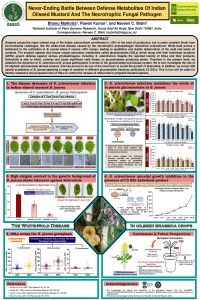
Oilseed Brassicas stand first in the edible oil production of India1 however, are under constant threats from environmental challenges like the white mold disease caused by the necrotrophic phytopathogen Sclerotinia sclerotiorum2. Indeed, in case of oilseed mustard Brassica juncea, a dominant oilseed crop of the Indian subcontinent, white mold has become a major limiting factor both during pre and the post-harvest stages with >92% yield losses reported3. Brassica species produce a group of unique defense metabolites called glucosinolates, which along with their hydrolysis products are reported for toxicity against Sclerotinia both under in-vitro and in-vivo conditions4,5. Nevertheless, pathogens like Sclerotinia, are able to infect, colonize and cause significant yield losses on glucosinolate producing plants. In this context, we initially assessed the disease dynamics of S. sclerotiorum-B. juncea pathosystem at different time points and analyzed changes in the in-planta levels of different glucosinolates (C3, C4 and C5 fractions) during Sclerotinia infection. Our results suggest that, Sclerotinia infection activates the glucosinolate-myrosinase system by modulating changes in total and component glucosinolates of B. juncea plants throughout the time course of infection. We also assessed the toxicity of allyl-ITC (degradation product of sinigrin, an abundant glucosinolate in B. juncea cultivars) on the growth of Sclerotinia in-vitro and observed that this C3-aliphatic glucosinolate derived product, has proven to be one of the most toxic to Sclerotinia. In addition, we performed HPLC analysis to determine the glucosinolate content and types across 250 diverse germplasm accessions of B. juncea that span a range of variation in the glucosinolate metabolite trait, which shall be useful for identification of resistance to Sclerotinia in the mustard crop. Overall, this research work will be useful to understand the disease mechanism and enable selective manipulation of defense metabolites to prevent white mold disease losses in polyploid crop species.
REFERENCES:
- Jat, R.S., Singh, V.V., Sharma, P. and Rai, P.K., 2019. Oilseed Brassica in India: Demand, supply, policy perspective and future potential. Oilseeds & Fats Crops and Lipids, 26, pp.8.
- Del Rio, L.E., Bradley, C.A., Henson, R.A., Endres, G.J., Hanson, B.K., McKay, K., Halvorson, M., Porter, P.M., Le Gare, D.G. and Lamey, H.A., 2007. Impact of Sclerotinia stem rot on yield of canola. Plant Disease, 91(2), pp.191-194.
- Shukla, A.K., 2005. Estimation of yield losses to Indian mustard (Brassica juncea) due to Sclerotinia stem rot. Journal of Phytological Research, 18(2), pp.267-268.
- Sotelo, T., Lema, M., Soengas, P., Cartea, M.E. and Velasco, P., 2015. In vitro activity of glucosinolates and their degradation products against Brassica-pathogenic bacteria and fungi. Applied and Environmental Microbiology, 81(1), pp.432-440.
- Stotz, H.U., Sawada, Y., Shimada, Y., Hirai, M.Y., Sasaki, E., Krischke, M., Brown, P.D., Saito, K. and Kamiya, Y., 2011. Role of camalexin, indole glucosinolates, and side chain modification of glucosinolate‐derived isothiocyanates in defense of Arabidopsis against Sclerotinia sclerotiorum. The Plant Journal, 67(1), pp.81-93.
Keywords
Plant defense
White-mold
Oilseed Brassica
Glucosinolates
Polyploid crops
Plant pathology
Disease resistance
Manuscript
sciforum_053029-done.pdf
Poster
BHANU MALHOTRA IECPS2021 EPOSTER.pdf
Natural Enrichment of Solanum tuberosum L. with Calcium—Monitorization of Mineral Interactions in Plant Tissues
Induction of Immune Response in Arabidopsis thaliana Treated with Phytopathogen Filtrates