Event submissions
EventsThe 2nd International Electronic Conference on Plant Sciences—10th Anniversary of Journal Plants
Published

This submission belongs to the session D. Phytochemistry and Phytoremediation, Plants in Urban Ecosystems of the event The 2nd International Electronic Conference on Plant Sciences—10th Anniversary of Journal Plants
Published date
30 Nov, 2021
Academic Editor
'%3e%3cpath%20d='M12.6657%2010.9104C12.4185%2010.325%2012.0599%209.79327%2011.6097%209.34482C11.1609%208.89508%2010.6293%208.5365%2010.0442%208.28888C10.0389%208.28626%2010.0337%208.28495%2010.0285%208.28233C10.8446%207.69279%2011.3752%206.73249%2011.3752%205.64904C11.3752%203.8542%209.92103%202.39999%208.1262%202.39999C6.33136%202.39999%204.87715%203.8542%204.87715%205.64904C4.87715%206.73249%205.40774%207.69279%206.22393%208.28364C6.21869%208.28626%206.21345%208.28757%206.20821%208.29019C5.62129%208.5378%205.09463%208.89284%204.64265%209.34613C4.1929%209.79493%203.83432%2010.3266%203.58671%2010.9117C3.34345%2011.4845%203.21226%2012.0987%203.20023%2012.7209C3.19988%2012.7349%203.20233%2012.7488%203.20744%2012.7619C3.21255%2012.7749%203.22022%2012.7867%203.22998%2012.7968C3.23975%2012.8068%203.25142%2012.8147%203.26431%2012.8202C3.2772%2012.8256%203.29105%2012.8284%203.30504%2012.8284H4.09109C4.14874%2012.8284%204.19459%2012.7825%204.1959%2012.7262C4.2221%2011.7148%204.62823%2010.7676%205.34617%2010.0497C6.08899%209.30683%207.0755%208.89808%208.1262%208.89808C9.17689%208.89808%2010.1634%209.30683%2010.9062%2010.0497C11.6242%2010.7676%2012.0303%2011.7148%2012.0565%2012.7262C12.0578%2012.7838%2012.1037%2012.8284%2012.1613%2012.8284H12.9474C12.9613%2012.8284%2012.9752%2012.8256%2012.9881%2012.8202C13.001%2012.8147%2013.0126%2012.8068%2013.0224%2012.7968C13.0322%2012.7867%2013.0398%2012.7749%2013.0449%2012.7619C13.0501%2012.7488%2013.0525%2012.7349%2013.0522%2012.7209C13.0391%2012.0947%2012.9094%2011.4855%2012.6657%2010.9104ZM8.1262%207.9024C7.52486%207.9024%206.9589%207.6679%206.53312%207.24211C6.10733%206.81633%205.87283%206.25037%205.87283%205.64904C5.87283%205.0477%206.10733%204.48174%206.53312%204.05596C6.9589%203.63018%207.52486%203.39567%208.1262%203.39567C8.72753%203.39567%209.29349%203.63018%209.71927%204.05596C10.1451%204.48174%2010.3796%205.0477%2010.3796%205.64904C10.3796%206.25037%2010.1451%206.81633%209.71927%207.24211C9.29349%207.6679%208.72753%207.9024%208.1262%207.9024Z'%20fill='%235D1EE1'/%3e%3c/g%3e%3c/svg%3e) Giedre Samuoliene
Giedre SamuolieneCitation
Anjali A. Kulkarni, Rohit P Kamble, α-Amylase Inhibitory Secondary Metabolites from Artemisia pallens Wall ex DC – Biochemical and Docking Studies, in Proceedings of The 2nd International Electronic Conference on Plant Sciences—10th Anniversary of Journal Plants, 1 December–15 December 2021, MDPI: Basel, Switzerland, doi: 10.3390/IECPS2021-11978
Share
Email
Facebook
Twitter
LinkedIn
α-Amylase Inhibitory Secondary Metabolites from Artemisia pallens Wall ex DC – Biochemical and Docking Studies
'%3e%3cpath%20d='M12.6647%2010.9104C12.4176%2010.325%2012.0589%209.7933%2011.6088%209.34485C11.16%208.89511%2010.6283%208.53653%2010.0432%208.28891C10.038%208.28629%2010.0327%208.28498%2010.0275%208.28236C10.8437%207.69282%2011.3743%206.73252%2011.3743%205.64907C11.3743%203.85423%209.92005%202.40002%208.12522%202.40002C6.33038%202.40002%204.87618%203.85423%204.87618%205.64907C4.87618%206.73252%205.40677%207.69282%206.22296%208.28367C6.21772%208.28629%206.21248%208.2876%206.20724%208.29022C5.62031%208.53783%205.09365%208.89287%204.64167%209.34616C4.19192%209.79496%203.83334%2010.3266%203.58573%2010.9117C3.34247%2011.4846%203.21128%2012.0987%203.19925%2012.721C3.1989%2012.735%203.20135%2012.7489%203.20646%2012.7619C3.21157%2012.7749%203.21924%2012.7868%203.22901%2012.7968C3.23877%2012.8068%203.25045%2012.8148%203.26334%2012.8202C3.27623%2012.8256%203.29007%2012.8284%203.30406%2012.8284H4.09012C4.14776%2012.8284%204.19362%2012.7825%204.19493%2012.7262C4.22113%2011.7148%204.62726%2010.7676%205.34519%2010.0497C6.08802%209.30686%207.07452%208.89811%208.12522%208.89811C9.17592%208.89811%2010.1624%209.30686%2010.9052%2010.0497C11.6232%2010.7676%2012.0293%2011.7148%2012.0555%2012.7262C12.0568%2012.7839%2012.1027%2012.8284%2012.1603%2012.8284H12.9464C12.9604%2012.8284%2012.9742%2012.8256%2012.9871%2012.8202C13%2012.8148%2013.0117%2012.8068%2013.0214%2012.7968C13.0312%2012.7868%2013.0389%2012.7749%2013.044%2012.7619C13.0491%2012.7489%2013.0515%2012.735%2013.0512%2012.721C13.0381%2012.0947%2012.9084%2011.4856%2012.6647%2010.9104ZM8.12522%207.90243C7.52388%207.90243%206.95792%207.66793%206.53214%207.24215C6.10636%206.81636%205.87185%206.2504%205.87185%205.64907C5.87185%205.04773%206.10636%204.48177%206.53214%204.05599C6.95792%203.63021%207.52388%203.3957%208.12522%203.3957C8.72655%203.3957%209.29252%203.63021%209.7183%204.05599C10.1441%204.48177%2010.3786%205.04773%2010.3786%205.64907C10.3786%206.2504%2010.1441%206.81636%209.7183%207.24215C9.29252%207.66793%208.72655%207.90243%208.12522%207.90243Z'%20fill='%235D1EE1'/%3e%3c/g%3e%3c/svg%3e)
Anjali A. Kulkarni 1
Rohit P Kamble 2
1. Department of Botany, Savitribai Phule Pune University (Formerly University of Pune), Ganeshkhind Road, Pune 411007, Maharashtra, India.
2. Department of Botany, Savitribai Phule Pune University, Pune 411 007
Abstract
Diabetes Mellitus Type-2 (DM-2) has become a challenging disease worldwide as many young adults are also getting affected by it due sedentary lifestyle and wrong diets. Multiple studies have shown that control over α-amylase enzyme in gut could be a better approach to treat DM-2. The secondary metabolites produced by the plants have various biological properties and many are used as drugs. In the current study, we isolated secondary metabolites from acetone leaf extracts of Artemisia pallens Wall ex DC (Family: Asteraceae) and tested them for their porcine pancreatic α-amylase (PPA) inhibitory activity in vitro and in silico. This extract exhibited good PPA inhibition, with IC50 value of 388.05 µg/ml. The IC50 value of Acarbose (a known pancreatic α-amylase inhibitor drug / positive control) was 9.71 µg/ml. Various secondary metabolites detected from acetone leaf extract by LC-MS analysis, were used for the molecular docking studies using AutoDock 4.2.6. The co-crystallised structure of PPA and Acarbose was retrieved from Protein Data Bank (PDB ID: 1OSE). The binding energies of few metabolites were (kcal/mol): Isoquercetin (-11.57), Cryptochlorogenic Acid (-11.17), Cirsilineol (-10.24), Kaempferide (-9.99), Fustin (-9.86), 6- Demetroxycapillarisin (-9.82), Piperine (-9.45), Ergometrine (-9.43), Apigenin (-9.38) & Artemisinin (-9.27). Acarbose had a binding energy of -17.58 kcal/mol. All the metabolites looked highly promising as α-amylase inhibitors and most of them interacted with PPA via hydrogen bonding with crucial amino acid residues: ASP197, ASP300 & GLU233. Thus the acetone extract of A. pallens leaves can potentially inhibit PPA (strong amino acid sequence similarity with human pancreatic α-amylase) and hence extrapolation of these inhibitory results could be valid for human pancreatic α-amylase as well.
Keywords
Type 2 diabetes
α-Amylase
Artemisia
Docking
Inhibition
Manuscript
sciforum-052339-done.pdf
Poster
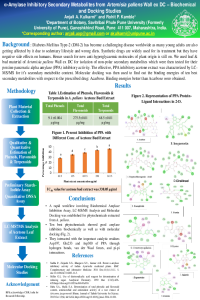
A pallens IECPS-2021 PPT-AAK-RPK.pdf
Detection of Celiac Active Polypeptides in Wheat, Oat and Buckwheat by Immunochemical Methods
Within-Canopy Variation in the Ascorbic Acid Content of Tuckeroo (Cupaniopsis anacardioides) Fruits