Event submissions
EventsThe 2nd International Electronic Conference on Animals - Global Sustainability and Animals: Welfare, Policies and Technologies
Published
 10.3390/IECA2021-11980 (registering DOI)
 This submission belongs to the session D. Sustainable animal health of the event The 2nd International Electronic Conference on Animals - Global Sustainability and Animals: Welfare, Policies and Technologies
Published date
30 Nov, 2021
Academic Editor
'%3e%3cpath%20d='M12.6657%2010.9104C12.4185%2010.325%2012.0599%209.79327%2011.6097%209.34482C11.1609%208.89508%2010.6293%208.5365%2010.0442%208.28888C10.0389%208.28626%2010.0337%208.28495%2010.0285%208.28233C10.8446%207.69279%2011.3752%206.73249%2011.3752%205.64904C11.3752%203.8542%209.92103%202.39999%208.1262%202.39999C6.33136%202.39999%204.87715%203.8542%204.87715%205.64904C4.87715%206.73249%205.40774%207.69279%206.22393%208.28364C6.21869%208.28626%206.21345%208.28757%206.20821%208.29019C5.62129%208.5378%205.09463%208.89284%204.64265%209.34613C4.1929%209.79493%203.83432%2010.3266%203.58671%2010.9117C3.34345%2011.4845%203.21226%2012.0987%203.20023%2012.7209C3.19988%2012.7349%203.20233%2012.7488%203.20744%2012.7619C3.21255%2012.7749%203.22022%2012.7867%203.22998%2012.7968C3.23975%2012.8068%203.25142%2012.8147%203.26431%2012.8202C3.2772%2012.8256%203.29105%2012.8284%203.30504%2012.8284H4.09109C4.14874%2012.8284%204.19459%2012.7825%204.1959%2012.7262C4.2221%2011.7148%204.62823%2010.7676%205.34617%2010.0497C6.08899%209.30683%207.0755%208.89808%208.1262%208.89808C9.17689%208.89808%2010.1634%209.30683%2010.9062%2010.0497C11.6242%2010.7676%2012.0303%2011.7148%2012.0565%2012.7262C12.0578%2012.7838%2012.1037%2012.8284%2012.1613%2012.8284H12.9474C12.9613%2012.8284%2012.9752%2012.8256%2012.9881%2012.8202C13.001%2012.8147%2013.0126%2012.8068%2013.0224%2012.7968C13.0322%2012.7867%2013.0398%2012.7749%2013.0449%2012.7619C13.0501%2012.7488%2013.0525%2012.7349%2013.0522%2012.7209C13.0391%2012.0947%2012.9094%2011.4855%2012.6657%2010.9104ZM8.1262%207.9024C7.52486%207.9024%206.9589%207.6679%206.53312%207.24211C6.10733%206.81633%205.87283%206.25037%205.87283%205.64904C5.87283%205.0477%206.10733%204.48174%206.53312%204.05596C6.9589%203.63018%207.52486%203.39567%208.1262%203.39567C8.72753%203.39567%209.29349%203.63018%209.71927%204.05596C10.1451%204.48174%2010.3796%205.0477%2010.3796%205.64904C10.3796%206.25037%2010.1451%206.81633%209.71927%207.24211C9.29349%207.6679%208.72753%207.9024%208.1262%207.9024Z'%20fill='%235D1EE1'/%3e%3c/g%3e%3c/svg%3e) Sabrina Lomax
Sabrina LomaxCitation
Andra-Sabina NECULAI-VALEANU, Adina-Mirela ARITON, Applications of Infrared Thermography for bovine mastitis prevention and sustainable dairy cattle production in Romania, in Proceedings of The 2nd International Electronic Conference on Animals - Global Sustainability and Animals: Welfare, Policies and Technologies, 29 November–13 December 2021, MDPI: Basel, Switzerland, doi: 10.3390/IECA2021-11980
Share
Email
Facebook
Twitter
LinkedIn
Applications of Infrared Thermography for bovine mastitis prevention and sustainable dairy cattle production in Romania

Andra-Sabina NECULAI-VALEANU 1
'%3e%3cpath%20d='M12.6647%2010.9104C12.4176%2010.325%2012.0589%209.7933%2011.6088%209.34485C11.16%208.89511%2010.6283%208.53653%2010.0432%208.28891C10.038%208.28629%2010.0327%208.28498%2010.0275%208.28236C10.8437%207.69282%2011.3743%206.73252%2011.3743%205.64907C11.3743%203.85423%209.92005%202.40002%208.12522%202.40002C6.33038%202.40002%204.87618%203.85423%204.87618%205.64907C4.87618%206.73252%205.40677%207.69282%206.22296%208.28367C6.21772%208.28629%206.21248%208.2876%206.20724%208.29022C5.62031%208.53783%205.09365%208.89287%204.64167%209.34616C4.19192%209.79496%203.83334%2010.3266%203.58573%2010.9117C3.34247%2011.4846%203.21128%2012.0987%203.19925%2012.721C3.1989%2012.735%203.20135%2012.7489%203.20646%2012.7619C3.21157%2012.7749%203.21924%2012.7868%203.22901%2012.7968C3.23877%2012.8068%203.25045%2012.8148%203.26334%2012.8202C3.27623%2012.8256%203.29007%2012.8284%203.30406%2012.8284H4.09012C4.14776%2012.8284%204.19362%2012.7825%204.19493%2012.7262C4.22113%2011.7148%204.62726%2010.7676%205.34519%2010.0497C6.08802%209.30686%207.07452%208.89811%208.12522%208.89811C9.17592%208.89811%2010.1624%209.30686%2010.9052%2010.0497C11.6232%2010.7676%2012.0293%2011.7148%2012.0555%2012.7262C12.0568%2012.7839%2012.1027%2012.8284%2012.1603%2012.8284H12.9464C12.9604%2012.8284%2012.9742%2012.8256%2012.9871%2012.8202C13%2012.8148%2013.0117%2012.8068%2013.0214%2012.7968C13.0312%2012.7868%2013.0389%2012.7749%2013.044%2012.7619C13.0491%2012.7489%2013.0515%2012.735%2013.0512%2012.721C13.0381%2012.0947%2012.9084%2011.4856%2012.6647%2010.9104ZM8.12522%207.90243C7.52388%207.90243%206.95792%207.66793%206.53214%207.24215C6.10636%206.81636%205.87185%206.2504%205.87185%205.64907C5.87185%205.04773%206.10636%204.48177%206.53214%204.05599C6.95792%203.63021%207.52388%203.3957%208.12522%203.3957C8.72655%203.3957%209.29252%203.63021%209.7183%204.05599C10.1441%204.48177%2010.3786%205.04773%2010.3786%205.64907C10.3786%206.2504%2010.1441%206.81636%209.7183%207.24215C9.29252%207.66793%208.72655%207.90243%208.12522%207.90243Z'%20fill='%235D1EE1'/%3e%3c/g%3e%3c/svg%3e)
Adina-Mirela ARITON 1
1. Research and Development Station for Cattle Breeding Dancu-Iasi
Abstract
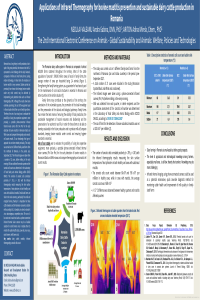
Romania has a long history in milk production, but in spite of its great potential, the entrance into the E.U represented a vivid challenge for the dairy livestock, composed of millions of small family farms, lacking modern technology. In these farms the incidence of bovine mastitis is very common. Studies carried out previously have shown that keeping bovine mastitis under very strict control may be achieved by implementing early detection tools such as infrared thermography (IRT). Although the results have been extremely promising, the cost of the equipment used in those studies limits their use in family-type farms. Therefore, the aim of our study was to evaluate the possibility of using less expensive equipment, more precisely, a portable phone-connected infrared thermal vision camera (Flir One Pro) for the early detection of bovine mastitis in Romanian Black and White cows and compare thermography and somatic cell counts results. To our knowledge, this type of approach has not been tested previously. The study was carried out on 5 different family-sized farms from the northeast of Romania, in the period July-September 2021. The Infrared images were taken from the teats in the area of Furstenberg’s rosette, from a number of 21 cows, before milking, in the early morning. Milk was collected from each quarter and the somatic cell count was determined in the Laboratory of Food Safety and Animal Biology within SCDCB DANCU. The number of somatic cells correlated positively (r= .709, p < .001) with the infrared thermography results measuring the skin surface temperature of teat sphincters in both healthy and cows with subclinical mastitis. Small-scale farms are vital to the rural economy, particularly for small and marginal farmers, thereby it is imperative for these cattle breeders and the Romanian economy to obtain milk according to E.U. standards, in order to valorize it at an advantageous, competitive price. The use of a low-cost non-invasive tool such as a phone-connected infrared thermal vision camera may be a feasible solution for small farmers since it enables them to monitor the udder health status, cow-side, in an easy, rapid manner, with lower costs.
Keywords
dairy cattle
mastitis
infrared thermography
somatic cells count
Poster
Applications of Infrared Thermography for bovine mastitis prevention and sustainable dairy cattle production in Romania.pdf
EMPETHY- First search engine for a conscious adoption
Importance of socio-positive interactions for livestock sustainability