Event submissions
EventsThe 2nd International Electronic Conference on Animals - Global Sustainability and Animals: Welfare, Policies and Technologies
Published
 10.3390/IECA2021-11981 (registering DOI)
 This submission belongs to the session C. Sustainable animal welfare, ethics, policies and politics of the event The 2nd International Electronic Conference on Animals - Global Sustainability and Animals: Welfare, Policies and Technologies
Published date
30 Nov, 2021
Academic Editor
'%3e%3cpath%20d='M12.6657%2010.9104C12.4185%2010.325%2012.0599%209.79327%2011.6097%209.34482C11.1609%208.89508%2010.6293%208.5365%2010.0442%208.28888C10.0389%208.28626%2010.0337%208.28495%2010.0285%208.28233C10.8446%207.69279%2011.3752%206.73249%2011.3752%205.64904C11.3752%203.8542%209.92103%202.39999%208.1262%202.39999C6.33136%202.39999%204.87715%203.8542%204.87715%205.64904C4.87715%206.73249%205.40774%207.69279%206.22393%208.28364C6.21869%208.28626%206.21345%208.28757%206.20821%208.29019C5.62129%208.5378%205.09463%208.89284%204.64265%209.34613C4.1929%209.79493%203.83432%2010.3266%203.58671%2010.9117C3.34345%2011.4845%203.21226%2012.0987%203.20023%2012.7209C3.19988%2012.7349%203.20233%2012.7488%203.20744%2012.7619C3.21255%2012.7749%203.22022%2012.7867%203.22998%2012.7968C3.23975%2012.8068%203.25142%2012.8147%203.26431%2012.8202C3.2772%2012.8256%203.29105%2012.8284%203.30504%2012.8284H4.09109C4.14874%2012.8284%204.19459%2012.7825%204.1959%2012.7262C4.2221%2011.7148%204.62823%2010.7676%205.34617%2010.0497C6.08899%209.30683%207.0755%208.89808%208.1262%208.89808C9.17689%208.89808%2010.1634%209.30683%2010.9062%2010.0497C11.6242%2010.7676%2012.0303%2011.7148%2012.0565%2012.7262C12.0578%2012.7838%2012.1037%2012.8284%2012.1613%2012.8284H12.9474C12.9613%2012.8284%2012.9752%2012.8256%2012.9881%2012.8202C13.001%2012.8147%2013.0126%2012.8068%2013.0224%2012.7968C13.0322%2012.7867%2013.0398%2012.7749%2013.0449%2012.7619C13.0501%2012.7488%2013.0525%2012.7349%2013.0522%2012.7209C13.0391%2012.0947%2012.9094%2011.4855%2012.6657%2010.9104ZM8.1262%207.9024C7.52486%207.9024%206.9589%207.6679%206.53312%207.24211C6.10733%206.81633%205.87283%206.25037%205.87283%205.64904C5.87283%205.0477%206.10733%204.48174%206.53312%204.05596C6.9589%203.63018%207.52486%203.39567%208.1262%203.39567C8.72753%203.39567%209.29349%203.63018%209.71927%204.05596C10.1451%204.48174%2010.3796%205.0477%2010.3796%205.64904C10.3796%206.25037%2010.1451%206.81633%209.71927%207.24211C9.29349%207.6679%208.72753%207.9024%208.1262%207.9024Z'%20fill='%235D1EE1'/%3e%3c/g%3e%3c/svg%3e) Vera Baumans
Vera BaumansCitation
João Pedro Donadio da Silva Pereira, Karolini Tenffen de Sousa, Belni Sperluk-Belmonte, Luiz Carlos Pinheiro Machado Filho, Importance of socio-positive interactions for livestock sustainability, in Proceedings of The 2nd International Electronic Conference on Animals - Global Sustainability and Animals: Welfare, Policies and Technologies, 29 November–13 December 2021, MDPI: Basel, Switzerland, doi: 10.3390/IECA2021-11981
Share
Email
Facebook
Twitter
LinkedIn
Importance of socio-positive interactions for livestock sustainability
'%3e%3cpath%20d='M12.6647%2010.9104C12.4176%2010.325%2012.0589%209.7933%2011.6088%209.34485C11.16%208.89511%2010.6283%208.53653%2010.0432%208.28891C10.038%208.28629%2010.0327%208.28498%2010.0275%208.28236C10.8437%207.69282%2011.3743%206.73252%2011.3743%205.64907C11.3743%203.85423%209.92005%202.40002%208.12522%202.40002C6.33038%202.40002%204.87618%203.85423%204.87618%205.64907C4.87618%206.73252%205.40677%207.69282%206.22296%208.28367C6.21772%208.28629%206.21248%208.2876%206.20724%208.29022C5.62031%208.53783%205.09365%208.89287%204.64167%209.34616C4.19192%209.79496%203.83334%2010.3266%203.58573%2010.9117C3.34247%2011.4846%203.21128%2012.0987%203.19925%2012.721C3.1989%2012.735%203.20135%2012.7489%203.20646%2012.7619C3.21157%2012.7749%203.21924%2012.7868%203.22901%2012.7968C3.23877%2012.8068%203.25045%2012.8148%203.26334%2012.8202C3.27623%2012.8256%203.29007%2012.8284%203.30406%2012.8284H4.09012C4.14776%2012.8284%204.19362%2012.7825%204.19493%2012.7262C4.22113%2011.7148%204.62726%2010.7676%205.34519%2010.0497C6.08802%209.30686%207.07452%208.89811%208.12522%208.89811C9.17592%208.89811%2010.1624%209.30686%2010.9052%2010.0497C11.6232%2010.7676%2012.0293%2011.7148%2012.0555%2012.7262C12.0568%2012.7839%2012.1027%2012.8284%2012.1603%2012.8284H12.9464C12.9604%2012.8284%2012.9742%2012.8256%2012.9871%2012.8202C13%2012.8148%2013.0117%2012.8068%2013.0214%2012.7968C13.0312%2012.7868%2013.0389%2012.7749%2013.044%2012.7619C13.0491%2012.7489%2013.0515%2012.735%2013.0512%2012.721C13.0381%2012.0947%2012.9084%2011.4856%2012.6647%2010.9104ZM8.12522%207.90243C7.52388%207.90243%206.95792%207.66793%206.53214%207.24215C6.10636%206.81636%205.87185%206.2504%205.87185%205.64907C5.87185%205.04773%206.10636%204.48177%206.53214%204.05599C6.95792%203.63021%207.52388%203.3957%208.12522%203.3957C8.72655%203.3957%209.29252%203.63021%209.7183%204.05599C10.1441%204.48177%2010.3786%205.04773%2010.3786%205.64907C10.3786%206.2504%2010.1441%206.81636%209.7183%207.24215C9.29252%207.66793%208.72655%207.90243%208.12522%207.90243Z'%20fill='%235D1EE1'/%3e%3c/g%3e%3c/svg%3e)
João Pedro Donadio da Silva Pereira 1

Karolini Tenffen de Sousa 2
Belni Sperluk-Belmonte 2
Luiz Carlos Pinheiro Machado Filho 2
1. Programa de Pós-Graduação em Zootecnia, Faculdade de Medicina Veterinária e Zootecnia, Universidade Estadual Paulista, Botucatu, São Paulo, Brazil
2. Laboratório de Etologia Aplicada e Bem-Estar Animal (LETA), Universidade Federal de Santa Catarina
Abstract
Most farm animals are gregarious species, i.e., living in group is a natural behavior. However, some livestock systems deprive the social interactions among animals, e.g., sow gestation stalls, or early cow-calf separation, with calf reared alone. In contrast, sustainable livestock systems aim to allow animals to express their natural behaviors. The gregarious species have a complex social organization, which includes negative (agonistic) and positive (affiliative) interactions that affect the group dynamics, individual behaviors, and access to resources. Both interactions are important to ensure group stability and animal welfare. Socio-negative behavior can affect the welfare of animals, and in particular of subordinate animals due to the limited access to resources. On the other hand, socio-positive can mitigate the stress that animals are subjected to in the reared environment, like decreasing heart rate and reducing stress responses to new environments. Among the socio-positive behaviors, allogrooming (e.g., licking in cows) and spatial proximity between pairs, occur while grazing and resting. From the observation of these behaviors, we can determine degrees of affinity between pairs, and establish groups of animals with some degree of affinity. Strong affinity relationships are usually formed between more closely related animals. Through the awareness of animal’s affinity, it is possible to adapt some livestock practices, like, in cattle, groups with high affinity may be easier to handle, e.g., during milking and transport. We also would like to highlight that socio-positive behaviors should be considered in studies with animals, as it has a large impact on animal behavior. Animal handling would be less stressful for both animals and handlers, if these factors were considered. Therefore, recognizing the social behavior of animals in handling is respectful to the animal’s life, allowing the production to be done in an ethical, ecological, and sustainable way.
Keywords
animal welfare
applied ethology
bonding
social interactions
social preferences
Poster
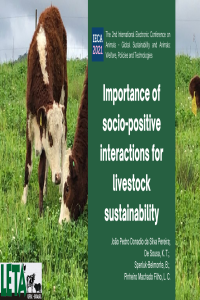
Importance of sociopositive...IECA2021.pdf
Applications of Infrared Thermography for bovine mastitis prevention and sustainable dairy cattle production in Romania
Effect of pre-slaughter handling on lamb welfare and meat quality