Event submissions
EventsThe 2nd International Electronic Conference on Plant Sciences—10th Anniversary of Journal Plants
Published

This submission belongs to the session C. Plant Response to Stresses and Changing Environment of the event The 2nd International Electronic Conference on Plant Sciences—10th Anniversary of Journal Plants
Published date
30 Nov, 2021
Academic Editor
'%3e%3cpath%20d='M12.6657%2010.9104C12.4185%2010.325%2012.0599%209.79327%2011.6097%209.34482C11.1609%208.89508%2010.6293%208.5365%2010.0442%208.28888C10.0389%208.28626%2010.0337%208.28495%2010.0285%208.28233C10.8446%207.69279%2011.3752%206.73249%2011.3752%205.64904C11.3752%203.8542%209.92103%202.39999%208.1262%202.39999C6.33136%202.39999%204.87715%203.8542%204.87715%205.64904C4.87715%206.73249%205.40774%207.69279%206.22393%208.28364C6.21869%208.28626%206.21345%208.28757%206.20821%208.29019C5.62129%208.5378%205.09463%208.89284%204.64265%209.34613C4.1929%209.79493%203.83432%2010.3266%203.58671%2010.9117C3.34345%2011.4845%203.21226%2012.0987%203.20023%2012.7209C3.19988%2012.7349%203.20233%2012.7488%203.20744%2012.7619C3.21255%2012.7749%203.22022%2012.7867%203.22998%2012.7968C3.23975%2012.8068%203.25142%2012.8147%203.26431%2012.8202C3.2772%2012.8256%203.29105%2012.8284%203.30504%2012.8284H4.09109C4.14874%2012.8284%204.19459%2012.7825%204.1959%2012.7262C4.2221%2011.7148%204.62823%2010.7676%205.34617%2010.0497C6.08899%209.30683%207.0755%208.89808%208.1262%208.89808C9.17689%208.89808%2010.1634%209.30683%2010.9062%2010.0497C11.6242%2010.7676%2012.0303%2011.7148%2012.0565%2012.7262C12.0578%2012.7838%2012.1037%2012.8284%2012.1613%2012.8284H12.9474C12.9613%2012.8284%2012.9752%2012.8256%2012.9881%2012.8202C13.001%2012.8147%2013.0126%2012.8068%2013.0224%2012.7968C13.0322%2012.7867%2013.0398%2012.7749%2013.0449%2012.7619C13.0501%2012.7488%2013.0525%2012.7349%2013.0522%2012.7209C13.0391%2012.0947%2012.9094%2011.4855%2012.6657%2010.9104ZM8.1262%207.9024C7.52486%207.9024%206.9589%207.6679%206.53312%207.24211C6.10733%206.81633%205.87283%206.25037%205.87283%205.64904C5.87283%205.0477%206.10733%204.48174%206.53312%204.05596C6.9589%203.63018%207.52486%203.39567%208.1262%203.39567C8.72753%203.39567%209.29349%203.63018%209.71927%204.05596C10.1451%204.48174%2010.3796%205.0477%2010.3796%205.64904C10.3796%206.25037%2010.1451%206.81633%209.71927%207.24211C9.29349%207.6679%208.72753%207.9024%208.1262%207.9024Z'%20fill='%235D1EE1'/%3e%3c/g%3e%3c/svg%3e) Iker Aranjuelo
Iker AranjueloCitation
Panagiota Ntasiou, ELEFTHERIOS VELLIS, ANTREAS GIANNOPOULOS, George Karaoglanidis, Novel Copper Nanoparticles for the Control of Tomato Foliar and Fruit Diseases, in Proceedings of The 2nd International Electronic Conference on Plant Sciences—10th Anniversary of Journal Plants, 1 December–15 December 2021, MDPI: Basel, Switzerland, doi: 10.3390/IECPS2021-11987
Share
Email
Facebook
Twitter
LinkedIn
Novel Copper Nanoparticles for the Control of Tomato Foliar and Fruit Diseases
'%3e%3cpath%20d='M12.6647%2010.9104C12.4176%2010.325%2012.0589%209.7933%2011.6088%209.34485C11.16%208.89511%2010.6283%208.53653%2010.0432%208.28891C10.038%208.28629%2010.0327%208.28498%2010.0275%208.28236C10.8437%207.69282%2011.3743%206.73252%2011.3743%205.64907C11.3743%203.85423%209.92005%202.40002%208.12522%202.40002C6.33038%202.40002%204.87618%203.85423%204.87618%205.64907C4.87618%206.73252%205.40677%207.69282%206.22296%208.28367C6.21772%208.28629%206.21248%208.2876%206.20724%208.29022C5.62031%208.53783%205.09365%208.89287%204.64167%209.34616C4.19192%209.79496%203.83334%2010.3266%203.58573%2010.9117C3.34247%2011.4846%203.21128%2012.0987%203.19925%2012.721C3.1989%2012.735%203.20135%2012.7489%203.20646%2012.7619C3.21157%2012.7749%203.21924%2012.7868%203.22901%2012.7968C3.23877%2012.8068%203.25045%2012.8148%203.26334%2012.8202C3.27623%2012.8256%203.29007%2012.8284%203.30406%2012.8284H4.09012C4.14776%2012.8284%204.19362%2012.7825%204.19493%2012.7262C4.22113%2011.7148%204.62726%2010.7676%205.34519%2010.0497C6.08802%209.30686%207.07452%208.89811%208.12522%208.89811C9.17592%208.89811%2010.1624%209.30686%2010.9052%2010.0497C11.6232%2010.7676%2012.0293%2011.7148%2012.0555%2012.7262C12.0568%2012.7839%2012.1027%2012.8284%2012.1603%2012.8284H12.9464C12.9604%2012.8284%2012.9742%2012.8256%2012.9871%2012.8202C13%2012.8148%2013.0117%2012.8068%2013.0214%2012.7968C13.0312%2012.7868%2013.0389%2012.7749%2013.044%2012.7619C13.0491%2012.7489%2013.0515%2012.735%2013.0512%2012.721C13.0381%2012.0947%2012.9084%2011.4856%2012.6647%2010.9104ZM8.12522%207.90243C7.52388%207.90243%206.95792%207.66793%206.53214%207.24215C6.10636%206.81636%205.87185%206.2504%205.87185%205.64907C5.87185%205.04773%206.10636%204.48177%206.53214%204.05599C6.95792%203.63021%207.52388%203.3957%208.12522%203.3957C8.72655%203.3957%209.29252%203.63021%209.7183%204.05599C10.1441%204.48177%2010.3786%205.04773%2010.3786%205.64907C10.3786%206.2504%2010.1441%206.81636%209.7183%207.24215C9.29252%207.66793%208.72655%207.90243%208.12522%207.90243Z'%20fill='%235D1EE1'/%3e%3c/g%3e%3c/svg%3e)
Panagiota Ntasiou 1
ELEFTHERIOS VELLIS 2
ANTREAS GIANNOPOULOS 2

George Karaoglanidis 1
1. Aristotle University of Thessaloniki, Faculty of Agriculture, Forestry and Natural Environment, School of Agriculture Laboratory of Plant Pathology, POB 269, 54124, Thessaloniki, Greece.
2. K&N Efthymiadis single member S.A., Business Development Division, Industrial Area of Thessaloniki, POB 48, 57022, Sindos, Thessaloniki, Greece.
Abstract
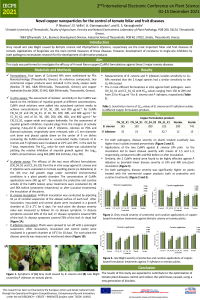
Grey mould caused by Botrytis cinerea and Late Blight caused by Phytophthora infestans, are the most important foliar and fruit diseases of tomato. Applications of fungicides are the main control measures of these diseases. However, development of resistance to single-site inhibitors by both pathogens necessitates research for the development of alternative products. Initially, 4 novel Nano-copper (Cu-NPs) formulations were evaluated in vitro. The 2 most efficient formulations (CN_S4_X1 and CC_S4_X2) from the in vitro assay were further evaluated for their efficacy against B. cinerea and P. infestans on tomato seedling plants (cv. Belladona) at the 4th true leaf growth stage under controlled environmental conditions. To evaluate the protective and curative activity of the Cu-NPs tested, spray treatments were conducted 24, 48 and 96 h before (protective treatments) or after (curative treatments) the inoculation of the plants. For both pathogens, disease severity on plants treated curatively was higher than in plants treated preventively. Applications of the two Cu-NPs against B. cinerea 24 h prior the inoculation led to lower disease severity with means of 1.5 and 1.3, respectively, compared to 48h and 96h before or after inoculation. Disease severity was significantly higher on plants treated with the commercial copper products. Similarly, the 2 Cu-NPs tested were found to be highly effective against P. infestans as provided lower disease severity at 24h and 48h pre-/post-inoculation. The results of this study are expected to contribute in the optimization of tomato diseases control and reduce the yield losses caused, using a new generation of biocides.
This research has been co‐financed by the European Union and Greek national funds through the Operational Program Competitiveness, Entrepreneurship, and Innovation, under the call RESEARCH – CREATE – INNOVATE (project code: T1EDK- 01492).
Keywords
Grey mould
Late Blight
tomato
copper nanoparticles
eco-friendly
Manuscript
sciforum_050478_original_Ntasiou_NPs_tomato_disease_IECPS_2021-done.pdf
Poster
IECPS 2021- NTASIOU.pdf
Galactolipids as Potential Biomarkers for Early Diagnosis of Esca Complex Disease in Asymptomatic Grapevine
Effects of Processing Methods on Phytochemical Compositions of Selected Plants Materials with Animal Nutrition Potentials