Event submissions
EventsThe 2nd International Electronic Conference on Plant Sciences—10th Anniversary of Journal Plants
Published

This submission belongs to the session D. Phytochemistry and Phytoremediation, Plants in Urban Ecosystems of the event The 2nd International Electronic Conference on Plant Sciences—10th Anniversary of Journal Plants
Published date
01 Dec, 2021
Academic Editor
'%3e%3cpath%20d='M12.6657%2010.9104C12.4185%2010.325%2012.0599%209.79327%2011.6097%209.34482C11.1609%208.89508%2010.6293%208.5365%2010.0442%208.28888C10.0389%208.28626%2010.0337%208.28495%2010.0285%208.28233C10.8446%207.69279%2011.3752%206.73249%2011.3752%205.64904C11.3752%203.8542%209.92103%202.39999%208.1262%202.39999C6.33136%202.39999%204.87715%203.8542%204.87715%205.64904C4.87715%206.73249%205.40774%207.69279%206.22393%208.28364C6.21869%208.28626%206.21345%208.28757%206.20821%208.29019C5.62129%208.5378%205.09463%208.89284%204.64265%209.34613C4.1929%209.79493%203.83432%2010.3266%203.58671%2010.9117C3.34345%2011.4845%203.21226%2012.0987%203.20023%2012.7209C3.19988%2012.7349%203.20233%2012.7488%203.20744%2012.7619C3.21255%2012.7749%203.22022%2012.7867%203.22998%2012.7968C3.23975%2012.8068%203.25142%2012.8147%203.26431%2012.8202C3.2772%2012.8256%203.29105%2012.8284%203.30504%2012.8284H4.09109C4.14874%2012.8284%204.19459%2012.7825%204.1959%2012.7262C4.2221%2011.7148%204.62823%2010.7676%205.34617%2010.0497C6.08899%209.30683%207.0755%208.89808%208.1262%208.89808C9.17689%208.89808%2010.1634%209.30683%2010.9062%2010.0497C11.6242%2010.7676%2012.0303%2011.7148%2012.0565%2012.7262C12.0578%2012.7838%2012.1037%2012.8284%2012.1613%2012.8284H12.9474C12.9613%2012.8284%2012.9752%2012.8256%2012.9881%2012.8202C13.001%2012.8147%2013.0126%2012.8068%2013.0224%2012.7968C13.0322%2012.7867%2013.0398%2012.7749%2013.0449%2012.7619C13.0501%2012.7488%2013.0525%2012.7349%2013.0522%2012.7209C13.0391%2012.0947%2012.9094%2011.4855%2012.6657%2010.9104ZM8.1262%207.9024C7.52486%207.9024%206.9589%207.6679%206.53312%207.24211C6.10733%206.81633%205.87283%206.25037%205.87283%205.64904C5.87283%205.0477%206.10733%204.48174%206.53312%204.05596C6.9589%203.63018%207.52486%203.39567%208.1262%203.39567C8.72753%203.39567%209.29349%203.63018%209.71927%204.05596C10.1451%204.48174%2010.3796%205.0477%2010.3796%205.64904C10.3796%206.25037%2010.1451%206.81633%209.71927%207.24211C9.29349%207.6679%208.72753%207.9024%208.1262%207.9024Z'%20fill='%235D1EE1'/%3e%3c/g%3e%3c/svg%3e) Suresh Awale
Suresh AwaleCitation
Ana Paulino, Teresa Brás, Daniela Rosa, Rita Pires, Jacqueline Santos, Margarida Pereira, Octávio S. Paulo, Liliana Marum, Maria Fátima Duarte, Chemical and Genetic Relationship of Cynara cardunculus L. (Cardoon) in Southern Portugal, in Proceedings of The 2nd International Electronic Conference on Plant Sciences—10th Anniversary of Journal Plants, 1 December–15 December 2021, MDPI: Basel, Switzerland, doi: 10.3390/IECPS2021-12011
Share
Email
Facebook
Twitter
LinkedIn
Chemical and Genetic Relationship of Cynara cardunculus L. (Cardoon) in Southern Portugal
'%3e%3cpath%20d='M12.6647%2010.9104C12.4176%2010.325%2012.0589%209.7933%2011.6088%209.34485C11.16%208.89511%2010.6283%208.53653%2010.0432%208.28891C10.038%208.28629%2010.0327%208.28498%2010.0275%208.28236C10.8437%207.69282%2011.3743%206.73252%2011.3743%205.64907C11.3743%203.85423%209.92005%202.40002%208.12522%202.40002C6.33038%202.40002%204.87618%203.85423%204.87618%205.64907C4.87618%206.73252%205.40677%207.69282%206.22296%208.28367C6.21772%208.28629%206.21248%208.2876%206.20724%208.29022C5.62031%208.53783%205.09365%208.89287%204.64167%209.34616C4.19192%209.79496%203.83334%2010.3266%203.58573%2010.9117C3.34247%2011.4846%203.21128%2012.0987%203.19925%2012.721C3.1989%2012.735%203.20135%2012.7489%203.20646%2012.7619C3.21157%2012.7749%203.21924%2012.7868%203.22901%2012.7968C3.23877%2012.8068%203.25045%2012.8148%203.26334%2012.8202C3.27623%2012.8256%203.29007%2012.8284%203.30406%2012.8284H4.09012C4.14776%2012.8284%204.19362%2012.7825%204.19493%2012.7262C4.22113%2011.7148%204.62726%2010.7676%205.34519%2010.0497C6.08802%209.30686%207.07452%208.89811%208.12522%208.89811C9.17592%208.89811%2010.1624%209.30686%2010.9052%2010.0497C11.6232%2010.7676%2012.0293%2011.7148%2012.0555%2012.7262C12.0568%2012.7839%2012.1027%2012.8284%2012.1603%2012.8284H12.9464C12.9604%2012.8284%2012.9742%2012.8256%2012.9871%2012.8202C13%2012.8148%2013.0117%2012.8068%2013.0214%2012.7968C13.0312%2012.7868%2013.0389%2012.7749%2013.044%2012.7619C13.0491%2012.7489%2013.0515%2012.735%2013.0512%2012.721C13.0381%2012.0947%2012.9084%2011.4856%2012.6647%2010.9104ZM8.12522%207.90243C7.52388%207.90243%206.95792%207.66793%206.53214%207.24215C6.10636%206.81636%205.87185%206.2504%205.87185%205.64907C5.87185%205.04773%206.10636%204.48177%206.53214%204.05599C6.95792%203.63021%207.52388%203.3957%208.12522%203.3957C8.72655%203.3957%209.29252%203.63021%209.7183%204.05599C10.1441%204.48177%2010.3786%205.04773%2010.3786%205.64907C10.3786%206.2504%2010.1441%206.81636%209.7183%207.24215C9.29252%207.66793%208.72655%207.90243%208.12522%207.90243Z'%20fill='%235D1EE1'/%3e%3c/g%3e%3c/svg%3e)
Ana Paulino 1,2
Teresa Brás 1,3
Daniela Rosa 1,3,4
Rita Pires 1
Jacqueline Santos 1,3
Margarida Pereira 1
Octávio S. Paulo 2
Liliana Marum 1,3

Maria Fátima Duarte 1,3
1. Centro de Biotecnologia Agrícola e Agro-Alimentar do Alentejo (CEBAL)/Instituto Politécnico de Beja (IPBeja), 7801-908 Beja, Portugal.
2. Centre for Ecology, Evolution and Environmental Changes (cE3c), Faculdade de Ciências, Universidade de Lisboa, 1749-016
3. MED – Mediterranean Institute for Agriculture, Environment and Development, CEBAL, 7801-908, Beja, Portugal.
4. Allelopathy Group, Department of Organic Chemistry, INBIO Institute of Biomolecules, Campus de Excelencia Internacional Agroalimentario (ceiA3), University of Cádiz, 11510 Puerto Real, Cádiz, Spain.
Abstract
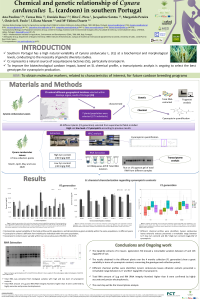
Southern Portugal has a high natural variability of Cynara cardunculus L. at a biochemical and morphological levels, conducting to the necessity of genetic diversity studies, for further plant breeding within certain desired agronomic traits [1]. Cardoon as a multipurpose crop represents a natural source of sesquiterpene lactones, namely cynaropicrin [2].
Previously, 175 individuals (generation F0) of wild cardoon from different geographical locations in the Alentejo region were identified, collected and chemically and genetically characterized [1]. To improve the biotechnological cardoon impact, based on sesquiterpene lactones chemical profile, a transcriptomic analysis is ongoing in order to select the best genotypes for cynaropicrin production. Thus, 49 cardoon plants were collected from F1 populations, along 4 months (March, April, May and June), and fresh cardoon leaves were chemical analysed, in terms of Cc leaves-lipophilic extracts cynaropicrin content (mg/g DW). Results show a great variability in terms of cynaropicrin content, concerning the genotype and collection period. For transcriptome analysis, total RNA was extracted from biological samples wigh high and low level of cynaropicrin content. RNA concentration and integrity was assessed by Agilant BioAnalyzer. cDNA libraries will be prepared, and stranded paired-end sequencing will be performed on Illumina Sequencers. The next step will be the bioinformatics analysis of the transcriptome data.
This research is a necessary step for a better conservation of the wild cardoon gene pool and for a more efficient use for future breeding programs of C.cardunculus.
This work is supported by Program Alentejo 2020, through the European Fund for Regional Development (FEDER) under the scope of MedCynaraBioTec – Selection of Cynara cardunculus genotypes for new biotechnological applications: the value chain improvement of cardoon, a well-adapted Mediterranean crop (ALT20-03-0145-FEDER-039495). Authors also acknowledge FCT for Contrato – Programa to L. Marum (CEECINST/00131/2018), PhD grant to A. Paulino (SFRH/BD/145383/2019) and D. Rosa (SFRH/BD/143845/2019), and Project UIDB/05183/2020 to Mediterranean Institute for Agriculture, Environment and Development (MED).
References
[1] Castro M. M. et al. PLoS ONE, 2021, 16(6): e0252792
[2] Ramos, P. A. et al. J. Agric. Food Chem., 2013, 61(35), 8420-8429
Keywords
Cynara cardunculus L.
cardoon
cynaropicrin
genetic diversity
Manuscript
sciforum-052813-Proceeding_IECPS_Paulino, A..pdf
Poster
Poster_IECPS_Paulino, A..pdf
The Role of PME2 and PME3 in Arabidopsis Stomatal Development and Morphology
Dynamics of Non-Structural Carbohydrates Reserves in Leaves of Two Perennial Woody Species, Hakea sericea and Pinus pinaster