Event submissions
EventsThe 2nd International Electronic Conference on Plant Sciences—10th Anniversary of Journal Plants
Published
 10.3390/IECPS2021-12013 (registering DOI)
 This submission belongs to the session C. Plant Response to Stresses and Changing Environment of the event The 2nd International Electronic Conference on Plant Sciences—10th Anniversary of Journal Plants
Published date
01 Dec, 2021
Academic Editor
'%3e%3cpath%20d='M12.6657%2010.9104C12.4185%2010.325%2012.0599%209.79327%2011.6097%209.34482C11.1609%208.89508%2010.6293%208.5365%2010.0442%208.28888C10.0389%208.28626%2010.0337%208.28495%2010.0285%208.28233C10.8446%207.69279%2011.3752%206.73249%2011.3752%205.64904C11.3752%203.8542%209.92103%202.39999%208.1262%202.39999C6.33136%202.39999%204.87715%203.8542%204.87715%205.64904C4.87715%206.73249%205.40774%207.69279%206.22393%208.28364C6.21869%208.28626%206.21345%208.28757%206.20821%208.29019C5.62129%208.5378%205.09463%208.89284%204.64265%209.34613C4.1929%209.79493%203.83432%2010.3266%203.58671%2010.9117C3.34345%2011.4845%203.21226%2012.0987%203.20023%2012.7209C3.19988%2012.7349%203.20233%2012.7488%203.20744%2012.7619C3.21255%2012.7749%203.22022%2012.7867%203.22998%2012.7968C3.23975%2012.8068%203.25142%2012.8147%203.26431%2012.8202C3.2772%2012.8256%203.29105%2012.8284%203.30504%2012.8284H4.09109C4.14874%2012.8284%204.19459%2012.7825%204.1959%2012.7262C4.2221%2011.7148%204.62823%2010.7676%205.34617%2010.0497C6.08899%209.30683%207.0755%208.89808%208.1262%208.89808C9.17689%208.89808%2010.1634%209.30683%2010.9062%2010.0497C11.6242%2010.7676%2012.0303%2011.7148%2012.0565%2012.7262C12.0578%2012.7838%2012.1037%2012.8284%2012.1613%2012.8284H12.9474C12.9613%2012.8284%2012.9752%2012.8256%2012.9881%2012.8202C13.001%2012.8147%2013.0126%2012.8068%2013.0224%2012.7968C13.0322%2012.7867%2013.0398%2012.7749%2013.0449%2012.7619C13.0501%2012.7488%2013.0525%2012.7349%2013.0522%2012.7209C13.0391%2012.0947%2012.9094%2011.4855%2012.6657%2010.9104ZM8.1262%207.9024C7.52486%207.9024%206.9589%207.6679%206.53312%207.24211C6.10733%206.81633%205.87283%206.25037%205.87283%205.64904C5.87283%205.0477%206.10733%204.48174%206.53312%204.05596C6.9589%203.63018%207.52486%203.39567%208.1262%203.39567C8.72753%203.39567%209.29349%203.63018%209.71927%204.05596C10.1451%204.48174%2010.3796%205.0477%2010.3796%205.64904C10.3796%206.25037%2010.1451%206.81633%209.71927%207.24211C9.29349%207.6679%208.72753%207.9024%208.1262%207.9024Z'%20fill='%235D1EE1'/%3e%3c/g%3e%3c/svg%3e) Iker Aranjuelo
Iker AranjueloCitation
Stefanos Gabriel Testempasis, Vasiliki Tsintila, George Karaoglanidis, Assessment of Sensitivity to Boscalid, Fluopyram and Tebuconazole in Monilinia fructicola Isolates Obtained from Peach Orchards in Greece, in Proceedings of The 2nd International Electronic Conference on Plant Sciences—10th Anniversary of Journal Plants, 1 December–15 December 2021, MDPI: Basel, Switzerland, doi: 10.3390/IECPS2021-12013
Share
Email
Facebook
Twitter
LinkedIn
Assessment of Sensitivity to Boscalid, Fluopyram and Tebuconazole in Monilinia fructicola Isolates Obtained from Peach Orchards in Greece
'%3e%3cpath%20d='M12.6647%2010.9104C12.4176%2010.325%2012.0589%209.7933%2011.6088%209.34485C11.16%208.89511%2010.6283%208.53653%2010.0432%208.28891C10.038%208.28629%2010.0327%208.28498%2010.0275%208.28236C10.8437%207.69282%2011.3743%206.73252%2011.3743%205.64907C11.3743%203.85423%209.92005%202.40002%208.12522%202.40002C6.33038%202.40002%204.87618%203.85423%204.87618%205.64907C4.87618%206.73252%205.40677%207.69282%206.22296%208.28367C6.21772%208.28629%206.21248%208.2876%206.20724%208.29022C5.62031%208.53783%205.09365%208.89287%204.64167%209.34616C4.19192%209.79496%203.83334%2010.3266%203.58573%2010.9117C3.34247%2011.4846%203.21128%2012.0987%203.19925%2012.721C3.1989%2012.735%203.20135%2012.7489%203.20646%2012.7619C3.21157%2012.7749%203.21924%2012.7868%203.22901%2012.7968C3.23877%2012.8068%203.25045%2012.8148%203.26334%2012.8202C3.27623%2012.8256%203.29007%2012.8284%203.30406%2012.8284H4.09012C4.14776%2012.8284%204.19362%2012.7825%204.19493%2012.7262C4.22113%2011.7148%204.62726%2010.7676%205.34519%2010.0497C6.08802%209.30686%207.07452%208.89811%208.12522%208.89811C9.17592%208.89811%2010.1624%209.30686%2010.9052%2010.0497C11.6232%2010.7676%2012.0293%2011.7148%2012.0555%2012.7262C12.0568%2012.7839%2012.1027%2012.8284%2012.1603%2012.8284H12.9464C12.9604%2012.8284%2012.9742%2012.8256%2012.9871%2012.8202C13%2012.8148%2013.0117%2012.8068%2013.0214%2012.7968C13.0312%2012.7868%2013.0389%2012.7749%2013.044%2012.7619C13.0491%2012.7489%2013.0515%2012.735%2013.0512%2012.721C13.0381%2012.0947%2012.9084%2011.4856%2012.6647%2010.9104ZM8.12522%207.90243C7.52388%207.90243%206.95792%207.66793%206.53214%207.24215C6.10636%206.81636%205.87185%206.2504%205.87185%205.64907C5.87185%205.04773%206.10636%204.48177%206.53214%204.05599C6.95792%203.63021%207.52388%203.3957%208.12522%203.3957C8.72655%203.3957%209.29252%203.63021%209.7183%204.05599C10.1441%204.48177%2010.3786%205.04773%2010.3786%205.64907C10.3786%206.2504%2010.1441%206.81636%209.7183%207.24215C9.29252%207.66793%208.72655%207.90243%208.12522%207.90243Z'%20fill='%235D1EE1'/%3e%3c/g%3e%3c/svg%3e)
Stefanos Gabriel Testempasis 1
Vasiliki Tsintila 1

George Karaoglanidis 1
1. Laboratory of Plant Pathology, Faculty of Agriculture, Forestry and Natural Environment Aristotle University of Thessaloniki
Abstract
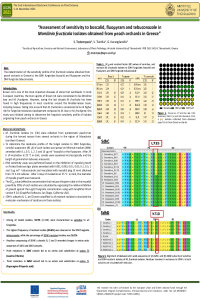
Brown rot is one of the most important diseases of stone fruit worldwide. In most European countries, the main agents of Brown rot were considered to be Monilinia laxa and M. fructigena. However, during the last decade M. fructicola has been found in high frequencies in most countries around the Mediterranean basin, including Greece. Taking into account that M. fructicola is considered to be of higher risk for fungicide resistance development compared to M. laxa or M. fructigena, this study was initiated aiming to determine the fungicide sensitivity profile of isolates originating from peach orchards in Greece. In total, 230 M. fructicola isolates were collected and assessed for their sensitivity to the SDHI fungicides boscalid and fluopyram and the DMI fungicide tebuconazole. Sensitivity assays were based on the inhibition of germ tube or the mycelial growth for SDHIs and DMIs, respectively. The assays revealed that 53.9% of the isolates (n=124) were sensitive to all the three fungicides tested, while 46.1% (n=106) were characterized as resistant. In detail, 7.8% (n=18) and 8.7% (n=20) of the SDHI-resistant subpopulation had a resistance factor (RF) higher than 2 to fluopyram and boscalid, respectively. In addition, a high percentage (29.6%) of the isolates (n=68) were resistant to tebuconazole with a RF values ranging from 2 to 13. To the best of our knowledge, this is the first report of resistant strains of M. fructicola to SDHIs and DMIs in Greece. Ongoing studies will elucidate the molecular mechanisms of resistance in these isolates.
Funding
This research has been co-financed by the European Union and Greek national funds through the Operational Program Competitiveness, Entrepreneurship and Innovation, under the call RESEARCH–CREATE–INNOVATE (project code: T1EDK- 04591).
Keywords
Brown rot
SDHI's
DMI's
stone-fruit
fungicide
resistance
Manuscript
sciforum-052819 -MDPI_Abstract_Assessment of fungicide sensitivity to Boscalid.pdf
Poster
POSTER_monilinia.pdf
Dynamics of Non-Structural Carbohydrates Reserves in Leaves of Two Perennial Woody Species, Hakea sericea and Pinus pinaster
Ozone Effects on the Quality of Swiss Chard. Peri-Urban Crops a Case Study