Event submissions
EventsThe 2nd International Electronic Conference on Plant Sciences—10th Anniversary of Journal Plants
Published

This submission belongs to the session D. Phytochemistry and Phytoremediation, Plants in Urban Ecosystems of the event The 2nd International Electronic Conference on Plant Sciences—10th Anniversary of Journal Plants
Published date
12 Apr, 2022
Academic Editor
'%3e%3cpath%20d='M12.6657%2010.9104C12.4185%2010.325%2012.0599%209.79327%2011.6097%209.34482C11.1609%208.89508%2010.6293%208.5365%2010.0442%208.28888C10.0389%208.28626%2010.0337%208.28495%2010.0285%208.28233C10.8446%207.69279%2011.3752%206.73249%2011.3752%205.64904C11.3752%203.8542%209.92103%202.39999%208.1262%202.39999C6.33136%202.39999%204.87715%203.8542%204.87715%205.64904C4.87715%206.73249%205.40774%207.69279%206.22393%208.28364C6.21869%208.28626%206.21345%208.28757%206.20821%208.29019C5.62129%208.5378%205.09463%208.89284%204.64265%209.34613C4.1929%209.79493%203.83432%2010.3266%203.58671%2010.9117C3.34345%2011.4845%203.21226%2012.0987%203.20023%2012.7209C3.19988%2012.7349%203.20233%2012.7488%203.20744%2012.7619C3.21255%2012.7749%203.22022%2012.7867%203.22998%2012.7968C3.23975%2012.8068%203.25142%2012.8147%203.26431%2012.8202C3.2772%2012.8256%203.29105%2012.8284%203.30504%2012.8284H4.09109C4.14874%2012.8284%204.19459%2012.7825%204.1959%2012.7262C4.2221%2011.7148%204.62823%2010.7676%205.34617%2010.0497C6.08899%209.30683%207.0755%208.89808%208.1262%208.89808C9.17689%208.89808%2010.1634%209.30683%2010.9062%2010.0497C11.6242%2010.7676%2012.0303%2011.7148%2012.0565%2012.7262C12.0578%2012.7838%2012.1037%2012.8284%2012.1613%2012.8284H12.9474C12.9613%2012.8284%2012.9752%2012.8256%2012.9881%2012.8202C13.001%2012.8147%2013.0126%2012.8068%2013.0224%2012.7968C13.0322%2012.7867%2013.0398%2012.7749%2013.0449%2012.7619C13.0501%2012.7488%2013.0525%2012.7349%2013.0522%2012.7209C13.0391%2012.0947%2012.9094%2011.4855%2012.6657%2010.9104ZM8.1262%207.9024C7.52486%207.9024%206.9589%207.6679%206.53312%207.24211C6.10733%206.81633%205.87283%206.25037%205.87283%205.64904C5.87283%205.0477%206.10733%204.48174%206.53312%204.05596C6.9589%203.63018%207.52486%203.39567%208.1262%203.39567C8.72753%203.39567%209.29349%203.63018%209.71927%204.05596C10.1451%204.48174%2010.3796%205.0477%2010.3796%205.64904C10.3796%206.25037%2010.1451%206.81633%209.71927%207.24211C9.29349%207.6679%208.72753%207.9024%208.1262%207.9024Z'%20fill='%235D1EE1'/%3e%3c/g%3e%3c/svg%3e) Giedre Samuoliene
Giedre SamuolieneCitation
Izamara De Oliveira, Sandrina Alves Heleno, Márcio Carocho, Maria José Alves, Rui Miguel Vaz de Abreu, Maria Inês Dias, Celestino Santos Buelga, Spyridon Petropoulos, Nikolaos Tzortzakis, Antonios Chrysargyris, Isabel Cristina Fernandes Rodrigues Ferreira, Lillian Barros, Comparison between different extraction methods in the recovery of bioactive molecules from Melissa officinalis L.under sustainable cultivation: chemical and bioactive characterization, in Proceedings of The 2nd International Electronic Conference on Plant Sciences—10th Anniversary of Journal Plants, 1 December–15 December 2021, MDPI: Basel, Switzerland, doi: 10.3390/IECPS2021-12020
Share
Email
Facebook
Twitter
LinkedIn
Comparison between different extraction methods in the recovery of bioactive molecules from Melissa officinalis L.under sustainable cultivation: chemical and bioactive characterization
'%3e%3cpath%20d='M12.6647%2010.9104C12.4176%2010.325%2012.0589%209.7933%2011.6088%209.34485C11.16%208.89511%2010.6283%208.53653%2010.0432%208.28891C10.038%208.28629%2010.0327%208.28498%2010.0275%208.28236C10.8437%207.69282%2011.3743%206.73252%2011.3743%205.64907C11.3743%203.85423%209.92005%202.40002%208.12522%202.40002C6.33038%202.40002%204.87618%203.85423%204.87618%205.64907C4.87618%206.73252%205.40677%207.69282%206.22296%208.28367C6.21772%208.28629%206.21248%208.2876%206.20724%208.29022C5.62031%208.53783%205.09365%208.89287%204.64167%209.34616C4.19192%209.79496%203.83334%2010.3266%203.58573%2010.9117C3.34247%2011.4846%203.21128%2012.0987%203.19925%2012.721C3.1989%2012.735%203.20135%2012.7489%203.20646%2012.7619C3.21157%2012.7749%203.21924%2012.7868%203.22901%2012.7968C3.23877%2012.8068%203.25045%2012.8148%203.26334%2012.8202C3.27623%2012.8256%203.29007%2012.8284%203.30406%2012.8284H4.09012C4.14776%2012.8284%204.19362%2012.7825%204.19493%2012.7262C4.22113%2011.7148%204.62726%2010.7676%205.34519%2010.0497C6.08802%209.30686%207.07452%208.89811%208.12522%208.89811C9.17592%208.89811%2010.1624%209.30686%2010.9052%2010.0497C11.6232%2010.7676%2012.0293%2011.7148%2012.0555%2012.7262C12.0568%2012.7839%2012.1027%2012.8284%2012.1603%2012.8284H12.9464C12.9604%2012.8284%2012.9742%2012.8256%2012.9871%2012.8202C13%2012.8148%2013.0117%2012.8068%2013.0214%2012.7968C13.0312%2012.7868%2013.0389%2012.7749%2013.044%2012.7619C13.0491%2012.7489%2013.0515%2012.735%2013.0512%2012.721C13.0381%2012.0947%2012.9084%2011.4856%2012.6647%2010.9104ZM8.12522%207.90243C7.52388%207.90243%206.95792%207.66793%206.53214%207.24215C6.10636%206.81636%205.87185%206.2504%205.87185%205.64907C5.87185%205.04773%206.10636%204.48177%206.53214%204.05599C6.95792%203.63021%207.52388%203.3957%208.12522%203.3957C8.72655%203.3957%209.29252%203.63021%209.7183%204.05599C10.1441%204.48177%2010.3786%205.04773%2010.3786%205.64907C10.3786%206.2504%2010.1441%206.81636%209.7183%207.24215C9.29252%207.66793%208.72655%207.90243%208.12522%207.90243Z'%20fill='%235D1EE1'/%3e%3c/g%3e%3c/svg%3e)
Izamara De Oliveira 1

Sandrina Alves Heleno 1

Márcio Carocho 1
Maria José Alves 1

Rui Miguel Vaz de Abreu 1

Maria Inês Dias 1

Celestino Santos Buelga 2

Spyridon Petropoulos 3

Nikolaos Tzortzakis 4
Antonios Chrysargyris 5

Isabel Cristina Fernandes Rodrigues Ferreira 1

Lillian Barros 1
1. Mountain Research Centre, Portugal.
2. Grupo de Investigación en Polifenoles (GIP-USAL), Facultad de Farmacia, Universidad de Salamanca, Spain
3. Department of Agriculture Crop Production and Rural Environment, University of Thessaly, Volos, Greece
4. Department of Agricultural Sciences, Biotechnology and Food Science, Cyprus University of Technology, Lemesos, Cyprus
5. University of the Peloponnese, Department of Agriculture, Kalamata, Greece
Abstract
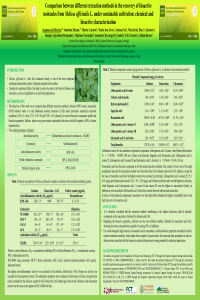
Melissa officinalis L., from the Lamiaceae family, is one of the most important medicinal and aromatic plants with potential in the market. With the passing of time, the use of medicinal plants in the treatment of some illness has gone from the simplest forms of local treatment to the industrial manufacture of phytotherapics. In addition to their medicinal effect, they can also be used in the form of infusions and decoctions and in various food preparations. In this sense, the objective of this work was to compare three different extraction methods: infusion (100% water), maceration (80:20 ethanol: water v:v) and ultrasound assisted extraction (UAE) under previous optimized extraction conditions (33.0 ± 3.2 min, 371.7 ± 19.3 W and 39.9 ± 1.4% ethanol), in plants grown under sustainable cultivation under full irrigation in June. The parameters studied included bioactive evaluation through antimicrobial (microdilution method), antioxidant (thiobarbituric acid reactive substances - TBARS), cytotoxicity (sulforhodamine B) and anti-inflammatory (RAW cells) assays. The composition of phenolic compounds and organic acids was also studied by GC-MS and HPLC-DAD, respectively. According to the obtained results, eight phenolic compounds were identified and quantified, being rosmarinic acid the main one for the three extraction methods (infusion: 107.1±0.9 mg/g extract; maceration: 155.7±0.3 mg/g extract; UAE: 118.7±0.6 mg/g extract). For Lithospermic acid A isomer (25.25 ± 0.01 mg/g) and Hydroxylsalvianolic E (111.70 ± 2.20 mg/g), the UAE revealed the lowest content of individual polyphenols, whereas maceration recorded the highest extractability. On the other hand, the content of six of the eight polyphenols detected for the ultrasound-assisted extraction was similar to the infusion and maceration methods. In terms of antioxidant activity, the infusions showed the highest capacity (3.00 ± 0.14 μg/mL), followed by maceration (5.33 ± 0.30 μg/mL) and UAE (12 ± 0.15 μg/mL). The highest anti-inflammatory activity was verified for the infusion (244 ± 11 μg/mL), followed by UAE (305 ± 9 μg/mL), with no activity recorded for the maceration extract (>400 μg/mL). The antitumor properties were evaluated in 5 cell lines, with the best results being recorded for infusion, except AGS (24 ± 1 μg/mL) where the best results were for the UAE; being the maceration extract more active against NCI-H460 (190 ± 7 μg/mL). It is therefore concluded that the extraction method that contributes to the highest obtainment of phenolic compounds is maceration, followed by infusion and ultrasound-assisted extraction. As for the bioactive and antioxidant compounds, infusion is the most efficient method, followed by maceration and ultrasound. Overall, these natural extracts are interesting ingredients, capable of replacing counterparts of synthetic origin, and can find wide applications in the industrial sector (e.g. food, pharmaceutical and cosmetic companies). Also emphasizing the high contents in rosmarinic acid, and the obtained bioactivity, that turns this samples of great interest to increase their production to obtain extracts enriched with this bioactive molecule.
Keywords
Melissa officinalis L.
different extraction methods
phenolic compounds.
Manuscript
sciforum-052822-abstract-done.pdf
Poster
IECPS_Melissa_ Poster_Izamara.pdf
Wheat Shoot Al, Fe, Mn and Zn Levels Are Influenced by Arbuscular Mycorrhiza Extraradical Mycelium Associated to Ornithopus compressus in Acidic Soils
Sea Fennel (Crithmum maritimum L.): A Promising Biosaline Crop. Extraction, Purification and Chemical Characterization of Polar Extracts