Event submissions
EventsThe 2nd International Electronic Conference on Animals - Global Sustainability and Animals: Welfare, Policies and Technologies
Published
 10.3390/IECA2021-12027 (registering DOI)
 This submission belongs to the session F. Smart technology and precision livestock farming of the event The 2nd International Electronic Conference on Animals - Global Sustainability and Animals: Welfare, Policies and Technologies
Published date
02 Dec, 2021
Academic Editor
'%3e%3cpath%20d='M12.6657%2010.9104C12.4185%2010.325%2012.0599%209.79327%2011.6097%209.34482C11.1609%208.89508%2010.6293%208.5365%2010.0442%208.28888C10.0389%208.28626%2010.0337%208.28495%2010.0285%208.28233C10.8446%207.69279%2011.3752%206.73249%2011.3752%205.64904C11.3752%203.8542%209.92103%202.39999%208.1262%202.39999C6.33136%202.39999%204.87715%203.8542%204.87715%205.64904C4.87715%206.73249%205.40774%207.69279%206.22393%208.28364C6.21869%208.28626%206.21345%208.28757%206.20821%208.29019C5.62129%208.5378%205.09463%208.89284%204.64265%209.34613C4.1929%209.79493%203.83432%2010.3266%203.58671%2010.9117C3.34345%2011.4845%203.21226%2012.0987%203.20023%2012.7209C3.19988%2012.7349%203.20233%2012.7488%203.20744%2012.7619C3.21255%2012.7749%203.22022%2012.7867%203.22998%2012.7968C3.23975%2012.8068%203.25142%2012.8147%203.26431%2012.8202C3.2772%2012.8256%203.29105%2012.8284%203.30504%2012.8284H4.09109C4.14874%2012.8284%204.19459%2012.7825%204.1959%2012.7262C4.2221%2011.7148%204.62823%2010.7676%205.34617%2010.0497C6.08899%209.30683%207.0755%208.89808%208.1262%208.89808C9.17689%208.89808%2010.1634%209.30683%2010.9062%2010.0497C11.6242%2010.7676%2012.0303%2011.7148%2012.0565%2012.7262C12.0578%2012.7838%2012.1037%2012.8284%2012.1613%2012.8284H12.9474C12.9613%2012.8284%2012.9752%2012.8256%2012.9881%2012.8202C13.001%2012.8147%2013.0126%2012.8068%2013.0224%2012.7968C13.0322%2012.7867%2013.0398%2012.7749%2013.0449%2012.7619C13.0501%2012.7488%2013.0525%2012.7349%2013.0522%2012.7209C13.0391%2012.0947%2012.9094%2011.4855%2012.6657%2010.9104ZM8.1262%207.9024C7.52486%207.9024%206.9589%207.6679%206.53312%207.24211C6.10733%206.81633%205.87283%206.25037%205.87283%205.64904C5.87283%205.0477%206.10733%204.48174%206.53312%204.05596C6.9589%203.63018%207.52486%203.39567%208.1262%203.39567C8.72753%203.39567%209.29349%203.63018%209.71927%204.05596C10.1451%204.48174%2010.3796%205.0477%2010.3796%205.64904C10.3796%206.25037%2010.1451%206.81633%209.71927%207.24211C9.29349%207.6679%208.72753%207.9024%208.1262%207.9024Z'%20fill='%235D1EE1'/%3e%3c/g%3e%3c/svg%3e) Andrea Pezzuolo
Andrea PezzuoloCitation
Lydia Lanzoni, Matteo Chincarini, Silvia Del Rosso, Nicola Ferri, Mizeck Chagunda, Giorgio Vignola, First assessment of methane emission in Mediterranean Buffaloes with a smart tool: preliminary results., in Proceedings of The 2nd International Electronic Conference on Animals - Global Sustainability and Animals: Welfare, Policies and Technologies, 29 November–13 December 2021, MDPI: Basel, Switzerland, doi: 10.3390/IECA2021-12027
Share
Email
Facebook
Twitter
LinkedIn
First assessment of methane emission in Mediterranean Buffaloes with a smart tool: preliminary results.

Lydia Lanzoni 1
'%3e%3cpath%20d='M12.6647%2010.9104C12.4176%2010.325%2012.0589%209.7933%2011.6088%209.34485C11.16%208.89511%2010.6283%208.53653%2010.0432%208.28891C10.038%208.28629%2010.0327%208.28498%2010.0275%208.28236C10.8437%207.69282%2011.3743%206.73252%2011.3743%205.64907C11.3743%203.85423%209.92005%202.40002%208.12522%202.40002C6.33038%202.40002%204.87618%203.85423%204.87618%205.64907C4.87618%206.73252%205.40677%207.69282%206.22296%208.28367C6.21772%208.28629%206.21248%208.2876%206.20724%208.29022C5.62031%208.53783%205.09365%208.89287%204.64167%209.34616C4.19192%209.79496%203.83334%2010.3266%203.58573%2010.9117C3.34247%2011.4846%203.21128%2012.0987%203.19925%2012.721C3.1989%2012.735%203.20135%2012.7489%203.20646%2012.7619C3.21157%2012.7749%203.21924%2012.7868%203.22901%2012.7968C3.23877%2012.8068%203.25045%2012.8148%203.26334%2012.8202C3.27623%2012.8256%203.29007%2012.8284%203.30406%2012.8284H4.09012C4.14776%2012.8284%204.19362%2012.7825%204.19493%2012.7262C4.22113%2011.7148%204.62726%2010.7676%205.34519%2010.0497C6.08802%209.30686%207.07452%208.89811%208.12522%208.89811C9.17592%208.89811%2010.1624%209.30686%2010.9052%2010.0497C11.6232%2010.7676%2012.0293%2011.7148%2012.0555%2012.7262C12.0568%2012.7839%2012.1027%2012.8284%2012.1603%2012.8284H12.9464C12.9604%2012.8284%2012.9742%2012.8256%2012.9871%2012.8202C13%2012.8148%2013.0117%2012.8068%2013.0214%2012.7968C13.0312%2012.7868%2013.0389%2012.7749%2013.044%2012.7619C13.0491%2012.7489%2013.0515%2012.735%2013.0512%2012.721C13.0381%2012.0947%2012.9084%2011.4856%2012.6647%2010.9104ZM8.12522%207.90243C7.52388%207.90243%206.95792%207.66793%206.53214%207.24215C6.10636%206.81636%205.87185%206.2504%205.87185%205.64907C5.87185%205.04773%206.10636%204.48177%206.53214%204.05599C6.95792%203.63021%207.52388%203.3957%208.12522%203.3957C8.72655%203.3957%209.29252%203.63021%209.7183%204.05599C10.1441%204.48177%2010.3786%205.04773%2010.3786%205.64907C10.3786%206.2504%2010.1441%206.81636%209.7183%207.24215C9.29252%207.66793%208.72655%207.90243%208.12522%207.90243Z'%20fill='%235D1EE1'/%3e%3c/g%3e%3c/svg%3e)
Matteo Chincarini 1
Silvia Del Rosso 1
Nicola Ferri 2
Mizeck Chagunda 3
Giorgio Vignola 1
1. Facoltà di Medicina Veterinaria, Università degli Studi di Teramo, Loc. Piano d’Accio, 64100 Teramo, Italy
2. Istituto Zooprofilattico Sperimentale dell’Abruzzo e del Molise ‘G. Caporale’, Campo Boario, 64100, Teramo, Italy
3. Animal Breeding and Husbandry in the Tropics and Subtropics, University of Hohenheim, Stuttgart, Germany
Abstract
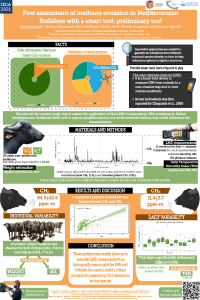
Animal productions are reported to be responsible for 14.5 % of the anthropogenic greenhouse gasses emissions, especially methane (CH4). Innovative solutions are needed to quantify the emissions from different ruminant species directly on farm to help determine optimal mitigation solutions. Portable smart tools have a big role to play in this regard. The use of a laser methane detector (LMD) in livestock was first reported by Chagunda et al., 2009. This is a hand-held device to measure CH4 from animals in a non-invasive way and in their natural conditions. The aim of the current study was to assess the application of the LMD in measuring CH4 emissions in Italian Mediterranean Buffaloes (IMB) and to explore possible animal and environmental factors that could influence the measurement. The LMD was used to measure CH4 emitted with the plume in twenty adult non-productive IMB (11 females; 9 males) fed with a low input diet (F:C = 80:20) during 12 consecutive days in summer. Each animal was assessed every day for 4 minutes while standing idle without physical restrain. The weight and sex of the animals were recorded. Daily Temperature Humidity Index (THI) was calculated for the trial period. LMD output data were divided for each day and each subject into eructation/peak CH4 (CHE) and breathing/basal CH4 (CHB). A linear mixed model and Pearson’s coefficient were used to analyze the effect and correlations of the variables. The average CHE and CHB was respectively 84.3±42.6ppm-m and 20.4±6.5 ppm-m and a significant positive correlation was found between these (R=0.63, p<0.001). A between-subject variation was observed for both eructation and breath, CHE (p<0.001, ε2=0.12) and CHB (p<0.001, ε2=0.21). However, this between-subject variation was not explainable by individual differences in terms of weight and sex. Trial days significantly influenced CHB (p<0.001), while no effect was found on CHE. Further analysis did not find any association between CHB and daily variation of the THI (average: 74.5±1.8; min: 71.9; max: 78.6). These preliminary results allow us to consider LMD measurements as biologically meaningful for IMB and indicate the need to build a robust protocol for measuring CH4 emissions in this species.
Keywords
Buffaloes
GHGs
Methane
LMD
Sustainability
Poster
poster_Lanzoni2021_IECA2021_LMDinBuffaloes.pdf
Livestock advisors’ perception of silvopastoral systems benefits in south Brazil
Global Livestock Production in Challenging Environment