Event submissions
EventsThe 2nd International Electronic Conference on Animals - Global Sustainability and Animals: Welfare, Policies and Technologies
Published
 10.3390/IECA2021-12029 (registering DOI)
 This submission belongs to the session A. Climate change and effects on the sustainability of animal systems of the event The 2nd International Electronic Conference on Animals - Global Sustainability and Animals: Welfare, Policies and Technologies
Published date
02 Dec, 2021
Academic Editor
'%3e%3cpath%20d='M12.6657%2010.9104C12.4185%2010.325%2012.0599%209.79327%2011.6097%209.34482C11.1609%208.89508%2010.6293%208.5365%2010.0442%208.28888C10.0389%208.28626%2010.0337%208.28495%2010.0285%208.28233C10.8446%207.69279%2011.3752%206.73249%2011.3752%205.64904C11.3752%203.8542%209.92103%202.39999%208.1262%202.39999C6.33136%202.39999%204.87715%203.8542%204.87715%205.64904C4.87715%206.73249%205.40774%207.69279%206.22393%208.28364C6.21869%208.28626%206.21345%208.28757%206.20821%208.29019C5.62129%208.5378%205.09463%208.89284%204.64265%209.34613C4.1929%209.79493%203.83432%2010.3266%203.58671%2010.9117C3.34345%2011.4845%203.21226%2012.0987%203.20023%2012.7209C3.19988%2012.7349%203.20233%2012.7488%203.20744%2012.7619C3.21255%2012.7749%203.22022%2012.7867%203.22998%2012.7968C3.23975%2012.8068%203.25142%2012.8147%203.26431%2012.8202C3.2772%2012.8256%203.29105%2012.8284%203.30504%2012.8284H4.09109C4.14874%2012.8284%204.19459%2012.7825%204.1959%2012.7262C4.2221%2011.7148%204.62823%2010.7676%205.34617%2010.0497C6.08899%209.30683%207.0755%208.89808%208.1262%208.89808C9.17689%208.89808%2010.1634%209.30683%2010.9062%2010.0497C11.6242%2010.7676%2012.0303%2011.7148%2012.0565%2012.7262C12.0578%2012.7838%2012.1037%2012.8284%2012.1613%2012.8284H12.9474C12.9613%2012.8284%2012.9752%2012.8256%2012.9881%2012.8202C13.001%2012.8147%2013.0126%2012.8068%2013.0224%2012.7968C13.0322%2012.7867%2013.0398%2012.7749%2013.0449%2012.7619C13.0501%2012.7488%2013.0525%2012.7349%2013.0522%2012.7209C13.0391%2012.0947%2012.9094%2011.4855%2012.6657%2010.9104ZM8.1262%207.9024C7.52486%207.9024%206.9589%207.6679%206.53312%207.24211C6.10733%206.81633%205.87283%206.25037%205.87283%205.64904C5.87283%205.0477%206.10733%204.48174%206.53312%204.05596C6.9589%203.63018%207.52486%203.39567%208.1262%203.39567C8.72753%203.39567%209.29349%203.63018%209.71927%204.05596C10.1451%204.48174%2010.3796%205.0477%2010.3796%205.64904C10.3796%206.25037%2010.1451%206.81633%209.71927%207.24211C9.29349%207.6679%208.72753%207.9024%208.1262%207.9024Z'%20fill='%235D1EE1'/%3e%3c/g%3e%3c/svg%3e) Andrea Pezzuolo
Andrea PezzuoloCitation
Hiba Qasir, Bjørg Heringstad, Ahmad Reza Sharifi, Kirsti Winnberg, Indirect selection for methane reduction in Norwegian Red cows, in Proceedings of The 2nd International Electronic Conference on Animals - Global Sustainability and Animals: Welfare, Policies and Technologies, 29 November–13 December 2021, MDPI: Basel, Switzerland, doi: 10.3390/IECA2021-12029
Share
Email
Facebook
Twitter
LinkedIn
Indirect selection for methane reduction in Norwegian Red cows
'%3e%3cpath%20d='M12.6647%2010.9104C12.4176%2010.325%2012.0589%209.7933%2011.6088%209.34485C11.16%208.89511%2010.6283%208.53653%2010.0432%208.28891C10.038%208.28629%2010.0327%208.28498%2010.0275%208.28236C10.8437%207.69282%2011.3743%206.73252%2011.3743%205.64907C11.3743%203.85423%209.92005%202.40002%208.12522%202.40002C6.33038%202.40002%204.87618%203.85423%204.87618%205.64907C4.87618%206.73252%205.40677%207.69282%206.22296%208.28367C6.21772%208.28629%206.21248%208.2876%206.20724%208.29022C5.62031%208.53783%205.09365%208.89287%204.64167%209.34616C4.19192%209.79496%203.83334%2010.3266%203.58573%2010.9117C3.34247%2011.4846%203.21128%2012.0987%203.19925%2012.721C3.1989%2012.735%203.20135%2012.7489%203.20646%2012.7619C3.21157%2012.7749%203.21924%2012.7868%203.22901%2012.7968C3.23877%2012.8068%203.25045%2012.8148%203.26334%2012.8202C3.27623%2012.8256%203.29007%2012.8284%203.30406%2012.8284H4.09012C4.14776%2012.8284%204.19362%2012.7825%204.19493%2012.7262C4.22113%2011.7148%204.62726%2010.7676%205.34519%2010.0497C6.08802%209.30686%207.07452%208.89811%208.12522%208.89811C9.17592%208.89811%2010.1624%209.30686%2010.9052%2010.0497C11.6232%2010.7676%2012.0293%2011.7148%2012.0555%2012.7262C12.0568%2012.7839%2012.1027%2012.8284%2012.1603%2012.8284H12.9464C12.9604%2012.8284%2012.9742%2012.8256%2012.9871%2012.8202C13%2012.8148%2013.0117%2012.8068%2013.0214%2012.7968C13.0312%2012.7868%2013.0389%2012.7749%2013.044%2012.7619C13.0491%2012.7489%2013.0515%2012.735%2013.0512%2012.721C13.0381%2012.0947%2012.9084%2011.4856%2012.6647%2010.9104ZM8.12522%207.90243C7.52388%207.90243%206.95792%207.66793%206.53214%207.24215C6.10636%206.81636%205.87185%206.2504%205.87185%205.64907C5.87185%205.04773%206.10636%204.48177%206.53214%204.05599C6.95792%203.63021%207.52388%203.3957%208.12522%203.3957C8.72655%203.3957%209.29252%203.63021%209.7183%204.05599C10.1441%204.48177%2010.3786%205.04773%2010.3786%205.64907C10.3786%206.2504%2010.1441%206.81636%209.7183%207.24215C9.29252%207.66793%208.72655%207.90243%208.12522%207.90243Z'%20fill='%235D1EE1'/%3e%3c/g%3e%3c/svg%3e)
Hiba Qasir 1
Bjørg Heringstad 1
Ahmad Reza Sharifi 2
Kirsti Winnberg 1
1. Norwegian University of Life Sciences
2. University of Göttingen
Abstract
Over the past years, methane production from dairy cattle gained a significant attraction because of its contribution to climate change and loss of dietary energy from the animals. This was the first study to compare methane emission between high milk yielding (HL) and mastitis resistance (FL) lines of Norwegian Red cows, in level and development through lactation, as a result of indirect selection for milk yield and mastitis resistance. The study also focussed on estimating the effects of genetic group, parity, lactation stage and calving season on methane emission. The data consisted of 5,012 observations of methane production measured with Greenfeed system from a herd of 47 Norwegian Red cows at the Center for Animal Experiments, NMBU. The data were analyzed using R software and least square means were calculated for methane production. The average methane production was 441g/d ranging from 115g/d to 497g/d. Overall, the average methane production was higher for HL than FL. The analysis of methane production showed that genetic group, lactation number, calving month- year, lactation week and group * lactation number all had a significant effect (p-value <0.005). The difference in methane production between two groups was significant, indicating that indirect selection for high milk yield or mastitis resistance affects the methane production. The pairwise differences showed non-significant differences between the lactation weeks except for week 11. Cows in lactation number 2 produced the highest methane (461g/d), and those in lactation 1 emitted the least amount (400g/d). There was a significant difference in methane emissions between lactation 1 and 2, and lactation 1 and 3 (p-value < 0.0001), however the difference was insignificant between lactation 2 and 3 (p-value: 0.4146). Cows calving in autumn months (September to November) produced more methane than those in winter months (December and January). There was a statistically significant difference between autumn months and winter months (p-value <0.05), however within months difference was insignificant (p-value >0.05). The study identified that selection for mastitis resistance or milk yield provides basis for indirect selection for methane reduction, however, further experiments with large dataset are required for building a solid conclusion.
Keywords
Methane reduction
indirect selection
milk yield
mastitis resistance
Poster
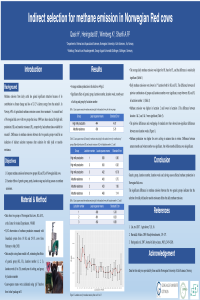
Qasir et al. Poster.pdf
Global Livestock Production in Challenging Environment
FOOD ALTERNATIVES FOR A SUSTAINABLE PRODUCTION OF RUMINANTS IN ARID AND SEMI-ARID ZONES IN MEXICO