Event submissions
EventsThe 2nd International Electronic Conference on Plant Sciences—10th Anniversary of Journal Plants
Published

This submission belongs to the session B. Plant Ecology, Biodiversity and Developmental Biology of the event The 2nd International Electronic Conference on Plant Sciences—10th Anniversary of Journal Plants
Published date
06 Dec, 2021
Academic Editor
'%3e%3cpath%20d='M12.6657%2010.9104C12.4185%2010.325%2012.0599%209.79327%2011.6097%209.34482C11.1609%208.89508%2010.6293%208.5365%2010.0442%208.28888C10.0389%208.28626%2010.0337%208.28495%2010.0285%208.28233C10.8446%207.69279%2011.3752%206.73249%2011.3752%205.64904C11.3752%203.8542%209.92103%202.39999%208.1262%202.39999C6.33136%202.39999%204.87715%203.8542%204.87715%205.64904C4.87715%206.73249%205.40774%207.69279%206.22393%208.28364C6.21869%208.28626%206.21345%208.28757%206.20821%208.29019C5.62129%208.5378%205.09463%208.89284%204.64265%209.34613C4.1929%209.79493%203.83432%2010.3266%203.58671%2010.9117C3.34345%2011.4845%203.21226%2012.0987%203.20023%2012.7209C3.19988%2012.7349%203.20233%2012.7488%203.20744%2012.7619C3.21255%2012.7749%203.22022%2012.7867%203.22998%2012.7968C3.23975%2012.8068%203.25142%2012.8147%203.26431%2012.8202C3.2772%2012.8256%203.29105%2012.8284%203.30504%2012.8284H4.09109C4.14874%2012.8284%204.19459%2012.7825%204.1959%2012.7262C4.2221%2011.7148%204.62823%2010.7676%205.34617%2010.0497C6.08899%209.30683%207.0755%208.89808%208.1262%208.89808C9.17689%208.89808%2010.1634%209.30683%2010.9062%2010.0497C11.6242%2010.7676%2012.0303%2011.7148%2012.0565%2012.7262C12.0578%2012.7838%2012.1037%2012.8284%2012.1613%2012.8284H12.9474C12.9613%2012.8284%2012.9752%2012.8256%2012.9881%2012.8202C13.001%2012.8147%2013.0126%2012.8068%2013.0224%2012.7968C13.0322%2012.7867%2013.0398%2012.7749%2013.0449%2012.7619C13.0501%2012.7488%2013.0525%2012.7349%2013.0522%2012.7209C13.0391%2012.0947%2012.9094%2011.4855%2012.6657%2010.9104ZM8.1262%207.9024C7.52486%207.9024%206.9589%207.6679%206.53312%207.24211C6.10733%206.81633%205.87283%206.25037%205.87283%205.64904C5.87283%205.0477%206.10733%204.48174%206.53312%204.05596C6.9589%203.63018%207.52486%203.39567%208.1262%203.39567C8.72753%203.39567%209.29349%203.63018%209.71927%204.05596C10.1451%204.48174%2010.3796%205.0477%2010.3796%205.64904C10.3796%206.25037%2010.1451%206.81633%209.71927%207.24211C9.29349%207.6679%208.72753%207.9024%208.1262%207.9024Z'%20fill='%235D1EE1'/%3e%3c/g%3e%3c/svg%3e) Carmen Arena
Carmen ArenaCitation
Mylena Dutra Cabrini, Alessandra Ribeiro Pinto, Amanda dos Santos Alencar, Catarina da Fonseca Lira de Medeiros, Effect of Altitudinal Variation on Phenology and Herbivory in Trifolium repens, in Proceedings of The 2nd International Electronic Conference on Plant Sciences—10th Anniversary of Journal Plants, 1 December–15 December 2021, MDPI: Basel, Switzerland, doi: 10.3390/IECPS2021-12048
Share
Email
Facebook
Twitter
LinkedIn
Effect of Altitudinal Variation on Phenology and Herbivory in Trifolium repens
'%3e%3cpath%20d='M12.6647%2010.9104C12.4176%2010.325%2012.0589%209.7933%2011.6088%209.34485C11.16%208.89511%2010.6283%208.53653%2010.0432%208.28891C10.038%208.28629%2010.0327%208.28498%2010.0275%208.28236C10.8437%207.69282%2011.3743%206.73252%2011.3743%205.64907C11.3743%203.85423%209.92005%202.40002%208.12522%202.40002C6.33038%202.40002%204.87618%203.85423%204.87618%205.64907C4.87618%206.73252%205.40677%207.69282%206.22296%208.28367C6.21772%208.28629%206.21248%208.2876%206.20724%208.29022C5.62031%208.53783%205.09365%208.89287%204.64167%209.34616C4.19192%209.79496%203.83334%2010.3266%203.58573%2010.9117C3.34247%2011.4846%203.21128%2012.0987%203.19925%2012.721C3.1989%2012.735%203.20135%2012.7489%203.20646%2012.7619C3.21157%2012.7749%203.21924%2012.7868%203.22901%2012.7968C3.23877%2012.8068%203.25045%2012.8148%203.26334%2012.8202C3.27623%2012.8256%203.29007%2012.8284%203.30406%2012.8284H4.09012C4.14776%2012.8284%204.19362%2012.7825%204.19493%2012.7262C4.22113%2011.7148%204.62726%2010.7676%205.34519%2010.0497C6.08802%209.30686%207.07452%208.89811%208.12522%208.89811C9.17592%208.89811%2010.1624%209.30686%2010.9052%2010.0497C11.6232%2010.7676%2012.0293%2011.7148%2012.0555%2012.7262C12.0568%2012.7839%2012.1027%2012.8284%2012.1603%2012.8284H12.9464C12.9604%2012.8284%2012.9742%2012.8256%2012.9871%2012.8202C13%2012.8148%2013.0117%2012.8068%2013.0214%2012.7968C13.0312%2012.7868%2013.0389%2012.7749%2013.044%2012.7619C13.0491%2012.7489%2013.0515%2012.735%2013.0512%2012.721C13.0381%2012.0947%2012.9084%2011.4856%2012.6647%2010.9104ZM8.12522%207.90243C7.52388%207.90243%206.95792%207.66793%206.53214%207.24215C6.10636%206.81636%205.87185%206.2504%205.87185%205.64907C5.87185%205.04773%206.10636%204.48177%206.53214%204.05599C6.95792%203.63021%207.52388%203.3957%208.12522%203.3957C8.72655%203.3957%209.29252%203.63021%209.7183%204.05599C10.1441%204.48177%2010.3786%205.04773%2010.3786%205.64907C10.3786%206.2504%2010.1441%206.81636%209.7183%207.24215C9.29252%207.66793%208.72655%207.90243%208.12522%207.90243Z'%20fill='%235D1EE1'/%3e%3c/g%3e%3c/svg%3e)
Mylena Dutra Cabrini 1,2
Alessandra Ribeiro Pinto 1,3
Amanda dos Santos Alencar 1,4
Catarina da Fonseca Lira de Medeiros 1
1. Jardim Botânico do Rio de Janeiro (JBRJ)
2. Universidade do Estado do Rio de Janeiro Faculdade de Formação de Professores (UERJFFP)
3. Programa de Pós-Graduação em Ecologia, Universidade Federal do Rio de Janeiro (UFRJ)
4. Programa de Pós-graduação em Botânica, Escola Nacional de Botânica Tropical Jardim Botânico do Rio de Janeiro (JBRJ)
Abstract
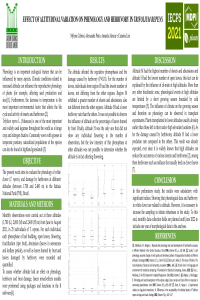
Phenology is an important ecological feature that can be influenced by many abiotic aspects. For example, the decrease in temperature along an altitudinal gradient display a fundamental role in the phenophases it affects the life cycle and activity of insects and herbivores, therefore, mountainous regions are great sites to perform studies to help the understanding of the reproductive cycle of plants. In this work, the phenological cycle and leaf damage rate caused by herbivores in Trifolium repens L. were observed, among three different altitudes (1.700, 2.000 and 2.400 m) in the Itatiaia National Park, from June to August of 2021 and statistical analysis were performed using linear mixed effects models. Preliminary results show that altitude affected vegetative phenophases (number of open leaves, shoots and abscissions) and herbivory (P < 0.01). The highest altitude sampled stands out for having a less open and damaged leaves, and for being the only altitude without any flowering events. However, due to low intensity of this phenophase at other altitudes, it wasn’t possible to determine if altitude is in fact affecting flowering. Nevertheless, the influence of growing season climate on phenology is often observed in transplanting experiments, in which at lower altitudes plants typically develop earlier than those in their high altitude native sites. As for the damage caused by herbivores, it was expected that the highest altitude would present a lower damage rate than the others sites, since it is known that environmental conditions of higher altitudes (such as decreased temperature) can reduce the aptitude of various insects.
Keywords
Fabaceae
white clover and leaf damage
Manuscript
[paper_reviewed_CabriniMylena]sciforum-052669-done.pdf
Poster
Banner_IECPS2021_MylenaCabrini.pdf
Biostimulant Based on Algae Extract and Fulvic Acids Is Able to Improve Photosynthetic Performance and Mitigate the Effects of Salinity in Soybean
Silencing of FaPG1, a fruit specific polygalacturonase gene, increased strawberry fruit resistance to Botrytis cinerea