Event submissions
EventsMOL2NET'21, Conference on Molecular, Biomed., Comput. & Network Science and Engineering, 7th ed.
Published
 10.3390/mol2net-07-12113 (registering DOI)
 This submission belongs to the session 01. CHEMBIO.INFO-07: Cheminfo., Chemom., Comput. Chem. & Bioinfo. Congress München, GR-Cambridge, UK-Ch. Hill, USA, 2021. of the event MOL2NET'21, Conference on Molecular, Biomed., Comput. & Network Science and Engineering, 7th ed.
Published date
27 Dec, 2021
Academic Editor
'%3e%3cpath%20d='M12.6657%2010.9104C12.4185%2010.325%2012.0599%209.79327%2011.6097%209.34482C11.1609%208.89508%2010.6293%208.5365%2010.0442%208.28888C10.0389%208.28626%2010.0337%208.28495%2010.0285%208.28233C10.8446%207.69279%2011.3752%206.73249%2011.3752%205.64904C11.3752%203.8542%209.92103%202.39999%208.1262%202.39999C6.33136%202.39999%204.87715%203.8542%204.87715%205.64904C4.87715%206.73249%205.40774%207.69279%206.22393%208.28364C6.21869%208.28626%206.21345%208.28757%206.20821%208.29019C5.62129%208.5378%205.09463%208.89284%204.64265%209.34613C4.1929%209.79493%203.83432%2010.3266%203.58671%2010.9117C3.34345%2011.4845%203.21226%2012.0987%203.20023%2012.7209C3.19988%2012.7349%203.20233%2012.7488%203.20744%2012.7619C3.21255%2012.7749%203.22022%2012.7867%203.22998%2012.7968C3.23975%2012.8068%203.25142%2012.8147%203.26431%2012.8202C3.2772%2012.8256%203.29105%2012.8284%203.30504%2012.8284H4.09109C4.14874%2012.8284%204.19459%2012.7825%204.1959%2012.7262C4.2221%2011.7148%204.62823%2010.7676%205.34617%2010.0497C6.08899%209.30683%207.0755%208.89808%208.1262%208.89808C9.17689%208.89808%2010.1634%209.30683%2010.9062%2010.0497C11.6242%2010.7676%2012.0303%2011.7148%2012.0565%2012.7262C12.0578%2012.7838%2012.1037%2012.8284%2012.1613%2012.8284H12.9474C12.9613%2012.8284%2012.9752%2012.8256%2012.9881%2012.8202C13.001%2012.8147%2013.0126%2012.8068%2013.0224%2012.7968C13.0322%2012.7867%2013.0398%2012.7749%2013.0449%2012.7619C13.0501%2012.7488%2013.0525%2012.7349%2013.0522%2012.7209C13.0391%2012.0947%2012.9094%2011.4855%2012.6657%2010.9104ZM8.1262%207.9024C7.52486%207.9024%206.9589%207.6679%206.53312%207.24211C6.10733%206.81633%205.87283%206.25037%205.87283%205.64904C5.87283%205.0477%206.10733%204.48174%206.53312%204.05596C6.9589%203.63018%207.52486%203.39567%208.1262%203.39567C8.72753%203.39567%209.29349%203.63018%209.71927%204.05596C10.1451%204.48174%2010.3796%205.0477%2010.3796%205.64904C10.3796%206.25037%2010.1451%206.81633%209.71927%207.24211C9.29349%207.6679%208.72753%207.9024%208.1262%207.9024Z'%20fill='%235D1EE1'/%3e%3c/g%3e%3c/svg%3e) Humbert G. Díaz
Humbert G. DíazCitation
Israa Mohamad Alakhras Aljnadi, Bruno L. Victor, Alexandra Paulo, Computational Screening and Design of G-quadruplex Ligands Targeting c-MYC in Breast Cancer, in Proceedings of MOL2NET'21, Conference on Molecular, Biomed., Comput. & Network Science and Engineering, 7th ed., 25 January–30 December 2021, MDPI: Basel, Switzerland, doi: 10.3390/mol2net-07-12113
Share
Email
Facebook
Twitter
LinkedIn
Computational Screening and Design of G-quadruplex Ligands Targeting c-MYC in Breast Cancer
'%3e%3cpath%20d='M12.6647%2010.9104C12.4176%2010.325%2012.0589%209.7933%2011.6088%209.34485C11.16%208.89511%2010.6283%208.53653%2010.0432%208.28891C10.038%208.28629%2010.0327%208.28498%2010.0275%208.28236C10.8437%207.69282%2011.3743%206.73252%2011.3743%205.64907C11.3743%203.85423%209.92005%202.40002%208.12522%202.40002C6.33038%202.40002%204.87618%203.85423%204.87618%205.64907C4.87618%206.73252%205.40677%207.69282%206.22296%208.28367C6.21772%208.28629%206.21248%208.2876%206.20724%208.29022C5.62031%208.53783%205.09365%208.89287%204.64167%209.34616C4.19192%209.79496%203.83334%2010.3266%203.58573%2010.9117C3.34247%2011.4846%203.21128%2012.0987%203.19925%2012.721C3.1989%2012.735%203.20135%2012.7489%203.20646%2012.7619C3.21157%2012.7749%203.21924%2012.7868%203.22901%2012.7968C3.23877%2012.8068%203.25045%2012.8148%203.26334%2012.8202C3.27623%2012.8256%203.29007%2012.8284%203.30406%2012.8284H4.09012C4.14776%2012.8284%204.19362%2012.7825%204.19493%2012.7262C4.22113%2011.7148%204.62726%2010.7676%205.34519%2010.0497C6.08802%209.30686%207.07452%208.89811%208.12522%208.89811C9.17592%208.89811%2010.1624%209.30686%2010.9052%2010.0497C11.6232%2010.7676%2012.0293%2011.7148%2012.0555%2012.7262C12.0568%2012.7839%2012.1027%2012.8284%2012.1603%2012.8284H12.9464C12.9604%2012.8284%2012.9742%2012.8256%2012.9871%2012.8202C13%2012.8148%2013.0117%2012.8068%2013.0214%2012.7968C13.0312%2012.7868%2013.0389%2012.7749%2013.044%2012.7619C13.0491%2012.7489%2013.0515%2012.735%2013.0512%2012.721C13.0381%2012.0947%2012.9084%2011.4856%2012.6647%2010.9104ZM8.12522%207.90243C7.52388%207.90243%206.95792%207.66793%206.53214%207.24215C6.10636%206.81636%205.87185%206.2504%205.87185%205.64907C5.87185%205.04773%206.10636%204.48177%206.53214%204.05599C6.95792%203.63021%207.52388%203.3957%208.12522%203.3957C8.72655%203.3957%209.29252%203.63021%209.7183%204.05599C10.1441%204.48177%2010.3786%205.04773%2010.3786%205.64907C10.3786%206.2504%2010.1441%206.81636%209.7183%207.24215C9.29252%207.66793%208.72655%207.90243%208.12522%207.90243Z'%20fill='%235D1EE1'/%3e%3c/g%3e%3c/svg%3e)
Israa Mohamad Alakhras Aljnadi 1,2
Bruno L. Victor 2
Alexandra Paulo 1
1. Medicinal Organic Chemistry Group, Research Institute for Medicines (iMed.ULisboa), Faculty of Pharmacy, Universidade de Lisboa, Av. Prof. Gama Pinto, 1649-003 Lisboa, Portugal.
2. BioISI - Biosystems and Integrative Sciences Institute, Faculty of Sciences, Universidade de Lisboa, Campo Grande, C8 building, 1749-016 Lisboa, Portugal
Abstract
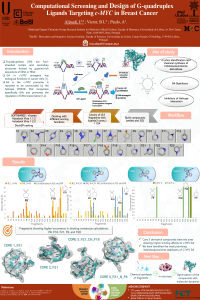
G-quadruplexes (G4) are four-stranded nucleic acid secondary structures formed by guanine-rich sequences of DNA or RNA. It has been shown that G4s are involved in relevant biological functions of normal mammalian cells, but more importantly, in cancer cells. Several studies reported that G4 is prevalent in telomeres and promotor regions of several oncogenes like c-MYC, which has a key role in several cellular regulatory processes, cancer development, and progression[1].
G4 formed in the promoter region of c-MYC may constitute an anticancer drug target by inhibiting the DNA transcription via the block of DNA polymerase and binding of transcription factors. Interestingly, G4 in the c-MYC promoter is reported to be unwounded by the helicase DHX36, a protein of the eukaryotic DEAH/RHA family that recognizes specifically G4s and promotes the regulation of DNA transcription[1,2]. Therefore, we will take advantage of the identified biological relevance of G4, together with the recent published crystallographic structure of DHX36 helicase with the c-MYC G4, to develop an in silico approach to identify inhibitors of this DNAG4-helicase interaction, with the objective to promote an anti-proliferative activity and downregulation of this oncogene expression[2,3]. In this communication, we report a molecular docking workflow that considers different scoring functions coupled to a consensus analysis approach to identify the most promising indoloisoquinoline (IDQ) derivatives capable to bind to c-MYC G4. From an initial library of 1104 ligands, we were able to identify a small group of fragment substituents with a high prevalence in the compounds with higher binding affinities to the c-MYC G4. These results will guide the chemical synthesis of a small subset of IDQ derivatives, and consequent in vitro validation. The obtained results will then afterward be used in subsequent in silico structure/activity studies to assure the optimization of the most promising c-MYC G4-helicase interaction inhibitors.
Keywords
G4
G-quadruplex
c-MYC
breast cancer
helicase
indoloisoquinoline.
Manuscript
ABSTRACT EJIBCE_20_December_2021 _ Israa_aljnadi.pdf
Poster
EJIBCE-POSTER Israa Alakharas ALjnadi 16.12.2021.pdf
Design of Indoloisoquinoline derivatives as potential inhibitors of the interaction between c-MYC:G4 and helicase
A novel US-CpHMD protocol to study the protonation-dependent mechanism of the ATP/ADP carrier.