Event submissions
EventsMOL2NET'21, Conference on Molecular, Biomed., Comput. & Network Science and Engineering, 7th ed.
Published
 10.3390/mol2net-07-12136 (registering DOI)
 This submission belongs to the session 01. USE.DAT-07: USA-Europe Data Analysis Trends Congress, Cambridge, UK-Bilbao, Basque Country-Miami, USA, 2021 of the event MOL2NET'21, Conference on Molecular, Biomed., Comput. & Network Science and Engineering, 7th ed.
Published date
10 Jan, 2022
Academic Editor
'%3e%3cpath%20d='M12.6657%2010.9104C12.4185%2010.325%2012.0599%209.79327%2011.6097%209.34482C11.1609%208.89508%2010.6293%208.5365%2010.0442%208.28888C10.0389%208.28626%2010.0337%208.28495%2010.0285%208.28233C10.8446%207.69279%2011.3752%206.73249%2011.3752%205.64904C11.3752%203.8542%209.92103%202.39999%208.1262%202.39999C6.33136%202.39999%204.87715%203.8542%204.87715%205.64904C4.87715%206.73249%205.40774%207.69279%206.22393%208.28364C6.21869%208.28626%206.21345%208.28757%206.20821%208.29019C5.62129%208.5378%205.09463%208.89284%204.64265%209.34613C4.1929%209.79493%203.83432%2010.3266%203.58671%2010.9117C3.34345%2011.4845%203.21226%2012.0987%203.20023%2012.7209C3.19988%2012.7349%203.20233%2012.7488%203.20744%2012.7619C3.21255%2012.7749%203.22022%2012.7867%203.22998%2012.7968C3.23975%2012.8068%203.25142%2012.8147%203.26431%2012.8202C3.2772%2012.8256%203.29105%2012.8284%203.30504%2012.8284H4.09109C4.14874%2012.8284%204.19459%2012.7825%204.1959%2012.7262C4.2221%2011.7148%204.62823%2010.7676%205.34617%2010.0497C6.08899%209.30683%207.0755%208.89808%208.1262%208.89808C9.17689%208.89808%2010.1634%209.30683%2010.9062%2010.0497C11.6242%2010.7676%2012.0303%2011.7148%2012.0565%2012.7262C12.0578%2012.7838%2012.1037%2012.8284%2012.1613%2012.8284H12.9474C12.9613%2012.8284%2012.9752%2012.8256%2012.9881%2012.8202C13.001%2012.8147%2013.0126%2012.8068%2013.0224%2012.7968C13.0322%2012.7867%2013.0398%2012.7749%2013.0449%2012.7619C13.0501%2012.7488%2013.0525%2012.7349%2013.0522%2012.7209C13.0391%2012.0947%2012.9094%2011.4855%2012.6657%2010.9104ZM8.1262%207.9024C7.52486%207.9024%206.9589%207.6679%206.53312%207.24211C6.10733%206.81633%205.87283%206.25037%205.87283%205.64904C5.87283%205.0477%206.10733%204.48174%206.53312%204.05596C6.9589%203.63018%207.52486%203.39567%208.1262%203.39567C8.72753%203.39567%209.29349%203.63018%209.71927%204.05596C10.1451%204.48174%2010.3796%205.0477%2010.3796%205.64904C10.3796%206.25037%2010.1451%206.81633%209.71927%207.24211C9.29349%207.6679%208.72753%207.9024%208.1262%207.9024Z'%20fill='%235D1EE1'/%3e%3c/g%3e%3c/svg%3e) Humberto Díaz
Humberto DíazCitation
Rosario Isasi, NEURODAT'21 IBRO-PERC Lecture on Policy Making in Biotechnology, Medicine, and Neurosciences, in Proceedings of MOL2NET'21, Conference on Molecular, Biomed., Comput. & Network Science and Engineering, 7th ed., 25 January–30 December 2021, MDPI: Basel, Switzerland, doi: 10.3390/mol2net-07-12136
Share
Email
Facebook
Twitter
LinkedIn
NEURODAT'21 IBRO-PERC Lecture on Policy Making in Biotechnology, Medicine, and Neurosciences
'%3e%3cpath%20d='M12.6647%2010.9104C12.4176%2010.325%2012.0589%209.7933%2011.6088%209.34485C11.16%208.89511%2010.6283%208.53653%2010.0432%208.28891C10.038%208.28629%2010.0327%208.28498%2010.0275%208.28236C10.8437%207.69282%2011.3743%206.73252%2011.3743%205.64907C11.3743%203.85423%209.92005%202.40002%208.12522%202.40002C6.33038%202.40002%204.87618%203.85423%204.87618%205.64907C4.87618%206.73252%205.40677%207.69282%206.22296%208.28367C6.21772%208.28629%206.21248%208.2876%206.20724%208.29022C5.62031%208.53783%205.09365%208.89287%204.64167%209.34616C4.19192%209.79496%203.83334%2010.3266%203.58573%2010.9117C3.34247%2011.4846%203.21128%2012.0987%203.19925%2012.721C3.1989%2012.735%203.20135%2012.7489%203.20646%2012.7619C3.21157%2012.7749%203.21924%2012.7868%203.22901%2012.7968C3.23877%2012.8068%203.25045%2012.8148%203.26334%2012.8202C3.27623%2012.8256%203.29007%2012.8284%203.30406%2012.8284H4.09012C4.14776%2012.8284%204.19362%2012.7825%204.19493%2012.7262C4.22113%2011.7148%204.62726%2010.7676%205.34519%2010.0497C6.08802%209.30686%207.07452%208.89811%208.12522%208.89811C9.17592%208.89811%2010.1624%209.30686%2010.9052%2010.0497C11.6232%2010.7676%2012.0293%2011.7148%2012.0555%2012.7262C12.0568%2012.7839%2012.1027%2012.8284%2012.1603%2012.8284H12.9464C12.9604%2012.8284%2012.9742%2012.8256%2012.9871%2012.8202C13%2012.8148%2013.0117%2012.8068%2013.0214%2012.7968C13.0312%2012.7868%2013.0389%2012.7749%2013.044%2012.7619C13.0491%2012.7489%2013.0515%2012.735%2013.0512%2012.721C13.0381%2012.0947%2012.9084%2011.4856%2012.6647%2010.9104ZM8.12522%207.90243C7.52388%207.90243%206.95792%207.66793%206.53214%207.24215C6.10636%206.81636%205.87185%206.2504%205.87185%205.64907C5.87185%205.04773%206.10636%204.48177%206.53214%204.05599C6.95792%203.63021%207.52388%203.3957%208.12522%203.3957C8.72655%203.3957%209.29252%203.63021%209.7183%204.05599C10.1441%204.48177%2010.3786%205.04773%2010.3786%205.64907C10.3786%206.2504%2010.1441%206.81636%209.7183%207.24215C9.29252%207.66793%208.72655%207.90243%208.12522%207.90243Z'%20fill='%235D1EE1'/%3e%3c/g%3e%3c/svg%3e)
Rosario Isasi 1
1. Dr J T Macdonald Foundation Department of Human Genetics, Institute of Bioethics & Health Policy, University of Miami Miller School of Medicine, Miami, FL 33136, USA.
Abstract
Description. Welcome to Prof. Rosario Isasi, J.D., M.P.H., invited lecturer tutoring channel on policy making on stem cells and genetic technologies. The talk is part of the NEURODAT’21 training program funded by IBRO-PERC Soft Skills Training call of the International Brain Research Organization (IBRO) and the Pan-Europe Regional Committee (PERC). NEURODAT’21 is devoted to promote soft skills on entry level medicine and also STEMS area students interested on neurosciences. This invited lecturer can made an introduction to the basic concepts related to bioethics, social, policy making, and regulatory affairs related to disruptive biotechnology, molecular biology, synthetic biology, and genetic technologies with emphasis in stem cells, gene editing, etc . Prof. Isasi, is a Research Associate Professor of Human Genetics at the Dr. John T. Macdonald Foundation Department of Human Genetics at the University of Miami Miller School ofMedicine (MSOM). She holds multiple appointments including, as Adjunct Professor of Law at UM School of Law and as member of the John P. Hussman Institute for Human Genomics and the Interdisciplinary Stem Cell Institute at the MSOM. Prof. Isasi’s research is devoted to identifying and analyzing the social, ethical and policy dimensions of novel and disruptive genetic technologies, such as gene editing and synthetic biology. She has built an international reputation as a scholar with particular expertise in the area of international comparative law and ethics regarding genomics and regenerative medicine. She holds many leadership roles in major international initiatives. From 2017-2020, Prof. Isasi was appointed as the President’s International Fellow of the Chinese Academy of Sciences (CAS)and is currently an Adjunct Professor at the CAS’ Institute of Zoology. She is a co-Principal Investigator and Ethics/Regulatory lead for the South East Enrollment Center a consortium member of NIH’s All of Us Research Program. At the All of Us she is the co-Chair of their Committee on Access, Privacy and Policy and Security (CAPS). In addition, she serves as the Ethics/Policy Advisor of the European Commission’s European Human Pluripotent Stem Cell Registry (hPSCREG), as a member of the Advisory Board of the ASHG’s Human Genetics Scholars Initiative, the Diversity, Equity, & Inclusion Task Force and the Professional Practice & Social Implications Committee as well as of the Ethics & Policy Committee and Guidelines Task Force of the International Society for Stem Cell Research (ISSCR).
Description of channel. This channel is part of the NEURODAT’21 training program funded by IBRO-PERC Soft Skills Training call of the International Brain Research Organization (IBRO) and the Pan-Europe Regional Committee (PERC). NEURODAT’21 is a training program devoted to promote soft skills on entry level Medicine and also STEMS area students interested on Neurosciences. In this tutoring channels students will be allowed to do online public questions and comments about different topics of Deep Learning and its applications in Neurosciences. Prof. Isasi will answer all questions within his area of expertise. This professor may interact with you in Romanian, English, or Spanish.
Talk & Channel Topics. The emphasis is on ioethics, social, policy making, and regulatory affairs related to disruptive biotechnology, molecular biology, synthetic biology, and genetic technologies with emphasis in stem cells, gene editing, etc ., in Neurosciences.
Instructions for students. The steps for participation are: (1) Wait for channel starting in 2021-Dec-25, you will see a posting comments option/button, (2) Register/login with your email and password to validate your user, (3) Post your question/comment for the Prof. of the channel, (4) Wait for the email advising that professor has answered your question, (5) Make other questions related to this topic or other topics, (6) Request your attendance certificate to mol2net.chair@gmail.com or directly to the email of the professor.
General notes. (1) Students are allowed to made multiple questions following the same discussion threat or open new questions. (2) Some professors may release different materials, slides, etc., that the student can use to study and/or follow the discussion, click the button bellow to see the pdf files. (3) Language note: some professors allow students to select their favorite language of interaction according to professor communications skills, accordingly materials, questions, and answers may appear in these languages. (4) The channel will be open until conference finish the post-publication stage, contact chairpersons for doubts: mol2net.chair@gmail.com
Keywords
regulatory affairs
bioethics
policy making
gene edition
stem cells
synthetic biology
Manuscript
USEDAT Biosketch_May_2021_R_Isasi.pdf
Poster
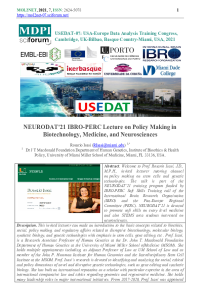
USEDAT Biosketch_May_2021_R_Isasi.pdf
Estimation of real-infection and immunity against SARS-CoV-2 in Indian populations
Bridging the gap between lactoferrin and V-ATPase through a multi-stage computational approach