Event submissions
Events1st International Online Conference on Agriculture - Advances in Agricultural Science and Technology
Published

This submission belongs to the session 5. Agricultural Soils of the event 1st International Online Conference on Agriculture - Advances in Agricultural Science and Technology
Published date
10 Feb, 2022
Academic Editor
'%3e%3cpath%20d='M12.6657%2010.9104C12.4185%2010.325%2012.0599%209.79327%2011.6097%209.34482C11.1609%208.89508%2010.6293%208.5365%2010.0442%208.28888C10.0389%208.28626%2010.0337%208.28495%2010.0285%208.28233C10.8446%207.69279%2011.3752%206.73249%2011.3752%205.64904C11.3752%203.8542%209.92103%202.39999%208.1262%202.39999C6.33136%202.39999%204.87715%203.8542%204.87715%205.64904C4.87715%206.73249%205.40774%207.69279%206.22393%208.28364C6.21869%208.28626%206.21345%208.28757%206.20821%208.29019C5.62129%208.5378%205.09463%208.89284%204.64265%209.34613C4.1929%209.79493%203.83432%2010.3266%203.58671%2010.9117C3.34345%2011.4845%203.21226%2012.0987%203.20023%2012.7209C3.19988%2012.7349%203.20233%2012.7488%203.20744%2012.7619C3.21255%2012.7749%203.22022%2012.7867%203.22998%2012.7968C3.23975%2012.8068%203.25142%2012.8147%203.26431%2012.8202C3.2772%2012.8256%203.29105%2012.8284%203.30504%2012.8284H4.09109C4.14874%2012.8284%204.19459%2012.7825%204.1959%2012.7262C4.2221%2011.7148%204.62823%2010.7676%205.34617%2010.0497C6.08899%209.30683%207.0755%208.89808%208.1262%208.89808C9.17689%208.89808%2010.1634%209.30683%2010.9062%2010.0497C11.6242%2010.7676%2012.0303%2011.7148%2012.0565%2012.7262C12.0578%2012.7838%2012.1037%2012.8284%2012.1613%2012.8284H12.9474C12.9613%2012.8284%2012.9752%2012.8256%2012.9881%2012.8202C13.001%2012.8147%2013.0126%2012.8068%2013.0224%2012.7968C13.0322%2012.7867%2013.0398%2012.7749%2013.0449%2012.7619C13.0501%2012.7488%2013.0525%2012.7349%2013.0522%2012.7209C13.0391%2012.0947%2012.9094%2011.4855%2012.6657%2010.9104ZM8.1262%207.9024C7.52486%207.9024%206.9589%207.6679%206.53312%207.24211C6.10733%206.81633%205.87283%206.25037%205.87283%205.64904C5.87283%205.0477%206.10733%204.48174%206.53312%204.05596C6.9589%203.63018%207.52486%203.39567%208.1262%203.39567C8.72753%203.39567%209.29349%203.63018%209.71927%204.05596C10.1451%204.48174%2010.3796%205.0477%2010.3796%205.64904C10.3796%206.25037%2010.1451%206.81633%209.71927%207.24211C9.29349%207.6679%208.72753%207.9024%208.1262%207.9024Z'%20fill='%235D1EE1'/%3e%3c/g%3e%3c/svg%3e) Raimundo Jimenez-Ballesta
Raimundo Jimenez-BallestaCitation
Yi Sze Koh, See Kiat Wong, Acharaporn Duangjai, Surasak Saokaew, Pochamana Phisalprapa, Khang Wei Tan, Bey Hing Goh, Siah Ying Tang, Unravelling Synergistic Effects of Palm Bunch Ash and Glutathione on Plant Growth, in Proceedings of 1st International Online Conference on Agriculture - Advances in Agricultural Science and Technology, 10 February–25 February 2022, MDPI: Basel, Switzerland, doi: 10.3390/IOCAG2022-12192
Share
Email
Facebook
Twitter
LinkedIn
Unravelling Synergistic Effects of Palm Bunch Ash and Glutathione on Plant Growth
'%3e%3cpath%20d='M12.6647%2010.9104C12.4176%2010.325%2012.0589%209.7933%2011.6088%209.34485C11.16%208.89511%2010.6283%208.53653%2010.0432%208.28891C10.038%208.28629%2010.0327%208.28498%2010.0275%208.28236C10.8437%207.69282%2011.3743%206.73252%2011.3743%205.64907C11.3743%203.85423%209.92005%202.40002%208.12522%202.40002C6.33038%202.40002%204.87618%203.85423%204.87618%205.64907C4.87618%206.73252%205.40677%207.69282%206.22296%208.28367C6.21772%208.28629%206.21248%208.2876%206.20724%208.29022C5.62031%208.53783%205.09365%208.89287%204.64167%209.34616C4.19192%209.79496%203.83334%2010.3266%203.58573%2010.9117C3.34247%2011.4846%203.21128%2012.0987%203.19925%2012.721C3.1989%2012.735%203.20135%2012.7489%203.20646%2012.7619C3.21157%2012.7749%203.21924%2012.7868%203.22901%2012.7968C3.23877%2012.8068%203.25045%2012.8148%203.26334%2012.8202C3.27623%2012.8256%203.29007%2012.8284%203.30406%2012.8284H4.09012C4.14776%2012.8284%204.19362%2012.7825%204.19493%2012.7262C4.22113%2011.7148%204.62726%2010.7676%205.34519%2010.0497C6.08802%209.30686%207.07452%208.89811%208.12522%208.89811C9.17592%208.89811%2010.1624%209.30686%2010.9052%2010.0497C11.6232%2010.7676%2012.0293%2011.7148%2012.0555%2012.7262C12.0568%2012.7839%2012.1027%2012.8284%2012.1603%2012.8284H12.9464C12.9604%2012.8284%2012.9742%2012.8256%2012.9871%2012.8202C13%2012.8148%2013.0117%2012.8068%2013.0214%2012.7968C13.0312%2012.7868%2013.0389%2012.7749%2013.044%2012.7619C13.0491%2012.7489%2013.0515%2012.735%2013.0512%2012.721C13.0381%2012.0947%2012.9084%2011.4856%2012.6647%2010.9104ZM8.12522%207.90243C7.52388%207.90243%206.95792%207.66793%206.53214%207.24215C6.10636%206.81636%205.87185%206.2504%205.87185%205.64907C5.87185%205.04773%206.10636%204.48177%206.53214%204.05599C6.95792%203.63021%207.52388%203.3957%208.12522%203.3957C8.72655%203.3957%209.29252%203.63021%209.7183%204.05599C10.1441%204.48177%2010.3786%205.04773%2010.3786%205.64907C10.3786%206.2504%2010.1441%206.81636%209.7183%207.24215C9.29252%207.66793%208.72655%207.90243%208.12522%207.90243Z'%20fill='%235D1EE1'/%3e%3c/g%3e%3c/svg%3e)
Yi Sze Koh 1
See Kiat Wong 1
Acharaporn Duangjai 2

Surasak Saokaew 2,3,4,5,6
Pochamana Phisalprapa 7
Khang Wei Tan 8

Bey Hing Goh 9,10

Siah Ying Tang 1,11
1. Chemical Engineering Discipline, School of Engineering, Monash University Malaysia
2. Unit of Excellence in Research and Product Development of Coffee, Division of Physiology, School of Medical Sciences, University of Phayao, Thailand
3. School of Pharmaceutical Sciences, Center of Health Outcomes Research and Therapeutic Safety (Cohorts), University of Phayao, Thailand
4. Unit of Excellence on Clinical Outcomes Research and IntegratioN (UNICORN), School of Pharmaceutical Sciences, University of Phayao, Thailand
5. Unit of Excellence on Herbal Medicine, School of Pharmaceutical Sciences, University of Phayao, Thailand
6. Division of Pharmacy Practice, Department of Pharmaceutical Care, School of Pharmaceutical Sciences, University of Phayao, Thailand
7. Division of Ambulatory Medicine, Department of Medicine, Faculty of Medicine Siriraj Hospital, Mahidol University, Thailand
8. School of Energy and Chemical Engineering, Xiamen University Malaysia
9. Biofunctional Molecule Exploratory Research Group, School of Pharmacy, Monash University Malaysia
10. College of Pharmaceutical Sciences, Zhejiang University, China
11. Tropical Medicine and Biology Platform, School of Science, Monash University Malaysia
Abstract
Palm bunch ash (PBA), a waste biomass from the palm oil industry, has been widely regarded as an alternative source of fertilizer to improve soil health, plant growth and yield. Glutathione (GSH), a bioactive tripeptide with potent antioxidant properties, has been proposed as a plant growth regulator that improves stress tolerance in plants. However, the use of PBA in combination with GSH has yet to be explored and remains as new gap in the literature. Herein, we aimed to assess the individual and the combinatory effects of PBA and GSH on vegetative plant growth, whereby okra was selected as the model plant and cultivated under well-watered, outdoor conditions. Plant growth parameters such as plant height, stem girth, number of leaves and leaf surface area were measured over a period of two months. The results showed that the application of PBA and GSH significantly influenced the plant growth parameters. The GSH-treated group recorded the tallest plant height (47.19 cm) as compared to the control group, PBA-treated group, and combination group of PBA and GSH. The combination group of PBA and GSH recorded the best parameters in terms of stem girth (4.45 mm), number of leaves (6.35), leaf surface area (118.38 cm2) with improved resistance towards diseases. These results implied that the combined application of PBA and GSH may have led to a synergistic effect on okra plant growth. Our findings suggest that the combined application of PBA and GSH is indeed recommended to improve plant growth and development.
Keywords
Palm bunch ash
glutathione
fertilizer
plant growth regulator.
Manuscript
IOCAG 2022 Chemistry proceeding final_YSK.pdf
Poster
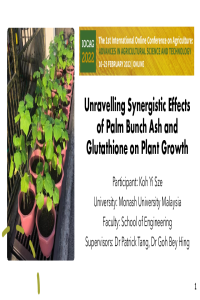
IOCAG 2022 presentation.pdf
Carbon sequestration and footprints in conventional and conservation agriculture under maize-wheat sequence in coarse-textured soils of subtropical climate
Biochar addition to the loam soil of soybean fields can reduce trifluralin usage in velvetleaf control