Event submissions
Events1st International Online Conference on Agriculture - Advances in Agricultural Science and Technology
Published
 10.3390/IOCAG2022-12203 (registering DOI)
 This submission belongs to the session 14. Poster Session of the event 1st International Online Conference on Agriculture - Advances in Agricultural Science and Technology
Published date
10 Feb, 2022
Academic Editor
'%3e%3cpath%20d='M12.6657%2010.9104C12.4185%2010.325%2012.0599%209.79327%2011.6097%209.34482C11.1609%208.89508%2010.6293%208.5365%2010.0442%208.28888C10.0389%208.28626%2010.0337%208.28495%2010.0285%208.28233C10.8446%207.69279%2011.3752%206.73249%2011.3752%205.64904C11.3752%203.8542%209.92103%202.39999%208.1262%202.39999C6.33136%202.39999%204.87715%203.8542%204.87715%205.64904C4.87715%206.73249%205.40774%207.69279%206.22393%208.28364C6.21869%208.28626%206.21345%208.28757%206.20821%208.29019C5.62129%208.5378%205.09463%208.89284%204.64265%209.34613C4.1929%209.79493%203.83432%2010.3266%203.58671%2010.9117C3.34345%2011.4845%203.21226%2012.0987%203.20023%2012.7209C3.19988%2012.7349%203.20233%2012.7488%203.20744%2012.7619C3.21255%2012.7749%203.22022%2012.7867%203.22998%2012.7968C3.23975%2012.8068%203.25142%2012.8147%203.26431%2012.8202C3.2772%2012.8256%203.29105%2012.8284%203.30504%2012.8284H4.09109C4.14874%2012.8284%204.19459%2012.7825%204.1959%2012.7262C4.2221%2011.7148%204.62823%2010.7676%205.34617%2010.0497C6.08899%209.30683%207.0755%208.89808%208.1262%208.89808C9.17689%208.89808%2010.1634%209.30683%2010.9062%2010.0497C11.6242%2010.7676%2012.0303%2011.7148%2012.0565%2012.7262C12.0578%2012.7838%2012.1037%2012.8284%2012.1613%2012.8284H12.9474C12.9613%2012.8284%2012.9752%2012.8256%2012.9881%2012.8202C13.001%2012.8147%2013.0126%2012.8068%2013.0224%2012.7968C13.0322%2012.7867%2013.0398%2012.7749%2013.0449%2012.7619C13.0501%2012.7488%2013.0525%2012.7349%2013.0522%2012.7209C13.0391%2012.0947%2012.9094%2011.4855%2012.6657%2010.9104ZM8.1262%207.9024C7.52486%207.9024%206.9589%207.6679%206.53312%207.24211C6.10733%206.81633%205.87283%206.25037%205.87283%205.64904C5.87283%205.0477%206.10733%204.48174%206.53312%204.05596C6.9589%203.63018%207.52486%203.39567%208.1262%203.39567C8.72753%203.39567%209.29349%203.63018%209.71927%204.05596C10.1451%204.48174%2010.3796%205.0477%2010.3796%205.64904C10.3796%206.25037%2010.1451%206.81633%209.71927%207.24211C9.29349%207.6679%208.72753%207.9024%208.1262%207.9024Z'%20fill='%235D1EE1'/%3e%3c/g%3e%3c/svg%3e) Isabel Lara
Isabel LaraCitation
Kristina Lekavičienė, Vilma Naujokienė, Egidijus Šarauskis, Zita Kriaučiūnienė, Eglė Jotautienė, Algirdas Jasinskas, Raimonda Zinkevičienė, Research on the efficiency of manure and granular manure fertilizers in terms of costs and environmental pollution, in Proceedings of 1st International Online Conference on Agriculture - Advances in Agricultural Science and Technology, 10 February–25 February 2022, MDPI: Basel, Switzerland, doi: 10.3390/IOCAG2022-12203
Share
Email
Facebook
Twitter
LinkedIn
Research on the efficiency of manure and granular manure fertilizers in terms of costs and environmental pollution

Kristina Lekavičienė 1

Vilma Naujokienė 1
'%3e%3cpath%20d='M12.6647%2010.9104C12.4176%2010.325%2012.0589%209.7933%2011.6088%209.34485C11.16%208.89511%2010.6283%208.53653%2010.0432%208.28891C10.038%208.28629%2010.0327%208.28498%2010.0275%208.28236C10.8437%207.69282%2011.3743%206.73252%2011.3743%205.64907C11.3743%203.85423%209.92005%202.40002%208.12522%202.40002C6.33038%202.40002%204.87618%203.85423%204.87618%205.64907C4.87618%206.73252%205.40677%207.69282%206.22296%208.28367C6.21772%208.28629%206.21248%208.2876%206.20724%208.29022C5.62031%208.53783%205.09365%208.89287%204.64167%209.34616C4.19192%209.79496%203.83334%2010.3266%203.58573%2010.9117C3.34247%2011.4846%203.21128%2012.0987%203.19925%2012.721C3.1989%2012.735%203.20135%2012.7489%203.20646%2012.7619C3.21157%2012.7749%203.21924%2012.7868%203.22901%2012.7968C3.23877%2012.8068%203.25045%2012.8148%203.26334%2012.8202C3.27623%2012.8256%203.29007%2012.8284%203.30406%2012.8284H4.09012C4.14776%2012.8284%204.19362%2012.7825%204.19493%2012.7262C4.22113%2011.7148%204.62726%2010.7676%205.34519%2010.0497C6.08802%209.30686%207.07452%208.89811%208.12522%208.89811C9.17592%208.89811%2010.1624%209.30686%2010.9052%2010.0497C11.6232%2010.7676%2012.0293%2011.7148%2012.0555%2012.7262C12.0568%2012.7839%2012.1027%2012.8284%2012.1603%2012.8284H12.9464C12.9604%2012.8284%2012.9742%2012.8256%2012.9871%2012.8202C13%2012.8148%2013.0117%2012.8068%2013.0214%2012.7968C13.0312%2012.7868%2013.0389%2012.7749%2013.044%2012.7619C13.0491%2012.7489%2013.0515%2012.735%2013.0512%2012.721C13.0381%2012.0947%2012.9084%2011.4856%2012.6647%2010.9104ZM8.12522%207.90243C7.52388%207.90243%206.95792%207.66793%206.53214%207.24215C6.10636%206.81636%205.87185%206.2504%205.87185%205.64907C5.87185%205.04773%206.10636%204.48177%206.53214%204.05599C6.95792%203.63021%207.52388%203.3957%208.12522%203.3957C8.72655%203.3957%209.29252%203.63021%209.7183%204.05599C10.1441%204.48177%2010.3786%205.04773%2010.3786%205.64907C10.3786%206.2504%2010.1441%206.81636%209.7183%207.24215C9.29252%207.66793%208.72655%207.90243%208.12522%207.90243Z'%20fill='%235D1EE1'/%3e%3c/g%3e%3c/svg%3e)
Egidijus Šarauskis 1
Zita Kriaučiūnienė 1

Eglė Jotautienė 1

Algirdas Jasinskas 1
Raimonda Zinkevičienė 1
1. Vytautas Magnus University
Abstract
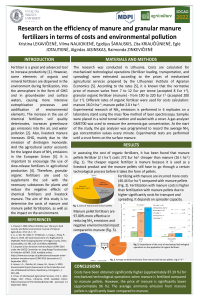
The increase in the use of chemical fertilizers soil quality deteriorates, increases greenhouse gas emissions into the air, and water pollution. Also, livestock manure increases GHG, mainly due to the emission of dinitrogen monoxide. And the agricultural sector accounts for the largest share of NH3 emissions in the European Union. Therefore, granular organic fertilizers are used to supplement the soil with the necessary substances for plants and reduce the negative effects of chemical fertilizers and livestock manure. The aim of this study is to determine the costs of manure and manure pellet fertilization, as well as the impact on the environment. The research was conducted in Lithuania. Costs are calculated for mechanized technological operations (fertilizer loading, transportation, and spreading). Different rates of organic fertilizer were used for costs calculation: manure 16.0 t ha−1, manure pellet 2.0 t ha−1. Experimental research of NH3 emissions is performed on a laboratory stand using the mass flow method of laser spectroscopy. Samples were placed in a wind tunnel section and sealed with a cover. A gas analyzer GME700 was used to measure the ammonia gas concentration. At the start of the study, the gas analyzer was programmed to record the average NH3 gas concentration values every minute. Experimental tests are performed until a crust forms on the surface manure. Costs have been obtained significantly higher (approximately 87.39 %) for mechanized technological operations when manure is fertilized compared to manure pellets. However, the price of manure is significantly lower (approximately 96 %). The average ammonia emission from manure pellets is significantly lower compared to manure.
Keywords
manure pellets
manure
ammonia emissions
fertilization
cost
Manuscript
sciforum-051102.pdf
Poster
sciforum-051102.pdf
Evaluating the Heterogeneous Impact of Adoption of Climate-Smart Agricultural Technologies on Rural Household Welfare in Mali
Sustainable nutrient-rich food production during covid-19 pandemic through year-round vegetable farming using hydroponic technique