Event submissions
Published

This submission belongs to the session J. Optical and Photonic Biosensors of the event The 2nd International Electronic Conference on Biosensors
Published date
14 Feb, 2022
Academic Editor
'%3e%3cpath%20d='M12.6657%2010.9104C12.4185%2010.325%2012.0599%209.79327%2011.6097%209.34482C11.1609%208.89508%2010.6293%208.5365%2010.0442%208.28888C10.0389%208.28626%2010.0337%208.28495%2010.0285%208.28233C10.8446%207.69279%2011.3752%206.73249%2011.3752%205.64904C11.3752%203.8542%209.92103%202.39999%208.1262%202.39999C6.33136%202.39999%204.87715%203.8542%204.87715%205.64904C4.87715%206.73249%205.40774%207.69279%206.22393%208.28364C6.21869%208.28626%206.21345%208.28757%206.20821%208.29019C5.62129%208.5378%205.09463%208.89284%204.64265%209.34613C4.1929%209.79493%203.83432%2010.3266%203.58671%2010.9117C3.34345%2011.4845%203.21226%2012.0987%203.20023%2012.7209C3.19988%2012.7349%203.20233%2012.7488%203.20744%2012.7619C3.21255%2012.7749%203.22022%2012.7867%203.22998%2012.7968C3.23975%2012.8068%203.25142%2012.8147%203.26431%2012.8202C3.2772%2012.8256%203.29105%2012.8284%203.30504%2012.8284H4.09109C4.14874%2012.8284%204.19459%2012.7825%204.1959%2012.7262C4.2221%2011.7148%204.62823%2010.7676%205.34617%2010.0497C6.08899%209.30683%207.0755%208.89808%208.1262%208.89808C9.17689%208.89808%2010.1634%209.30683%2010.9062%2010.0497C11.6242%2010.7676%2012.0303%2011.7148%2012.0565%2012.7262C12.0578%2012.7838%2012.1037%2012.8284%2012.1613%2012.8284H12.9474C12.9613%2012.8284%2012.9752%2012.8256%2012.9881%2012.8202C13.001%2012.8147%2013.0126%2012.8068%2013.0224%2012.7968C13.0322%2012.7867%2013.0398%2012.7749%2013.0449%2012.7619C13.0501%2012.7488%2013.0525%2012.7349%2013.0522%2012.7209C13.0391%2012.0947%2012.9094%2011.4855%2012.6657%2010.9104ZM8.1262%207.9024C7.52486%207.9024%206.9589%207.6679%206.53312%207.24211C6.10733%206.81633%205.87283%206.25037%205.87283%205.64904C5.87283%205.0477%206.10733%204.48174%206.53312%204.05596C6.9589%203.63018%207.52486%203.39567%208.1262%203.39567C8.72753%203.39567%209.29349%203.63018%209.71927%204.05596C10.1451%204.48174%2010.3796%205.0477%2010.3796%205.64904C10.3796%206.25037%2010.1451%206.81633%209.71927%207.24211C9.29349%207.6679%208.72753%207.9024%208.1262%207.9024Z'%20fill='%235D1EE1'/%3e%3c/g%3e%3c/svg%3e) Sara Tombelli
Sara TombelliCitation
Michailia Angelopoulou, Panagiota Petrou, Konstantinos Misiakos, Ioannis Raptis, Sotirios Kakabakos, Simultaneous detection of Salmonella typhimurium and Escherichia coli O157 :H7 in drinking water with Mach-Zehnder interferometers monolithically integrated on silicon chips, in Proceedings of The 2nd International Electronic Conference on Biosensors, 14 February–18 February 2022, MDPI: Basel, Switzerland, doi: 10.3390/IECB2022-12269
Share
Email
Facebook
Twitter
LinkedIn
Simultaneous detection of Salmonella typhimurium and Escherichia coli O157 :H7 in drinking water with Mach-Zehnder interferometers monolithically integrated on silicon chips
'%3e%3cpath%20d='M12.6647%2010.9104C12.4176%2010.325%2012.0589%209.7933%2011.6088%209.34485C11.16%208.89511%2010.6283%208.53653%2010.0432%208.28891C10.038%208.28629%2010.0327%208.28498%2010.0275%208.28236C10.8437%207.69282%2011.3743%206.73252%2011.3743%205.64907C11.3743%203.85423%209.92005%202.40002%208.12522%202.40002C6.33038%202.40002%204.87618%203.85423%204.87618%205.64907C4.87618%206.73252%205.40677%207.69282%206.22296%208.28367C6.21772%208.28629%206.21248%208.2876%206.20724%208.29022C5.62031%208.53783%205.09365%208.89287%204.64167%209.34616C4.19192%209.79496%203.83334%2010.3266%203.58573%2010.9117C3.34247%2011.4846%203.21128%2012.0987%203.19925%2012.721C3.1989%2012.735%203.20135%2012.7489%203.20646%2012.7619C3.21157%2012.7749%203.21924%2012.7868%203.22901%2012.7968C3.23877%2012.8068%203.25045%2012.8148%203.26334%2012.8202C3.27623%2012.8256%203.29007%2012.8284%203.30406%2012.8284H4.09012C4.14776%2012.8284%204.19362%2012.7825%204.19493%2012.7262C4.22113%2011.7148%204.62726%2010.7676%205.34519%2010.0497C6.08802%209.30686%207.07452%208.89811%208.12522%208.89811C9.17592%208.89811%2010.1624%209.30686%2010.9052%2010.0497C11.6232%2010.7676%2012.0293%2011.7148%2012.0555%2012.7262C12.0568%2012.7839%2012.1027%2012.8284%2012.1603%2012.8284H12.9464C12.9604%2012.8284%2012.9742%2012.8256%2012.9871%2012.8202C13%2012.8148%2013.0117%2012.8068%2013.0214%2012.7968C13.0312%2012.7868%2013.0389%2012.7749%2013.044%2012.7619C13.0491%2012.7489%2013.0515%2012.735%2013.0512%2012.721C13.0381%2012.0947%2012.9084%2011.4856%2012.6647%2010.9104ZM8.12522%207.90243C7.52388%207.90243%206.95792%207.66793%206.53214%207.24215C6.10636%206.81636%205.87185%206.2504%205.87185%205.64907C5.87185%205.04773%206.10636%204.48177%206.53214%204.05599C6.95792%203.63021%207.52388%203.3957%208.12522%203.3957C8.72655%203.3957%209.29252%203.63021%209.7183%204.05599C10.1441%204.48177%2010.3786%205.04773%2010.3786%205.64907C10.3786%206.2504%2010.1441%206.81636%209.7183%207.24215C9.29252%207.66793%208.72655%207.90243%208.12522%207.90243Z'%20fill='%235D1EE1'/%3e%3c/g%3e%3c/svg%3e)
Michailia Angelopoulou 1

Panagiota Petrou 1
Konstantinos Misiakos 2

Ioannis Raptis 2

Sotirios Kakabakos 1
1. Immunoassays-Immunosensors Lab, INRASTES, NCSR “Demokritos”, Athens, Greece
2. Optical sensors Lab, Institute of Nanoscience & Nanotechnology, NCSR “Demokritos”, Athens, Greece
Abstract
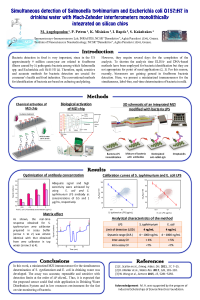
Bacteria detection in food is very important, since in the US approximately 9 million cases per year are related to foodborne illness caused by 31 pathogenic bacteria among which Salmonella spp. and Escherichia coli O157:H7. Therefore, rapid, sensitive and accurate detection methods for bacteria detection are crucial not only for consumer’s health but also for food industries. The conventional methods for identification of bacteria are based on culturing and plating and although reliable they require several days for the completion of the analysis. To shorten the analysis time ELISA- and DNA-based methods have been employed for bacteria identification but they are not appropriate for point of need applications. For this reason, recently, biosensors are gaining ground in foodborne bacteria detection. Here, we present a miniaturized immunosensor for the simultaneous, label-free, real-time determination of bacteria in milk. The transducer consists of an array of ten broad-band Mach-Zehnder interferometers (MZIs) integrated onto silicon chips along with the corresponding optical sources. For bacteria detection, the sensing areas of the MZIs were biofunctionalized with bacteria membrane antigens, prior to the assembly of the microfluidic module. For the assay, bacteria solutions were mixed with anti-bacteria-specific antibodies, pre-incubated for 30 min and run over the chip followed by running biotinylated anti-species specific antibody and streptavidin solutions. The transmission spectra of MZIs were continuously recorded by an external miniaturized spectrometer and subjected to Discrete Fourier Transform to convert spectral shifts to phase shifts. The assays were accurate and reproducible with detection limits of 5X10² CFU/mL for S. typhimurium and E. coli in milk samples. The analytical characteristics, combined with the short analysis time (~10 min) and the small chip size make the proposed biosensor ideal for on-site bacteria determination in food samples.
Acknowledgment: M. Angelopoulou was supported by the program of Industrial Scholarships of Stavros Niarchos Foundation.
Keywords
Mach-Zehnder interferometer
bacteria detection
optical immunosensor
milk
Manuscript
sciforum-055878 - done.pdf
Poster
055878-poster-M Angelopoulou IECB2022.pdf
Application of Optical and Acoustic Methods for Detection of Bacterial Pathogens Using DNA Aptamers as Receptors
Fast and accurate determination of minute Ochratoxin A levels in flours: towards the application at the field