Event submissions
Published
 10.3390/IECB2022-12277 (registering DOI)
 This submission belongs to the session G. Young Scientists Session of the event The 2nd International Electronic Conference on Biosensors
Published date
15 Feb, 2022
Academic Editor
'%3e%3cpath%20d='M12.6657%2010.9104C12.4185%2010.325%2012.0599%209.79327%2011.6097%209.34482C11.1609%208.89508%2010.6293%208.5365%2010.0442%208.28888C10.0389%208.28626%2010.0337%208.28495%2010.0285%208.28233C10.8446%207.69279%2011.3752%206.73249%2011.3752%205.64904C11.3752%203.8542%209.92103%202.39999%208.1262%202.39999C6.33136%202.39999%204.87715%203.8542%204.87715%205.64904C4.87715%206.73249%205.40774%207.69279%206.22393%208.28364C6.21869%208.28626%206.21345%208.28757%206.20821%208.29019C5.62129%208.5378%205.09463%208.89284%204.64265%209.34613C4.1929%209.79493%203.83432%2010.3266%203.58671%2010.9117C3.34345%2011.4845%203.21226%2012.0987%203.20023%2012.7209C3.19988%2012.7349%203.20233%2012.7488%203.20744%2012.7619C3.21255%2012.7749%203.22022%2012.7867%203.22998%2012.7968C3.23975%2012.8068%203.25142%2012.8147%203.26431%2012.8202C3.2772%2012.8256%203.29105%2012.8284%203.30504%2012.8284H4.09109C4.14874%2012.8284%204.19459%2012.7825%204.1959%2012.7262C4.2221%2011.7148%204.62823%2010.7676%205.34617%2010.0497C6.08899%209.30683%207.0755%208.89808%208.1262%208.89808C9.17689%208.89808%2010.1634%209.30683%2010.9062%2010.0497C11.6242%2010.7676%2012.0303%2011.7148%2012.0565%2012.7262C12.0578%2012.7838%2012.1037%2012.8284%2012.1613%2012.8284H12.9474C12.9613%2012.8284%2012.9752%2012.8256%2012.9881%2012.8202C13.001%2012.8147%2013.0126%2012.8068%2013.0224%2012.7968C13.0322%2012.7867%2013.0398%2012.7749%2013.0449%2012.7619C13.0501%2012.7488%2013.0525%2012.7349%2013.0522%2012.7209C13.0391%2012.0947%2012.9094%2011.4855%2012.6657%2010.9104ZM8.1262%207.9024C7.52486%207.9024%206.9589%207.6679%206.53312%207.24211C6.10733%206.81633%205.87283%206.25037%205.87283%205.64904C5.87283%205.0477%206.10733%204.48174%206.53312%204.05596C6.9589%203.63018%207.52486%203.39567%208.1262%203.39567C8.72753%203.39567%209.29349%203.63018%209.71927%204.05596C10.1451%204.48174%2010.3796%205.0477%2010.3796%205.64904C10.3796%206.25037%2010.1451%206.81633%209.71927%207.24211C9.29349%207.6679%208.72753%207.9024%208.1262%207.9024Z'%20fill='%235D1EE1'/%3e%3c/g%3e%3c/svg%3e) Sara Tombelli
Sara TombelliCitation
Gheorghe Melinte, Oana Hosu, Cecilia Cristea, Giovanna Marrazza, Development of an electrochemical platform for selective Ara h1 allergen detection, in Proceedings of The 2nd International Electronic Conference on Biosensors, 14 February–18 February 2022, MDPI: Basel, Switzerland, doi: 10.3390/IECB2022-12277
Share
Email
Facebook
Twitter
LinkedIn
Development of an electrochemical platform for selective Ara h1 allergen detection
'%3e%3cpath%20d='M12.6647%2010.9104C12.4176%2010.325%2012.0589%209.7933%2011.6088%209.34485C11.16%208.89511%2010.6283%208.53653%2010.0432%208.28891C10.038%208.28629%2010.0327%208.28498%2010.0275%208.28236C10.8437%207.69282%2011.3743%206.73252%2011.3743%205.64907C11.3743%203.85423%209.92005%202.40002%208.12522%202.40002C6.33038%202.40002%204.87618%203.85423%204.87618%205.64907C4.87618%206.73252%205.40677%207.69282%206.22296%208.28367C6.21772%208.28629%206.21248%208.2876%206.20724%208.29022C5.62031%208.53783%205.09365%208.89287%204.64167%209.34616C4.19192%209.79496%203.83334%2010.3266%203.58573%2010.9117C3.34247%2011.4846%203.21128%2012.0987%203.19925%2012.721C3.1989%2012.735%203.20135%2012.7489%203.20646%2012.7619C3.21157%2012.7749%203.21924%2012.7868%203.22901%2012.7968C3.23877%2012.8068%203.25045%2012.8148%203.26334%2012.8202C3.27623%2012.8256%203.29007%2012.8284%203.30406%2012.8284H4.09012C4.14776%2012.8284%204.19362%2012.7825%204.19493%2012.7262C4.22113%2011.7148%204.62726%2010.7676%205.34519%2010.0497C6.08802%209.30686%207.07452%208.89811%208.12522%208.89811C9.17592%208.89811%2010.1624%209.30686%2010.9052%2010.0497C11.6232%2010.7676%2012.0293%2011.7148%2012.0555%2012.7262C12.0568%2012.7839%2012.1027%2012.8284%2012.1603%2012.8284H12.9464C12.9604%2012.8284%2012.9742%2012.8256%2012.9871%2012.8202C13%2012.8148%2013.0117%2012.8068%2013.0214%2012.7968C13.0312%2012.7868%2013.0389%2012.7749%2013.044%2012.7619C13.0491%2012.7489%2013.0515%2012.735%2013.0512%2012.721C13.0381%2012.0947%2012.9084%2011.4856%2012.6647%2010.9104ZM8.12522%207.90243C7.52388%207.90243%206.95792%207.66793%206.53214%207.24215C6.10636%206.81636%205.87185%206.2504%205.87185%205.64907C5.87185%205.04773%206.10636%204.48177%206.53214%204.05599C6.95792%203.63021%207.52388%203.3957%208.12522%203.3957C8.72655%203.3957%209.29252%203.63021%209.7183%204.05599C10.1441%204.48177%2010.3786%205.04773%2010.3786%205.64907C10.3786%206.2504%2010.1441%206.81636%209.7183%207.24215C9.29252%207.66793%208.72655%207.90243%208.12522%207.90243Z'%20fill='%235D1EE1'/%3e%3c/g%3e%3c/svg%3e)
Gheorghe Melinte 1,2

Oana Hosu 1

Cecilia Cristea 3

Giovanna Marrazza 4
1. Department of Analytical Chemistry, Faculty of Pharmacy, "Iuliu Haţieganu" University of Medicine and Pharmacy, 4 Pasteur Street, 400349 Cluj-Napoca, Romania
2. Department of Chemistry ”Ugo Schiff”, University of Florence, Via della Lastruccia 3, 50019 Sesto Fiorentino (Fi), Italy
3. 1Department of Analytical Chemistry, Faculty of Pharmacy, "Iuliu Haţieganu" University of Medicine and Pharmacy, 4 Pasteur Street, 400349 Cluj-Napoca, Romania
4. Department of Chemistry “Ugo Schiff”, University of Florence, Via della Lastruccia 3, 50019 Sesto Fiorentino (FI), Italy
Abstract
Ara h1 is one of the major peanut allergens. It is considered one of the most severe, life-threatening food sensitivities since it triggers the highest frequency of severe and fatal reactions, even in trace amounts. Thus, it is extremely important to develop fast, accurate and easy-to-use analytical methods to determine Ara h1 allergen from food products that might contain traces of peanuts [1].
Electrochemical aptasensors have high specificity thanks to the affinity reaction between the DNA receptor and the analyte and have the ability to bind the target, even from complex matrices. The most critical steps in their development are represented by the immobilisation of the DNA strands and the signal generation [2].
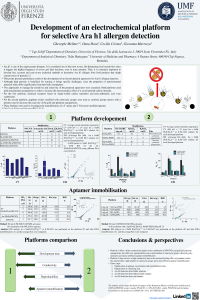
This poster presents the preliminary results in the development of an electrochemical aptasensor for Ara h1 allergen detection. Although high porosity is beneficial for sensing, it brings specific challenges, since the properties of nanostructured materials often differ significantly from their bulk counterparts. Therefore, two approaches to manage the sensitivity and selectivity of the proposed aptasensor were examined. Both platforms used gold and platinum nanoparticles in order to increase the electrocatalytic effect of a screen-printed carbon electrode. For the first platform, chemical receptors based on single-walled carbon nanotubes and poly-anthranilic acid were synthesized. As for the second platform, graphene oxides modified with carboxylic groups were used as carboxyl groups donors with a polymer used to decrease the reactivity of the gold and platinum nanoparticles. These findings were used to investigate the immobilization of a 5’ amino and 3’ Ferrocene modified aptamer. For investigation of the aptamer selectivity, the newly developed aptasensor was tested in the presence of Ara h1. The process was monitored by DPV and analyzed the redox activity of the label to establish in-situ information on the binding process.
Acknowledgments
The authors acknowledge the financial support of the Romanian Ministry of Education and Research, CNCS-UEFISCDI, project number PN-III-P1-1.1-PD-2019-0631, within PNCDI III and the Italian Government in the framework of PRIN 2017, Prot. 2017YER72K_005
Bibliography
- Tran, D.T. et al. Biosensors and Bioelectronics 2013, 43, 245–251,
- Piro, B. et al. Biosensors 2016, 6.
Keywords
Allergens
nanostructures
nanoparticles
aptasensor
peanuts
Manuscript
Poster IECB Gheorghe Melinte.pdf
Poster
Poster IECB Gheorghe Melinte.pdf
A precise electrochemical point-of-care testing device for early diagnosis of ovarian cancer
Acetone-sensitive thin films of poly(vinyl alcohol)-g-poly(methyl acrylate) – properties and perspectives in optical detection of acetone in exhaled human breath