Event submissions
Events1st International Online Conference on Agriculture - Advances in Agricultural Science and Technology
Published

This submission belongs to the session 14. Poster Session of the event 1st International Online Conference on Agriculture - Advances in Agricultural Science and Technology
Published date
16 Feb, 2022
Academic Editor
'%3e%3cpath%20d='M12.6657%2010.9104C12.4185%2010.325%2012.0599%209.79327%2011.6097%209.34482C11.1609%208.89508%2010.6293%208.5365%2010.0442%208.28888C10.0389%208.28626%2010.0337%208.28495%2010.0285%208.28233C10.8446%207.69279%2011.3752%206.73249%2011.3752%205.64904C11.3752%203.8542%209.92103%202.39999%208.1262%202.39999C6.33136%202.39999%204.87715%203.8542%204.87715%205.64904C4.87715%206.73249%205.40774%207.69279%206.22393%208.28364C6.21869%208.28626%206.21345%208.28757%206.20821%208.29019C5.62129%208.5378%205.09463%208.89284%204.64265%209.34613C4.1929%209.79493%203.83432%2010.3266%203.58671%2010.9117C3.34345%2011.4845%203.21226%2012.0987%203.20023%2012.7209C3.19988%2012.7349%203.20233%2012.7488%203.20744%2012.7619C3.21255%2012.7749%203.22022%2012.7867%203.22998%2012.7968C3.23975%2012.8068%203.25142%2012.8147%203.26431%2012.8202C3.2772%2012.8256%203.29105%2012.8284%203.30504%2012.8284H4.09109C4.14874%2012.8284%204.19459%2012.7825%204.1959%2012.7262C4.2221%2011.7148%204.62823%2010.7676%205.34617%2010.0497C6.08899%209.30683%207.0755%208.89808%208.1262%208.89808C9.17689%208.89808%2010.1634%209.30683%2010.9062%2010.0497C11.6242%2010.7676%2012.0303%2011.7148%2012.0565%2012.7262C12.0578%2012.7838%2012.1037%2012.8284%2012.1613%2012.8284H12.9474C12.9613%2012.8284%2012.9752%2012.8256%2012.9881%2012.8202C13.001%2012.8147%2013.0126%2012.8068%2013.0224%2012.7968C13.0322%2012.7867%2013.0398%2012.7749%2013.0449%2012.7619C13.0501%2012.7488%2013.0525%2012.7349%2013.0522%2012.7209C13.0391%2012.0947%2012.9094%2011.4855%2012.6657%2010.9104ZM8.1262%207.9024C7.52486%207.9024%206.9589%207.6679%206.53312%207.24211C6.10733%206.81633%205.87283%206.25037%205.87283%205.64904C5.87283%205.0477%206.10733%204.48174%206.53312%204.05596C6.9589%203.63018%207.52486%203.39567%208.1262%203.39567C8.72753%203.39567%209.29349%203.63018%209.71927%204.05596C10.1451%204.48174%2010.3796%205.0477%2010.3796%205.64904C10.3796%206.25037%2010.1451%206.81633%209.71927%207.24211C9.29349%207.6679%208.72753%207.9024%208.1262%207.9024Z'%20fill='%235D1EE1'/%3e%3c/g%3e%3c/svg%3e) Raimundo Jimenez-Ballesta
Raimundo Jimenez-BallestaCitation
Wacław Jarecki, Maria Czernicka, Yield and quality of winter wheat (Triticum aestivum L.) depending on multi-component foliar fertilization , in Proceedings of 1st International Online Conference on Agriculture - Advances in Agricultural Science and Technology, 10 February–25 February 2022, MDPI: Basel, Switzerland, doi: 10.3390/IOCAG2022-12292
Share
Email
Facebook
Twitter
LinkedIn
Yield and quality of winter wheat (Triticum aestivum L.) depending on multi-component foliar fertilization

Wacław Jarecki 1

Maria Czernicka 1
1. University of Rzeszow
Abstract
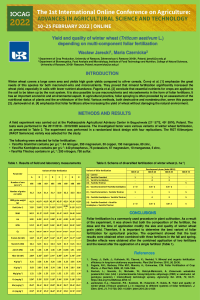
Winter wheat is a popular cultivated grain. In order to produce high and good quality yields, it requires proper fertilization. In a field experiment, the reactions of winter wheat, cv. RGT Kilimanjaro to multi-component foliar fertilization were assessed. The tested factor were foliar fertilizers used in various combinations: (A) - Control, (B) - YaraVita Gramitrel, (C) - YaraVita Kombiphos, (D) - YaraVita Thiotrac, (E) - YaraVita Gramitrel + YaraVita Kombiphos, (F) - YaraVita Gramitrel + YaraVita Thiotrac, (G) - YaraVita Kombiphos + YaraVita Thiotrac, (H) - YaraVita Gramitrel + YaraVita Kombiphos + YaraVita Thiotrac. The variable weather conditions in the years of the research had a modifying effect on the yields obtained. The best results were achieved by applying three times foliar fertilization (variant H). The increase in grain yield in relation to control (A) amounted to 0.62 t⸱ha-1. The innovation of the experiment is the possibility of limiting the doses of soil fertilizers in the cultivation of winter wheat without reducing the size and quality of the grain yield. This has an important ecological and economic aspect. The combinations of foliar fertilizers used contained quickly digestible micro- and macronutrients. Compared to the control, the content of protein and microelements in the grain increased and the fibers decreased. Plant field measurements showed that index SPAD (Soil Plant Analysis Development) and LAI (Leaf Area Index) readings increased after foliar fertilization, but the index MTA (Mean Tip Angle) was decreased compared to the control. In the case of the stomatal conductance of leaves (Gs), the applied fertilization in variant H resulted in a reduction of measurements in relation to the control.
Keywords
winter wheat
foliar fertilization
grain yield
protein
microelements
Manuscript
sciforum-055906_revised.pdf
Poster
Jarecki and Czernicka 2.pdf
A case study on minerals accumulation in grains and flours of bread wheat fertilized with ZnSO4 and Tecnifol Zinc
Characterization of a Triticum aestivum L. experimental field to implement an agronomic biofortification workflow