Event submissions
Events1st International Online Conference on Agriculture - Advances in Agricultural Science and Technology
Published
This submission belongs to the session 14. Poster Session of the event 1st International Online Conference on Agriculture - Advances in Agricultural Science and Technology
Published date
24 Feb, 2022
Academic Editor
'%3e%3cpath%20d='M12.6657%2010.9104C12.4185%2010.325%2012.0599%209.79327%2011.6097%209.34482C11.1609%208.89508%2010.6293%208.5365%2010.0442%208.28888C10.0389%208.28626%2010.0337%208.28495%2010.0285%208.28233C10.8446%207.69279%2011.3752%206.73249%2011.3752%205.64904C11.3752%203.8542%209.92103%202.39999%208.1262%202.39999C6.33136%202.39999%204.87715%203.8542%204.87715%205.64904C4.87715%206.73249%205.40774%207.69279%206.22393%208.28364C6.21869%208.28626%206.21345%208.28757%206.20821%208.29019C5.62129%208.5378%205.09463%208.89284%204.64265%209.34613C4.1929%209.79493%203.83432%2010.3266%203.58671%2010.9117C3.34345%2011.4845%203.21226%2012.0987%203.20023%2012.7209C3.19988%2012.7349%203.20233%2012.7488%203.20744%2012.7619C3.21255%2012.7749%203.22022%2012.7867%203.22998%2012.7968C3.23975%2012.8068%203.25142%2012.8147%203.26431%2012.8202C3.2772%2012.8256%203.29105%2012.8284%203.30504%2012.8284H4.09109C4.14874%2012.8284%204.19459%2012.7825%204.1959%2012.7262C4.2221%2011.7148%204.62823%2010.7676%205.34617%2010.0497C6.08899%209.30683%207.0755%208.89808%208.1262%208.89808C9.17689%208.89808%2010.1634%209.30683%2010.9062%2010.0497C11.6242%2010.7676%2012.0303%2011.7148%2012.0565%2012.7262C12.0578%2012.7838%2012.1037%2012.8284%2012.1613%2012.8284H12.9474C12.9613%2012.8284%2012.9752%2012.8256%2012.9881%2012.8202C13.001%2012.8147%2013.0126%2012.8068%2013.0224%2012.7968C13.0322%2012.7867%2013.0398%2012.7749%2013.0449%2012.7619C13.0501%2012.7488%2013.0525%2012.7349%2013.0522%2012.7209C13.0391%2012.0947%2012.9094%2011.4855%2012.6657%2010.9104ZM8.1262%207.9024C7.52486%207.9024%206.9589%207.6679%206.53312%207.24211C6.10733%206.81633%205.87283%206.25037%205.87283%205.64904C5.87283%205.0477%206.10733%204.48174%206.53312%204.05596C6.9589%203.63018%207.52486%203.39567%208.1262%203.39567C8.72753%203.39567%209.29349%203.63018%209.71927%204.05596C10.1451%204.48174%2010.3796%205.0477%2010.3796%205.64904C10.3796%206.25037%2010.1451%206.81633%209.71927%207.24211C9.29349%207.6679%208.72753%207.9024%208.1262%207.9024Z'%20fill='%235D1EE1'/%3e%3c/g%3e%3c/svg%3e) Bin Gao
Bin GaoCitation
Dainius Steponavičius, Kristina Lekavičienė, Albinas Andriušis, Ernestas Zaleckas, Remigijus Zinkevičius, Tadas Jomantas, Jonas Ignatavičius, The influence of drift reduction agents and wind speed on spray drift in the wind tunnel, in Proceedings of 1st International Online Conference on Agriculture - Advances in Agricultural Science and Technology, 10 February–25 February 2022, MDPI: Basel, Switzerland
Share
Email
Facebook
Twitter
LinkedIn
The influence of drift reduction agents and wind speed on spray drift in the wind tunnel

Dainius Steponavičius 1

Kristina Lekavičienė 1
'%3e%3cpath%20d='M12.6647%2010.9104C12.4176%2010.325%2012.0589%209.7933%2011.6088%209.34485C11.16%208.89511%2010.6283%208.53653%2010.0432%208.28891C10.038%208.28629%2010.0327%208.28498%2010.0275%208.28236C10.8437%207.69282%2011.3743%206.73252%2011.3743%205.64907C11.3743%203.85423%209.92005%202.40002%208.12522%202.40002C6.33038%202.40002%204.87618%203.85423%204.87618%205.64907C4.87618%206.73252%205.40677%207.69282%206.22296%208.28367C6.21772%208.28629%206.21248%208.2876%206.20724%208.29022C5.62031%208.53783%205.09365%208.89287%204.64167%209.34616C4.19192%209.79496%203.83334%2010.3266%203.58573%2010.9117C3.34247%2011.4846%203.21128%2012.0987%203.19925%2012.721C3.1989%2012.735%203.20135%2012.7489%203.20646%2012.7619C3.21157%2012.7749%203.21924%2012.7868%203.22901%2012.7968C3.23877%2012.8068%203.25045%2012.8148%203.26334%2012.8202C3.27623%2012.8256%203.29007%2012.8284%203.30406%2012.8284H4.09012C4.14776%2012.8284%204.19362%2012.7825%204.19493%2012.7262C4.22113%2011.7148%204.62726%2010.7676%205.34519%2010.0497C6.08802%209.30686%207.07452%208.89811%208.12522%208.89811C9.17592%208.89811%2010.1624%209.30686%2010.9052%2010.0497C11.6232%2010.7676%2012.0293%2011.7148%2012.0555%2012.7262C12.0568%2012.7839%2012.1027%2012.8284%2012.1603%2012.8284H12.9464C12.9604%2012.8284%2012.9742%2012.8256%2012.9871%2012.8202C13%2012.8148%2013.0117%2012.8068%2013.0214%2012.7968C13.0312%2012.7868%2013.0389%2012.7749%2013.044%2012.7619C13.0491%2012.7489%2013.0515%2012.735%2013.0512%2012.721C13.0381%2012.0947%2012.9084%2011.4856%2012.6647%2010.9104ZM8.12522%207.90243C7.52388%207.90243%206.95792%207.66793%206.53214%207.24215C6.10636%206.81636%205.87185%206.2504%205.87185%205.64907C5.87185%205.04773%206.10636%204.48177%206.53214%204.05599C6.95792%203.63021%207.52388%203.3957%208.12522%203.3957C8.72655%203.3957%209.29252%203.63021%209.7183%204.05599C10.1441%204.48177%2010.3786%205.04773%2010.3786%205.64907C10.3786%206.2504%2010.1441%206.81636%209.7183%207.24215C9.29252%207.66793%208.72655%207.90243%208.12522%207.90243Z'%20fill='%235D1EE1'/%3e%3c/g%3e%3c/svg%3e)
Albinas Andriušis 1
Ernestas Zaleckas 1
Remigijus Zinkevičius 1
Tadas Jomantas 1
Jonas Ignatavičius 2
1. Vytautas Magnus University
2. Company "Nando Labs"
Abstract
Due to wind-induced dispersion of the spray liquid higher costs are incurred, pollutes the environment and may cause adverse effects on human health. To reduce the negative influence, preparations with anti-drift properties are increasingly being investigated. Therefore, the aim of the study – to analyse the efficiency of the new developed drift reduction agents at different wind speeds.
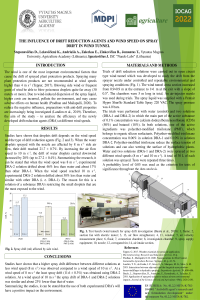
Trials of drift reduction solutions were carried out in open circuit type wind tunnel which was developed to study the drift from the sprayer nozzle under controlled and repeatable environmental and spraying conditions. Solutions were spread at two different wind speeds (8 m s-1 and 10 m s-1). The chambers were 5 m long in total. An air-injector nozzle was used during trials. The spray pressure was 4.0 bars.
The trials were performed with water (control) and two solutions (DRA-1 and DRA-2) in which the main part of the active substance of 0.1% concentration was calcium dodecylbenzenesulfonate CDS (50%) and butanol (18%). In both solutions, one of the active ingredients was polyether-modified trisiloxane PMT. Polyether-modified trisiloxane concentration was 0.06% in solution DRA-1 and 0.10% in solution DRA-2. A total of 30 L of each solution was sprayed. Tests were repeated three times.Summarizing the research, it can be stated that when the wind speed was 8 m s–1, experimental DRA-2 solution drifted about 46% less than water and about 17% than other DRA-1. When the wind speed reached 10 m s–1, experimental DRA-2 solution drifted about 30% less than water and similar with other DRA (DRA-1). The reason for this is a solution of a substance DRA’s restricting the small droplets that are the most exposed to the wind.
Keywords
droplets
anti-drift
agent
wind speed
spray
Manuscript
sciforum-050984.pdf
Poster
Poster MDPI_Lekaviciene.pdf
Evaluation of the environmental performance of stevia glycosides production using Precision Agriculture and green processing techniques
Zn nutrition of Vitis vinifera White Grapes: Characterization of Antagonistic and Synergistic Interactions by µEDXRF tissue analyses