Event submissions
Events1st International Online Conference on Agriculture - Advances in Agricultural Science and Technology
Published

This submission belongs to the session 11. Agricultural Systems and Management of the event 1st International Online Conference on Agriculture - Advances in Agricultural Science and Technology
Published date
14 Mar, 2022
Academic Editor
'%3e%3cpath%20d='M12.6657%2010.9104C12.4185%2010.325%2012.0599%209.79327%2011.6097%209.34482C11.1609%208.89508%2010.6293%208.5365%2010.0442%208.28888C10.0389%208.28626%2010.0337%208.28495%2010.0285%208.28233C10.8446%207.69279%2011.3752%206.73249%2011.3752%205.64904C11.3752%203.8542%209.92103%202.39999%208.1262%202.39999C6.33136%202.39999%204.87715%203.8542%204.87715%205.64904C4.87715%206.73249%205.40774%207.69279%206.22393%208.28364C6.21869%208.28626%206.21345%208.28757%206.20821%208.29019C5.62129%208.5378%205.09463%208.89284%204.64265%209.34613C4.1929%209.79493%203.83432%2010.3266%203.58671%2010.9117C3.34345%2011.4845%203.21226%2012.0987%203.20023%2012.7209C3.19988%2012.7349%203.20233%2012.7488%203.20744%2012.7619C3.21255%2012.7749%203.22022%2012.7867%203.22998%2012.7968C3.23975%2012.8068%203.25142%2012.8147%203.26431%2012.8202C3.2772%2012.8256%203.29105%2012.8284%203.30504%2012.8284H4.09109C4.14874%2012.8284%204.19459%2012.7825%204.1959%2012.7262C4.2221%2011.7148%204.62823%2010.7676%205.34617%2010.0497C6.08899%209.30683%207.0755%208.89808%208.1262%208.89808C9.17689%208.89808%2010.1634%209.30683%2010.9062%2010.0497C11.6242%2010.7676%2012.0303%2011.7148%2012.0565%2012.7262C12.0578%2012.7838%2012.1037%2012.8284%2012.1613%2012.8284H12.9474C12.9613%2012.8284%2012.9752%2012.8256%2012.9881%2012.8202C13.001%2012.8147%2013.0126%2012.8068%2013.0224%2012.7968C13.0322%2012.7867%2013.0398%2012.7749%2013.0449%2012.7619C13.0501%2012.7488%2013.0525%2012.7349%2013.0522%2012.7209C13.0391%2012.0947%2012.9094%2011.4855%2012.6657%2010.9104ZM8.1262%207.9024C7.52486%207.9024%206.9589%207.6679%206.53312%207.24211C6.10733%206.81633%205.87283%206.25037%205.87283%205.64904C5.87283%205.0477%206.10733%204.48174%206.53312%204.05596C6.9589%203.63018%207.52486%203.39567%208.1262%203.39567C8.72753%203.39567%209.29349%203.63018%209.71927%204.05596C10.1451%204.48174%2010.3796%205.0477%2010.3796%205.64904C10.3796%206.25037%2010.1451%206.81633%209.71927%207.24211C9.29349%207.6679%208.72753%207.9024%208.1262%207.9024Z'%20fill='%235D1EE1'/%3e%3c/g%3e%3c/svg%3e) Bin Gao
Bin GaoCitation
Héctor Tecumshé Mojica Zárate, Ecotechnological Redesign of Sustainability from Integrated Strategic Management in Agroproductive Nodes of the Sonoran Desert, Mexico, in Proceedings of 1st International Online Conference on Agriculture - Advances in Agricultural Science and Technology, 10 February–25 February 2022, MDPI: Basel, Switzerland, doi: 10.3390/IOCAG2022-12346
Share
Email
Facebook
Twitter
LinkedIn
Ecotechnological Redesign of Sustainability from Integrated Strategic Management in Agroproductive Nodes of the Sonoran Desert, Mexico
'%3e%3cpath%20d='M12.6647%2010.9104C12.4176%2010.325%2012.0589%209.7933%2011.6088%209.34485C11.16%208.89511%2010.6283%208.53653%2010.0432%208.28891C10.038%208.28629%2010.0327%208.28498%2010.0275%208.28236C10.8437%207.69282%2011.3743%206.73252%2011.3743%205.64907C11.3743%203.85423%209.92005%202.40002%208.12522%202.40002C6.33038%202.40002%204.87618%203.85423%204.87618%205.64907C4.87618%206.73252%205.40677%207.69282%206.22296%208.28367C6.21772%208.28629%206.21248%208.2876%206.20724%208.29022C5.62031%208.53783%205.09365%208.89287%204.64167%209.34616C4.19192%209.79496%203.83334%2010.3266%203.58573%2010.9117C3.34247%2011.4846%203.21128%2012.0987%203.19925%2012.721C3.1989%2012.735%203.20135%2012.7489%203.20646%2012.7619C3.21157%2012.7749%203.21924%2012.7868%203.22901%2012.7968C3.23877%2012.8068%203.25045%2012.8148%203.26334%2012.8202C3.27623%2012.8256%203.29007%2012.8284%203.30406%2012.8284H4.09012C4.14776%2012.8284%204.19362%2012.7825%204.19493%2012.7262C4.22113%2011.7148%204.62726%2010.7676%205.34519%2010.0497C6.08802%209.30686%207.07452%208.89811%208.12522%208.89811C9.17592%208.89811%2010.1624%209.30686%2010.9052%2010.0497C11.6232%2010.7676%2012.0293%2011.7148%2012.0555%2012.7262C12.0568%2012.7839%2012.1027%2012.8284%2012.1603%2012.8284H12.9464C12.9604%2012.8284%2012.9742%2012.8256%2012.9871%2012.8202C13%2012.8148%2013.0117%2012.8068%2013.0214%2012.7968C13.0312%2012.7868%2013.0389%2012.7749%2013.044%2012.7619C13.0491%2012.7489%2013.0515%2012.735%2013.0512%2012.721C13.0381%2012.0947%2012.9084%2011.4856%2012.6647%2010.9104ZM8.12522%207.90243C7.52388%207.90243%206.95792%207.66793%206.53214%207.24215C6.10636%206.81636%205.87185%206.2504%205.87185%205.64907C5.87185%205.04773%206.10636%204.48177%206.53214%204.05599C6.95792%203.63021%207.52388%203.3957%208.12522%203.3957C8.72655%203.3957%209.29252%203.63021%209.7183%204.05599C10.1441%204.48177%2010.3786%205.04773%2010.3786%205.64907C10.3786%206.2504%2010.1441%206.81636%209.7183%207.24215C9.29252%207.66793%208.72655%207.90243%208.12522%207.90243Z'%20fill='%235D1EE1'/%3e%3c/g%3e%3c/svg%3e)
Héctor Tecumshé Mojica Zárate 1
1. Division of Biological Sciences of the Universidad de la Sierra. Moctezuma, Sonora, Mexico
Abstract
The permanence and sustainability of the agro-productive nodes in Sonora, Mexico are threatened by the climatic emergency and the conditioned use of water resources. In this scenario, some nodes tend to integrate and value various techniques, strategies, and practical approaches from an ecotechnological conception. The purpose of this work is to evaluate the diversification and understanding of the complexity of the inclusion of new activities of an Agroproductive Node with Sustainable Tendency (ANST) in Moctezuma, Sonora, Mexico with a productive orientation of forage for hay. For the sustainable evaluation, a Braden scale was defined, in Braden Units (UB) interpreting the inter-monthly and seasonal changes of the landscape in the study node to identify the process of opening and adopting the strategic ecological management. New approaches are the inclusion of aridtourism with 23 ± 5.6 BU, haymaking and silage practices with minimum tillage of 18 ± 2.3 BU, the establishment of xeric organoponics with 47 ± 1.9 BU; the definition of buffer areas to protect wildlife 79 ± 6.7 UB; the use of rescue grazing 14 ± 2.8 BU, the care of Dynamic Pollination Zones 89 ± 5.6 BU; soil rescue and organic matter management 56.7 ± 3.4; the definition of grape cultivation with low water consumption and organic management 76.4 ± 4.8UB. Sustainable ecotechnological adoption is a process that represents restrictions and deficiencies that are being solved but necessary for the node to remain under the erratic and severe changes in climate and characteristics of water availability. The adoption process in the study node suggests that the complex, strategic and integrated nature of the SDG guideline and trend has been internalized in its redesign and is defined as a technical reference with potential for the conservation of natural resources from an original agricultural production plan
Keywords
Complex Systems
Sustainable Landscape Assessment
Food Security
Strategic Agro-productive Conversion
Climate Emergency
Sustainable Management of Natural Resources
Arid Territories
Manuscript
sciforum-055308_revised.pdf
Poster
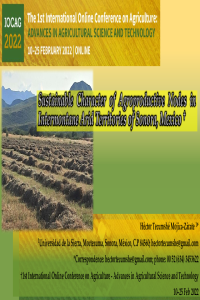
Sustainable Character of Agroproductive Nodes in Intermontane Arid Territories of Sonora, Mexico PRESENTATION.pdf
Effect of exogenous application of an aqueous quercetin solution on the physiological properties of Andropogon gerardi plants
Benefits of Cultivating Industrial Hemp (Cannabis sativa ssp. sativa) - A versatile plant for a sustainable future