Event submissions
Published

This submission belongs to the session S1. Nutrition and Inflammation of the event The 2nd International Electronic Conference on Nutrients
Published date
14 Mar, 2022
Academic Editor
'%3e%3cpath%20d='M12.6657%2010.9104C12.4185%2010.325%2012.0599%209.79327%2011.6097%209.34482C11.1609%208.89508%2010.6293%208.5365%2010.0442%208.28888C10.0389%208.28626%2010.0337%208.28495%2010.0285%208.28233C10.8446%207.69279%2011.3752%206.73249%2011.3752%205.64904C11.3752%203.8542%209.92103%202.39999%208.1262%202.39999C6.33136%202.39999%204.87715%203.8542%204.87715%205.64904C4.87715%206.73249%205.40774%207.69279%206.22393%208.28364C6.21869%208.28626%206.21345%208.28757%206.20821%208.29019C5.62129%208.5378%205.09463%208.89284%204.64265%209.34613C4.1929%209.79493%203.83432%2010.3266%203.58671%2010.9117C3.34345%2011.4845%203.21226%2012.0987%203.20023%2012.7209C3.19988%2012.7349%203.20233%2012.7488%203.20744%2012.7619C3.21255%2012.7749%203.22022%2012.7867%203.22998%2012.7968C3.23975%2012.8068%203.25142%2012.8147%203.26431%2012.8202C3.2772%2012.8256%203.29105%2012.8284%203.30504%2012.8284H4.09109C4.14874%2012.8284%204.19459%2012.7825%204.1959%2012.7262C4.2221%2011.7148%204.62823%2010.7676%205.34617%2010.0497C6.08899%209.30683%207.0755%208.89808%208.1262%208.89808C9.17689%208.89808%2010.1634%209.30683%2010.9062%2010.0497C11.6242%2010.7676%2012.0303%2011.7148%2012.0565%2012.7262C12.0578%2012.7838%2012.1037%2012.8284%2012.1613%2012.8284H12.9474C12.9613%2012.8284%2012.9752%2012.8256%2012.9881%2012.8202C13.001%2012.8147%2013.0126%2012.8068%2013.0224%2012.7968C13.0322%2012.7867%2013.0398%2012.7749%2013.0449%2012.7619C13.0501%2012.7488%2013.0525%2012.7349%2013.0522%2012.7209C13.0391%2012.0947%2012.9094%2011.4855%2012.6657%2010.9104ZM8.1262%207.9024C7.52486%207.9024%206.9589%207.6679%206.53312%207.24211C6.10733%206.81633%205.87283%206.25037%205.87283%205.64904C5.87283%205.0477%206.10733%204.48174%206.53312%204.05596C6.9589%203.63018%207.52486%203.39567%208.1262%203.39567C8.72753%203.39567%209.29349%203.63018%209.71927%204.05596C10.1451%204.48174%2010.3796%205.0477%2010.3796%205.64904C10.3796%206.25037%2010.1451%206.81633%209.71927%207.24211C9.29349%207.6679%208.72753%207.9024%208.1262%207.9024Z'%20fill='%235D1EE1'/%3e%3c/g%3e%3c/svg%3e) Nick Bellissimo
Nick BellissimoCitation
Anouk Charlot, Anne-Laure Charles, Isabelle Georg, Fabienne Goupilleau, Léa Debrut, Mégane Pizzimenti, Joris Mallard, Allan Pagano, Bernard Geny, Joffrey Zoll, Beneficals effects of Ketogenic Diet on hepatic inflammation in obese mice model., in Proceedings of The 2nd International Electronic Conference on Nutrients, 15 March–31 March 2022, MDPI: Basel, Switzerland, doi: 10.3390/IECN2022-12368
Share
Email
Facebook
Twitter
LinkedIn
Beneficals effects of Ketogenic Diet on hepatic inflammation in obese mice model.
'%3e%3cpath%20d='M12.6647%2010.9104C12.4176%2010.325%2012.0589%209.7933%2011.6088%209.34485C11.16%208.89511%2010.6283%208.53653%2010.0432%208.28891C10.038%208.28629%2010.0327%208.28498%2010.0275%208.28236C10.8437%207.69282%2011.3743%206.73252%2011.3743%205.64907C11.3743%203.85423%209.92005%202.40002%208.12522%202.40002C6.33038%202.40002%204.87618%203.85423%204.87618%205.64907C4.87618%206.73252%205.40677%207.69282%206.22296%208.28367C6.21772%208.28629%206.21248%208.2876%206.20724%208.29022C5.62031%208.53783%205.09365%208.89287%204.64167%209.34616C4.19192%209.79496%203.83334%2010.3266%203.58573%2010.9117C3.34247%2011.4846%203.21128%2012.0987%203.19925%2012.721C3.1989%2012.735%203.20135%2012.7489%203.20646%2012.7619C3.21157%2012.7749%203.21924%2012.7868%203.22901%2012.7968C3.23877%2012.8068%203.25045%2012.8148%203.26334%2012.8202C3.27623%2012.8256%203.29007%2012.8284%203.30406%2012.8284H4.09012C4.14776%2012.8284%204.19362%2012.7825%204.19493%2012.7262C4.22113%2011.7148%204.62726%2010.7676%205.34519%2010.0497C6.08802%209.30686%207.07452%208.89811%208.12522%208.89811C9.17592%208.89811%2010.1624%209.30686%2010.9052%2010.0497C11.6232%2010.7676%2012.0293%2011.7148%2012.0555%2012.7262C12.0568%2012.7839%2012.1027%2012.8284%2012.1603%2012.8284H12.9464C12.9604%2012.8284%2012.9742%2012.8256%2012.9871%2012.8202C13%2012.8148%2013.0117%2012.8068%2013.0214%2012.7968C13.0312%2012.7868%2013.0389%2012.7749%2013.044%2012.7619C13.0491%2012.7489%2013.0515%2012.735%2013.0512%2012.721C13.0381%2012.0947%2012.9084%2011.4856%2012.6647%2010.9104ZM8.12522%207.90243C7.52388%207.90243%206.95792%207.66793%206.53214%207.24215C6.10636%206.81636%205.87185%206.2504%205.87185%205.64907C5.87185%205.04773%206.10636%204.48177%206.53214%204.05599C6.95792%203.63021%207.52388%203.3957%208.12522%203.3957C8.72655%203.3957%209.29252%203.63021%209.7183%204.05599C10.1441%204.48177%2010.3786%205.04773%2010.3786%205.64907C10.3786%206.2504%2010.1441%206.81636%209.7183%207.24215C9.29252%207.66793%208.72655%207.90243%208.12522%207.90243Z'%20fill='%235D1EE1'/%3e%3c/g%3e%3c/svg%3e)
Anouk Charlot 1
Anne-Laure Charles 1
Isabelle Georg 1
Fabienne Goupilleau 1
Léa Debrut 1
Mégane Pizzimenti 1
Joris Mallard 1
Allan Pagano 1
Bernard Geny 1

Joffrey Zoll 1
1. UR3072 - CRBS, University of Strasbourg, France
Abstract
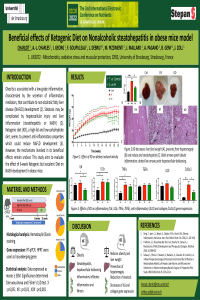
Rationale: Obesity is associated with a low-grade inflammation, characterized by the secretion of inflammatory mediators. In the liver, they contribute to non-alcoholic steatohepatitis (NASH) development and its progression toward higher risk cirrhotic states. Ketogenic diet (KD), a high-fat and low-carbohydrate diet, seems to present anti-inflammatory properties which could reduce NASH development. However, the mechanisms involved in its beneficial effects remain unclear.
Methods: Obesity was induced in C57/Bl6 mice (n=20) by using a high-fat high-sugar diet (HFD). After 16 weeks of HFD, mice were split into 2 groups for 6 weeks: KD mice (n=10) and HFD mice (n=10). At the end of the 22-week protocol, we measured liver weight, hepatic lipid accumulation and inflammatory infiltrates with histological staining, and hepatic gene expression by RT-qPCR. Both HFD and KD were isocaloric and compared with a control diet (Ctrl) group of mice (n=10).
Results: After 22 weeks of HFD, mice developped obesity (+82% of weight gain, p<0.001) associated with an increase of weight liver (+113%, p<0.001) and an hepatic lipid accumulation (+158%, p<0.001), compared with Ctrl. RT-qPCR revealed an increase of TNFa (p<0.05), IL-1 (p<0.05) and collagen 1 (p<0.01) gene expression, but no changes of IL-10, TGFb and IFNg, compared to Ctrl. Histological staining showed an important steatosis and inflammatory infiltrates. Compared to HFD, 6 weeks of KD allow to reduce the liver weight (-31%, p<0.01), the inflammatory inflitratres, and decreased IL-6 (p<0.05) and collagen 1 (p<0.05) gene expression. But KD had no effect on hepatic lipid accumulation and on IL-1, TNFa, IFNg, IL-10 gene expression, compared to HFD.
Conclusions: Isolcaloric KD demonstrates beneficial effects regarding hepatic fibrosis and inflammation, preventing NASH development. These results prove the importance of reducing sugar intake and suggest that KD could be an effective strategy to reduce NASH progression.
Keywords
Obesity
NASH
Ketogenic Diet
Inflammation
Manuscript
1 sciforum-056389 - done.pdf
Poster
POSTERcongrès IECN.pdf
Modulatory effects of a lunasin-enriched soybean extract on immune response and oxidative stress-associated biomarkers
Psychological distress and its association with discretionary choices intake in Australian women of reproductive age during COVID-19