Event submissions
Published

This submission belongs to the session S5. Nutrition and Oxidative Stress of the event The 2nd International Electronic Conference on Nutrients
Published date
14 Mar, 2022
Academic Editor
'%3e%3cpath%20d='M12.6657%2010.9104C12.4185%2010.325%2012.0599%209.79327%2011.6097%209.34482C11.1609%208.89508%2010.6293%208.5365%2010.0442%208.28888C10.0389%208.28626%2010.0337%208.28495%2010.0285%208.28233C10.8446%207.69279%2011.3752%206.73249%2011.3752%205.64904C11.3752%203.8542%209.92103%202.39999%208.1262%202.39999C6.33136%202.39999%204.87715%203.8542%204.87715%205.64904C4.87715%206.73249%205.40774%207.69279%206.22393%208.28364C6.21869%208.28626%206.21345%208.28757%206.20821%208.29019C5.62129%208.5378%205.09463%208.89284%204.64265%209.34613C4.1929%209.79493%203.83432%2010.3266%203.58671%2010.9117C3.34345%2011.4845%203.21226%2012.0987%203.20023%2012.7209C3.19988%2012.7349%203.20233%2012.7488%203.20744%2012.7619C3.21255%2012.7749%203.22022%2012.7867%203.22998%2012.7968C3.23975%2012.8068%203.25142%2012.8147%203.26431%2012.8202C3.2772%2012.8256%203.29105%2012.8284%203.30504%2012.8284H4.09109C4.14874%2012.8284%204.19459%2012.7825%204.1959%2012.7262C4.2221%2011.7148%204.62823%2010.7676%205.34617%2010.0497C6.08899%209.30683%207.0755%208.89808%208.1262%208.89808C9.17689%208.89808%2010.1634%209.30683%2010.9062%2010.0497C11.6242%2010.7676%2012.0303%2011.7148%2012.0565%2012.7262C12.0578%2012.7838%2012.1037%2012.8284%2012.1613%2012.8284H12.9474C12.9613%2012.8284%2012.9752%2012.8256%2012.9881%2012.8202C13.001%2012.8147%2013.0126%2012.8068%2013.0224%2012.7968C13.0322%2012.7867%2013.0398%2012.7749%2013.0449%2012.7619C13.0501%2012.7488%2013.0525%2012.7349%2013.0522%2012.7209C13.0391%2012.0947%2012.9094%2011.4855%2012.6657%2010.9104ZM8.1262%207.9024C7.52486%207.9024%206.9589%207.6679%206.53312%207.24211C6.10733%206.81633%205.87283%206.25037%205.87283%205.64904C5.87283%205.0477%206.10733%204.48174%206.53312%204.05596C6.9589%203.63018%207.52486%203.39567%208.1262%203.39567C8.72753%203.39567%209.29349%203.63018%209.71927%204.05596C10.1451%204.48174%2010.3796%205.0477%2010.3796%205.64904C10.3796%206.25037%2010.1451%206.81633%209.71927%207.24211C9.29349%207.6679%208.72753%207.9024%208.1262%207.9024Z'%20fill='%235D1EE1'/%3e%3c/g%3e%3c/svg%3e) David Nieman
David NiemanCitation
Margalida Monserrat Mesquida, Mª Magdalena Quetglas-Llabrés, Sofía Montemayor, Catalina Mª Mascaró, Silvia Tejada, Antoni Pons, Josep A. Tur, Antoni Sureda, A greater reduction in intrahepatic fat content after a lifestyle intervention is related to a better inflammatory and oxidative status, in Proceedings of The 2nd International Electronic Conference on Nutrients, 15 March–31 March 2022, MDPI: Basel, Switzerland, doi: 10.3390/IECN2022-12374
Share
Email
Facebook
Twitter
LinkedIn
A greater reduction in intrahepatic fat content after a lifestyle intervention is related to a better inflammatory and oxidative status

Margalida Monserrat Mesquida 1

Mª Magdalena Quetglas-Llabrés 1
'%3e%3cpath%20d='M12.6647%2010.9104C12.4176%2010.325%2012.0589%209.7933%2011.6088%209.34485C11.16%208.89511%2010.6283%208.53653%2010.0432%208.28891C10.038%208.28629%2010.0327%208.28498%2010.0275%208.28236C10.8437%207.69282%2011.3743%206.73252%2011.3743%205.64907C11.3743%203.85423%209.92005%202.40002%208.12522%202.40002C6.33038%202.40002%204.87618%203.85423%204.87618%205.64907C4.87618%206.73252%205.40677%207.69282%206.22296%208.28367C6.21772%208.28629%206.21248%208.2876%206.20724%208.29022C5.62031%208.53783%205.09365%208.89287%204.64167%209.34616C4.19192%209.79496%203.83334%2010.3266%203.58573%2010.9117C3.34247%2011.4846%203.21128%2012.0987%203.19925%2012.721C3.1989%2012.735%203.20135%2012.7489%203.20646%2012.7619C3.21157%2012.7749%203.21924%2012.7868%203.22901%2012.7968C3.23877%2012.8068%203.25045%2012.8148%203.26334%2012.8202C3.27623%2012.8256%203.29007%2012.8284%203.30406%2012.8284H4.09012C4.14776%2012.8284%204.19362%2012.7825%204.19493%2012.7262C4.22113%2011.7148%204.62726%2010.7676%205.34519%2010.0497C6.08802%209.30686%207.07452%208.89811%208.12522%208.89811C9.17592%208.89811%2010.1624%209.30686%2010.9052%2010.0497C11.6232%2010.7676%2012.0293%2011.7148%2012.0555%2012.7262C12.0568%2012.7839%2012.1027%2012.8284%2012.1603%2012.8284H12.9464C12.9604%2012.8284%2012.9742%2012.8256%2012.9871%2012.8202C13%2012.8148%2013.0117%2012.8068%2013.0214%2012.7968C13.0312%2012.7868%2013.0389%2012.7749%2013.044%2012.7619C13.0491%2012.7489%2013.0515%2012.735%2013.0512%2012.721C13.0381%2012.0947%2012.9084%2011.4856%2012.6647%2010.9104ZM8.12522%207.90243C7.52388%207.90243%206.95792%207.66793%206.53214%207.24215C6.10636%206.81636%205.87185%206.2504%205.87185%205.64907C5.87185%205.04773%206.10636%204.48177%206.53214%204.05599C6.95792%203.63021%207.52388%203.3957%208.12522%203.3957C8.72655%203.3957%209.29252%203.63021%209.7183%204.05599C10.1441%204.48177%2010.3786%205.04773%2010.3786%205.64907C10.3786%206.2504%2010.1441%206.81636%209.7183%207.24215C9.29252%207.66793%208.72655%207.90243%208.12522%207.90243Z'%20fill='%235D1EE1'/%3e%3c/g%3e%3c/svg%3e)
Sofía Montemayor 1
Catalina Mª Mascaró 1

Silvia Tejada 2

Antoni Pons 1

Josep A. Tur 1

Antoni Sureda 1
1. Research Group in Community Nutrition and Oxidative Stress, Health Research Institute of Balearic Islands (IdISBa) and CIBER Physiopathology of Obesity and Nutrition (CIBEROBN), University of the Balearic Islands-IUNICS, Palma de Mallorca, Spain.
2. Laboratory of neurophysiology, Health Research Institute of Balearic Islands (IdISBa) and CIBER Physiopathology of Obesity and Nutrition (CIBEROBN), University of the Balearic Islands-IUNICS, Palma de Mallorca, Spain.
Abstract
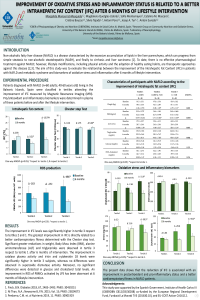
Non-alcoholic fatty liver disease (NAFLD) is a disease characterized by the excessive accumulation of lipids in the liver parenchyma. To date, there is no effective pharmacological treatment against NAFLD; however, lifestyle modifications, including physical activity and the adoption of healthy eating habits, are therapeutic approaches against this disease. The aim of this study was to evaluate the relationship between the improvement of the intrahepatic fat content (IFC) in patients with NAFLD and metabolic syndrome and biomarkers of oxidative stress and inflammation after 6 months of lifestyle intervention which included a hypocaloric diet and the promotion of physical activity. Patients diagnosed with NAFLD (n=60 adults; 40-60 years old) living in the Balearic Islands, Spain were classified in tertiles attending the improvement of IFC measured by Magnetic Resonance Imaging (MRI). Pro/antioxidant and inflammatory biomarkers were determined in plasma before and after the lifestyle intervention. The greatest improvement in IFC is directly related to a better cardiorespiratory fitness determined with the Chester step test. Significant greater reductions in weight, body mass index, alanine aminotransferase and triglycerides were observed in the group with the greatest improvement in IFC compared to the one that improved the least after the intervention. No significant differences were detected in glucose, cholesterol and in aspartate aminotransferase. Similarly, the reduction in catalase plasma activity, irisin and cytokeratin 18 levels were significantly higher in the group with the highest degree of IFC reduction, whereas no differences were observed in superoxide dismutase activity and in malondialdehyde and protein carbonyl levels. A progressive decrease in reactive oxygen species production by peripheral blood mononuclear cells activated with lipopolysaccharide was observed after the lifestyle intervention. The present data shows that a greater reduction in IFC is related to an improvement in pro/antioxidant and pro-inflammatory status and a better cardiorespiratory fitness in NAFLD patients.
Keywords
NAFLD
Intrahepatic Fat Content
oxidative stress
inflammation
biomarkers
Manuscript
1 sciforum-056691-done.pdf
Poster
sciforum-056691 poster.pdf
Serum leptin level in patients with cystic fibrosis
Antioxidant supplementation hinders the role of exercise training as a natural activator of SIRT1