Event submissions
Published
 10.3390/IECN2022-12387 (registering DOI)
 This submission belongs to the session S5. Nutrition and Oxidative Stress of the event The 2nd International Electronic Conference on Nutrients
Published date
14 Mar, 2022
Academic Editor
'%3e%3cpath%20d='M12.6657%2010.9104C12.4185%2010.325%2012.0599%209.79327%2011.6097%209.34482C11.1609%208.89508%2010.6293%208.5365%2010.0442%208.28888C10.0389%208.28626%2010.0337%208.28495%2010.0285%208.28233C10.8446%207.69279%2011.3752%206.73249%2011.3752%205.64904C11.3752%203.8542%209.92103%202.39999%208.1262%202.39999C6.33136%202.39999%204.87715%203.8542%204.87715%205.64904C4.87715%206.73249%205.40774%207.69279%206.22393%208.28364C6.21869%208.28626%206.21345%208.28757%206.20821%208.29019C5.62129%208.5378%205.09463%208.89284%204.64265%209.34613C4.1929%209.79493%203.83432%2010.3266%203.58671%2010.9117C3.34345%2011.4845%203.21226%2012.0987%203.20023%2012.7209C3.19988%2012.7349%203.20233%2012.7488%203.20744%2012.7619C3.21255%2012.7749%203.22022%2012.7867%203.22998%2012.7968C3.23975%2012.8068%203.25142%2012.8147%203.26431%2012.8202C3.2772%2012.8256%203.29105%2012.8284%203.30504%2012.8284H4.09109C4.14874%2012.8284%204.19459%2012.7825%204.1959%2012.7262C4.2221%2011.7148%204.62823%2010.7676%205.34617%2010.0497C6.08899%209.30683%207.0755%208.89808%208.1262%208.89808C9.17689%208.89808%2010.1634%209.30683%2010.9062%2010.0497C11.6242%2010.7676%2012.0303%2011.7148%2012.0565%2012.7262C12.0578%2012.7838%2012.1037%2012.8284%2012.1613%2012.8284H12.9474C12.9613%2012.8284%2012.9752%2012.8256%2012.9881%2012.8202C13.001%2012.8147%2013.0126%2012.8068%2013.0224%2012.7968C13.0322%2012.7867%2013.0398%2012.7749%2013.0449%2012.7619C13.0501%2012.7488%2013.0525%2012.7349%2013.0522%2012.7209C13.0391%2012.0947%2012.9094%2011.4855%2012.6657%2010.9104ZM8.1262%207.9024C7.52486%207.9024%206.9589%207.6679%206.53312%207.24211C6.10733%206.81633%205.87283%206.25037%205.87283%205.64904C5.87283%205.0477%206.10733%204.48174%206.53312%204.05596C6.9589%203.63018%207.52486%203.39567%208.1262%203.39567C8.72753%203.39567%209.29349%203.63018%209.71927%204.05596C10.1451%204.48174%2010.3796%205.0477%2010.3796%205.64904C10.3796%206.25037%2010.1451%206.81633%209.71927%207.24211C9.29349%207.6679%208.72753%207.9024%208.1262%207.9024Z'%20fill='%235D1EE1'/%3e%3c/g%3e%3c/svg%3e) David Nieman
David NiemanCitation
Maria Magdalena Quetglas Llabrés, Margalida Monserrat-Mesquida, Cristina Bouzas, Silvia Garcia, Lucía Ugarriza, Antoni Sureda, Josep A. Tur, Greater adherence to the Mediterranean diet pattern is related to a better inflammatory and oxidative status in patients with metabolic syndrome, in Proceedings of The 2nd International Electronic Conference on Nutrients, 15 March–31 March 2022, MDPI: Basel, Switzerland, doi: 10.3390/IECN2022-12387
Share
Email
Facebook
Twitter
LinkedIn
Greater adherence to the Mediterranean diet pattern is related to a better inflammatory and oxidative status in patients with metabolic syndrome

Maria Magdalena Quetglas Llabrés 1

Margalida Monserrat-Mesquida 1,2
'%3e%3cpath%20d='M12.6647%2010.9104C12.4176%2010.325%2012.0589%209.7933%2011.6088%209.34485C11.16%208.89511%2010.6283%208.53653%2010.0432%208.28891C10.038%208.28629%2010.0327%208.28498%2010.0275%208.28236C10.8437%207.69282%2011.3743%206.73252%2011.3743%205.64907C11.3743%203.85423%209.92005%202.40002%208.12522%202.40002C6.33038%202.40002%204.87618%203.85423%204.87618%205.64907C4.87618%206.73252%205.40677%207.69282%206.22296%208.28367C6.21772%208.28629%206.21248%208.2876%206.20724%208.29022C5.62031%208.53783%205.09365%208.89287%204.64167%209.34616C4.19192%209.79496%203.83334%2010.3266%203.58573%2010.9117C3.34247%2011.4846%203.21128%2012.0987%203.19925%2012.721C3.1989%2012.735%203.20135%2012.7489%203.20646%2012.7619C3.21157%2012.7749%203.21924%2012.7868%203.22901%2012.7968C3.23877%2012.8068%203.25045%2012.8148%203.26334%2012.8202C3.27623%2012.8256%203.29007%2012.8284%203.30406%2012.8284H4.09012C4.14776%2012.8284%204.19362%2012.7825%204.19493%2012.7262C4.22113%2011.7148%204.62726%2010.7676%205.34519%2010.0497C6.08802%209.30686%207.07452%208.89811%208.12522%208.89811C9.17592%208.89811%2010.1624%209.30686%2010.9052%2010.0497C11.6232%2010.7676%2012.0293%2011.7148%2012.0555%2012.7262C12.0568%2012.7839%2012.1027%2012.8284%2012.1603%2012.8284H12.9464C12.9604%2012.8284%2012.9742%2012.8256%2012.9871%2012.8202C13%2012.8148%2013.0117%2012.8068%2013.0214%2012.7968C13.0312%2012.7868%2013.0389%2012.7749%2013.044%2012.7619C13.0491%2012.7489%2013.0515%2012.735%2013.0512%2012.721C13.0381%2012.0947%2012.9084%2011.4856%2012.6647%2010.9104ZM8.12522%207.90243C7.52388%207.90243%206.95792%207.66793%206.53214%207.24215C6.10636%206.81636%205.87185%206.2504%205.87185%205.64907C5.87185%205.04773%206.10636%204.48177%206.53214%204.05599C6.95792%203.63021%207.52388%203.3957%208.12522%203.3957C8.72655%203.3957%209.29252%203.63021%209.7183%204.05599C10.1441%204.48177%2010.3786%205.04773%2010.3786%205.64907C10.3786%206.2504%2010.1441%206.81636%209.7183%207.24215C9.29252%207.66793%208.72655%207.90243%208.12522%207.90243Z'%20fill='%235D1EE1'/%3e%3c/g%3e%3c/svg%3e)
Cristina Bouzas 1,2
Silvia Garcia 1,2
Lucía Ugarriza 1

Antoni Sureda 1,2

Josep A. Tur 1,2
1. Research Group in Community Nutrition and Oxidative Stress, University of the Balearic Islands-IUNICS, 07122 Palma de Mallorca and Health Research Institute of Balearic Islands (IdISBa), 07120 Palma de Mallorca.
2. CIBER Physiopathology of Obesity and Nutrition (CIBEROBN), Institute of Health Carlos III (ISCIII), 28029 Madrid.
Abstract
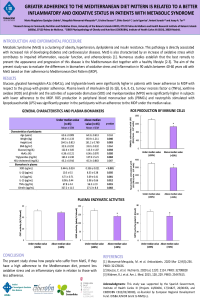
Metabolic Syndrome (MetS) is a clustering of obesity, hypertension, dyslipidemia and insulin resistance. This pathology is directly associated with increased risk of developing diabetes and cardiovascular diseases. MetS is also characterized by an increase of oxidative stress which contributes to impaired inflammation, vascular function, and atherosclerosis. Numerous studies establish that the best remedy to prevent the appearance and progression of this disease is the Mediterranean diet together with a healthy lifestyle. The aim of the present study was to evaluate the differences in biomarkers of oxidative stress and inflammation in 90 adults between 40-60 years old with MetS based on their adherence to Mediterranean Diet Pattern (MDP). Glucose, glycated haemoglobin A1c (HbA1c), and triglyceride levels were significantly higher in patients with lower adherence to MDP with respect to the group with greater adherence. Plasma levels of interleukin-1β (IL-1β), IL-6, IL-15, tumour necrosis factor α (TNFα), xanthine oxidase (XOD) and ghrelin and the activities of superoxide dismutase (SOD) and myeloperoxidase (MPO) were significantly higher in subjects with lower adherence to the MDP. ROS production in peripheral blood mononuclear cells (PBMCs) and neutrophils stimulated with lipopolysaccharide (LPS) was significantly greater in the participants with an adherence to the MDP under the median value. In conclusion, the present study evidenced that people who suffer from MetS, if they have a high adherence to the Mediterranean diet, present a lower degree of oxidative stress and an inflammatory state in relation to those with less adherence.
Keywords
Mediterranean diet
inflammatory mediators
oxidative stress
obesity
biomarkers
Manuscript
1 sciforum-056753-done.pdf
Poster
sciforum-056753 poster.pdf
Vitamin D supplementation and photodynamic therapy .
Phytochemical Analysis, Antioxidant Potential and Radical Scavenging Activity of Lomatium dissectum: An Ancient Plant of North America.