Event submissions
Published

This submission belongs to the session A. Animals Diversity of the event The 2nd International Electronic Conference on Diversity
Published date
14 Mar, 2022
Academic Editor
'%3e%3cpath%20d='M12.6657%2010.9104C12.4185%2010.325%2012.0599%209.79327%2011.6097%209.34482C11.1609%208.89508%2010.6293%208.5365%2010.0442%208.28888C10.0389%208.28626%2010.0337%208.28495%2010.0285%208.28233C10.8446%207.69279%2011.3752%206.73249%2011.3752%205.64904C11.3752%203.8542%209.92103%202.39999%208.1262%202.39999C6.33136%202.39999%204.87715%203.8542%204.87715%205.64904C4.87715%206.73249%205.40774%207.69279%206.22393%208.28364C6.21869%208.28626%206.21345%208.28757%206.20821%208.29019C5.62129%208.5378%205.09463%208.89284%204.64265%209.34613C4.1929%209.79493%203.83432%2010.3266%203.58671%2010.9117C3.34345%2011.4845%203.21226%2012.0987%203.20023%2012.7209C3.19988%2012.7349%203.20233%2012.7488%203.20744%2012.7619C3.21255%2012.7749%203.22022%2012.7867%203.22998%2012.7968C3.23975%2012.8068%203.25142%2012.8147%203.26431%2012.8202C3.2772%2012.8256%203.29105%2012.8284%203.30504%2012.8284H4.09109C4.14874%2012.8284%204.19459%2012.7825%204.1959%2012.7262C4.2221%2011.7148%204.62823%2010.7676%205.34617%2010.0497C6.08899%209.30683%207.0755%208.89808%208.1262%208.89808C9.17689%208.89808%2010.1634%209.30683%2010.9062%2010.0497C11.6242%2010.7676%2012.0303%2011.7148%2012.0565%2012.7262C12.0578%2012.7838%2012.1037%2012.8284%2012.1613%2012.8284H12.9474C12.9613%2012.8284%2012.9752%2012.8256%2012.9881%2012.8202C13.001%2012.8147%2013.0126%2012.8068%2013.0224%2012.7968C13.0322%2012.7867%2013.0398%2012.7749%2013.0449%2012.7619C13.0501%2012.7488%2013.0525%2012.7349%2013.0522%2012.7209C13.0391%2012.0947%2012.9094%2011.4855%2012.6657%2010.9104ZM8.1262%207.9024C7.52486%207.9024%206.9589%207.6679%206.53312%207.24211C6.10733%206.81633%205.87283%206.25037%205.87283%205.64904C5.87283%205.0477%206.10733%204.48174%206.53312%204.05596C6.9589%203.63018%207.52486%203.39567%208.1262%203.39567C8.72753%203.39567%209.29349%203.63018%209.71927%204.05596C10.1451%204.48174%2010.3796%205.0477%2010.3796%205.64904C10.3796%206.25037%2010.1451%206.81633%209.71927%207.24211C9.29349%207.6679%208.72753%207.9024%208.1262%207.9024Z'%20fill='%235D1EE1'/%3e%3c/g%3e%3c/svg%3e) Matthieu Chauvat
Matthieu ChauvatCitation
Marius Jasiulionis, Vitalijus Stirkė, Linas Balčiauskas, Invasive raccoon dog (Nyctereutes procyonoides) and raccoon (Procyon lotor) monitoring in Lithuania based on camera traps data, in Proceedings of The 2nd International Electronic Conference on Diversity, 15 March–31 March 2022, MDPI: Basel, Switzerland, doi: 10.3390/IECD2022-12406
Share
Email
Facebook
Twitter
LinkedIn
Invasive raccoon dog (Nyctereutes procyonoides) and raccoon (Procyon lotor) monitoring in Lithuania based on camera traps data
'%3e%3cpath%20d='M12.6647%2010.9104C12.4176%2010.325%2012.0589%209.7933%2011.6088%209.34485C11.16%208.89511%2010.6283%208.53653%2010.0432%208.28891C10.038%208.28629%2010.0327%208.28498%2010.0275%208.28236C10.8437%207.69282%2011.3743%206.73252%2011.3743%205.64907C11.3743%203.85423%209.92005%202.40002%208.12522%202.40002C6.33038%202.40002%204.87618%203.85423%204.87618%205.64907C4.87618%206.73252%205.40677%207.69282%206.22296%208.28367C6.21772%208.28629%206.21248%208.2876%206.20724%208.29022C5.62031%208.53783%205.09365%208.89287%204.64167%209.34616C4.19192%209.79496%203.83334%2010.3266%203.58573%2010.9117C3.34247%2011.4846%203.21128%2012.0987%203.19925%2012.721C3.1989%2012.735%203.20135%2012.7489%203.20646%2012.7619C3.21157%2012.7749%203.21924%2012.7868%203.22901%2012.7968C3.23877%2012.8068%203.25045%2012.8148%203.26334%2012.8202C3.27623%2012.8256%203.29007%2012.8284%203.30406%2012.8284H4.09012C4.14776%2012.8284%204.19362%2012.7825%204.19493%2012.7262C4.22113%2011.7148%204.62726%2010.7676%205.34519%2010.0497C6.08802%209.30686%207.07452%208.89811%208.12522%208.89811C9.17592%208.89811%2010.1624%209.30686%2010.9052%2010.0497C11.6232%2010.7676%2012.0293%2011.7148%2012.0555%2012.7262C12.0568%2012.7839%2012.1027%2012.8284%2012.1603%2012.8284H12.9464C12.9604%2012.8284%2012.9742%2012.8256%2012.9871%2012.8202C13%2012.8148%2013.0117%2012.8068%2013.0214%2012.7968C13.0312%2012.7868%2013.0389%2012.7749%2013.044%2012.7619C13.0491%2012.7489%2013.0515%2012.735%2013.0512%2012.721C13.0381%2012.0947%2012.9084%2011.4856%2012.6647%2010.9104ZM8.12522%207.90243C7.52388%207.90243%206.95792%207.66793%206.53214%207.24215C6.10636%206.81636%205.87185%206.2504%205.87185%205.64907C5.87185%205.04773%206.10636%204.48177%206.53214%204.05599C6.95792%203.63021%207.52388%203.3957%208.12522%203.3957C8.72655%203.3957%209.29252%203.63021%209.7183%204.05599C10.1441%204.48177%2010.3786%205.04773%2010.3786%205.64907C10.3786%206.2504%2010.1441%206.81636%209.7183%207.24215C9.29252%207.66793%208.72655%207.90243%208.12522%207.90243Z'%20fill='%235D1EE1'/%3e%3c/g%3e%3c/svg%3e)
Marius Jasiulionis 1
Vitalijus Stirkė 1

Linas Balčiauskas 1
1. Nature Research Centre, Akademijos 2, Vilnius, Lithuania.
Abstract
Invasive mammal species outside their natural range are causing damage to the native ecosystems. Raccoon dogs were first observed in Lithuania in 1948 and since then spread across the country. Surveys of this species stopped in 1997, therefore numbers and trends currently are unknown. Raccoons were first observed in 2012, with only a few sporadical reports over the decade. Both species are listed as an EU species of concern. Between September 2019 and July 2021 we evaluated distribution and densities of these animals using camera traps (system with a motion trigger/sensor that activates a camera to take a photograph when an animal is present) at 85 locations with a total sampling effort of 11501 camera trap days. Raccoon dog was identified in 57 locations (67.1 % of all surveyed) and raccoon 1 location (1.2 %). The average relative shooting frequency of raccoon dogs was 5.12 photos/100 days and that of raccoons was 0.18 photos/100 days. The abundance of raccoon dog was not uniform. In northeastern part of Lithuania their relative shooting frequency was significantly higher than in western part (6.26 and 2.31 photos/100 days, respectively; p < 0.05). Raccoons were present in only one location, however, during the study period they were registered 21 times. This indicates that a viable population has developed and it can become a source of further invasion in the nearest future, requiring immediate control actions. Research was funded by contract No. 05.5.1-APVA-V-018-01-0012.
Keywords
invasive mammals
raccoon dog
raccoon
camera trap
relative shooting frequency
Manuscript
052962-PUBLISH.pdf
Poster
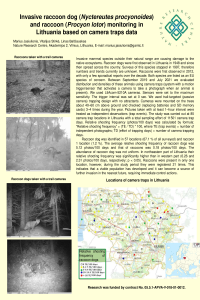
poster IECD 2022 (1).pdf
Composition and Ecology of the Insect Community and
Microbiota in Galls on a Hawkweed Hieracium × robustum Fries, 1848
Microbiota in Galls on a Hawkweed Hieracium × robustum Fries, 1848
Filling Biodiversity Knowledge Gaps: Sponges (Porifera: Demospongiae) Recorded off San Jorge Gulf (Argentina), SW Atlantic Ocean