Event submissions
Published

This submission belongs to the session A. Animals Diversity of the event The 2nd International Electronic Conference on Diversity
Published date
14 Mar, 2022
Academic Editor
'%3e%3cpath%20d='M12.6657%2010.9104C12.4185%2010.325%2012.0599%209.79327%2011.6097%209.34482C11.1609%208.89508%2010.6293%208.5365%2010.0442%208.28888C10.0389%208.28626%2010.0337%208.28495%2010.0285%208.28233C10.8446%207.69279%2011.3752%206.73249%2011.3752%205.64904C11.3752%203.8542%209.92103%202.39999%208.1262%202.39999C6.33136%202.39999%204.87715%203.8542%204.87715%205.64904C4.87715%206.73249%205.40774%207.69279%206.22393%208.28364C6.21869%208.28626%206.21345%208.28757%206.20821%208.29019C5.62129%208.5378%205.09463%208.89284%204.64265%209.34613C4.1929%209.79493%203.83432%2010.3266%203.58671%2010.9117C3.34345%2011.4845%203.21226%2012.0987%203.20023%2012.7209C3.19988%2012.7349%203.20233%2012.7488%203.20744%2012.7619C3.21255%2012.7749%203.22022%2012.7867%203.22998%2012.7968C3.23975%2012.8068%203.25142%2012.8147%203.26431%2012.8202C3.2772%2012.8256%203.29105%2012.8284%203.30504%2012.8284H4.09109C4.14874%2012.8284%204.19459%2012.7825%204.1959%2012.7262C4.2221%2011.7148%204.62823%2010.7676%205.34617%2010.0497C6.08899%209.30683%207.0755%208.89808%208.1262%208.89808C9.17689%208.89808%2010.1634%209.30683%2010.9062%2010.0497C11.6242%2010.7676%2012.0303%2011.7148%2012.0565%2012.7262C12.0578%2012.7838%2012.1037%2012.8284%2012.1613%2012.8284H12.9474C12.9613%2012.8284%2012.9752%2012.8256%2012.9881%2012.8202C13.001%2012.8147%2013.0126%2012.8068%2013.0224%2012.7968C13.0322%2012.7867%2013.0398%2012.7749%2013.0449%2012.7619C13.0501%2012.7488%2013.0525%2012.7349%2013.0522%2012.7209C13.0391%2012.0947%2012.9094%2011.4855%2012.6657%2010.9104ZM8.1262%207.9024C7.52486%207.9024%206.9589%207.6679%206.53312%207.24211C6.10733%206.81633%205.87283%206.25037%205.87283%205.64904C5.87283%205.0477%206.10733%204.48174%206.53312%204.05596C6.9589%203.63018%207.52486%203.39567%208.1262%203.39567C8.72753%203.39567%209.29349%203.63018%209.71927%204.05596C10.1451%204.48174%2010.3796%205.0477%2010.3796%205.64904C10.3796%206.25037%2010.1451%206.81633%209.71927%207.24211C9.29349%207.6679%208.72753%207.9024%208.1262%207.9024Z'%20fill='%235D1EE1'/%3e%3c/g%3e%3c/svg%3e) Matthieu Chauvat
Matthieu ChauvatCitation
Laura Schejter, Diego A. Giberto, Filling Biodiversity Knowledge Gaps: Sponges (Porifera: Demospongiae) Recorded off San Jorge Gulf (Argentina), SW Atlantic Ocean, in Proceedings of The 2nd International Electronic Conference on Diversity, 15 March–31 March 2022, MDPI: Basel, Switzerland, doi: 10.3390/IECD2022-12407
Share
Email
Facebook
Twitter
LinkedIn
Filling Biodiversity Knowledge Gaps: Sponges (Porifera: Demospongiae) Recorded off San Jorge Gulf (Argentina), SW Atlantic Ocean

Laura Schejter 1,2
'%3e%3cpath%20d='M12.6647%2010.9104C12.4176%2010.325%2012.0589%209.7933%2011.6088%209.34485C11.16%208.89511%2010.6283%208.53653%2010.0432%208.28891C10.038%208.28629%2010.0327%208.28498%2010.0275%208.28236C10.8437%207.69282%2011.3743%206.73252%2011.3743%205.64907C11.3743%203.85423%209.92005%202.40002%208.12522%202.40002C6.33038%202.40002%204.87618%203.85423%204.87618%205.64907C4.87618%206.73252%205.40677%207.69282%206.22296%208.28367C6.21772%208.28629%206.21248%208.2876%206.20724%208.29022C5.62031%208.53783%205.09365%208.89287%204.64167%209.34616C4.19192%209.79496%203.83334%2010.3266%203.58573%2010.9117C3.34247%2011.4846%203.21128%2012.0987%203.19925%2012.721C3.1989%2012.735%203.20135%2012.7489%203.20646%2012.7619C3.21157%2012.7749%203.21924%2012.7868%203.22901%2012.7968C3.23877%2012.8068%203.25045%2012.8148%203.26334%2012.8202C3.27623%2012.8256%203.29007%2012.8284%203.30406%2012.8284H4.09012C4.14776%2012.8284%204.19362%2012.7825%204.19493%2012.7262C4.22113%2011.7148%204.62726%2010.7676%205.34519%2010.0497C6.08802%209.30686%207.07452%208.89811%208.12522%208.89811C9.17592%208.89811%2010.1624%209.30686%2010.9052%2010.0497C11.6232%2010.7676%2012.0293%2011.7148%2012.0555%2012.7262C12.0568%2012.7839%2012.1027%2012.8284%2012.1603%2012.8284H12.9464C12.9604%2012.8284%2012.9742%2012.8256%2012.9871%2012.8202C13%2012.8148%2013.0117%2012.8068%2013.0214%2012.7968C13.0312%2012.7868%2013.0389%2012.7749%2013.044%2012.7619C13.0491%2012.7489%2013.0515%2012.735%2013.0512%2012.721C13.0381%2012.0947%2012.9084%2011.4856%2012.6647%2010.9104ZM8.12522%207.90243C7.52388%207.90243%206.95792%207.66793%206.53214%207.24215C6.10636%206.81636%205.87185%206.2504%205.87185%205.64907C5.87185%205.04773%206.10636%204.48177%206.53214%204.05599C6.95792%203.63021%207.52388%203.3957%208.12522%203.3957C8.72655%203.3957%209.29252%203.63021%209.7183%204.05599C10.1441%204.48177%2010.3786%205.04773%2010.3786%205.64907C10.3786%206.2504%2010.1441%206.81636%209.7183%207.24215C9.29252%207.66793%208.72655%207.90243%208.12522%207.90243Z'%20fill='%235D1EE1'/%3e%3c/g%3e%3c/svg%3e)
Diego A. Giberto 2,3
1. Instituto Nacional de Investigacion y Desarrollo Pesquero, Mar del Plata, Buenos Aires Province
2. Consejo Nacional de Investigaciones Científicas y Técnicas
3. Instituto Nacional de Investigacion y Desarrollo Pesquero
Abstract
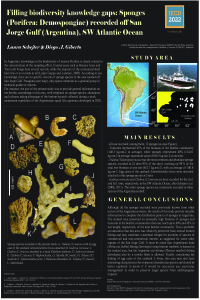
In Argentina, our knowledge on the biodiversity of marine Porifera is closely related to the concentration of the sampling effort. Coastal areas such as Buenos Aires and Tierra del Fuego have several records, while the majority of the continental shelf have few or no records at all. In December 2020, the RV “Victor Angelescu” performed a regular stock assessment expedition in order to evaluate the population of the Argentinean squid Illex argentinus off San Jorge Gulf (44°S-46°S, 84m-114m). Sampling was designed using bottom trawls. At 23 random sampling sites, the invertebrate by-catch was preserved frozen and studied at the Benthos Laboratory of the INIDEP. According to our knowledge, there are no specific records of sponge species in this area, only sparse mentions as a general group in technical reports. Our results showed that sponges were conspicuous and abundant components in the benthic communities of the area. They represented up to 40% of the total invertebrate bycatch (with an average value of ~130 kg.mn2 per site). Surprisingly, the species Tedania (Tedaniopsis) mucosa Thiele, 1905 was found to be dominant in the area and was recorded in 22 sites, reaching up to 34 % of the wet biomass (average of ~100 kg.nm2). Other recorded species belong to the genera Isodictya, Iophon, Clathria, Haliclona, Tedania and Siphonochalina. The results of this study contribute to fill in the gaps on the distribution of the sponges in the continental shelf of Argentina.
Keywords
Argentina
Porifera
SW Atlantic Ocean
distribution
bycatch species
Manuscript
055377.pdf
Poster
poster 18 feb.pdf
Invasive raccoon dog (Nyctereutes procyonoides) and raccoon (Procyon lotor) monitoring in Lithuania based on camera traps data
The spread of the invasive locust digitate leafminer Parectopa robiniella Clemens, 1863 (Lepidoptera: Gracillariidae): the Ukrainian context