Event submissions
Published

This submission belongs to the session B. Plants Diversity of the event The 2nd International Electronic Conference on Diversity
Published date
15 Mar, 2022
Academic Editor
'%3e%3cpath%20d='M12.6657%2010.9104C12.4185%2010.325%2012.0599%209.79327%2011.6097%209.34482C11.1609%208.89508%2010.6293%208.5365%2010.0442%208.28888C10.0389%208.28626%2010.0337%208.28495%2010.0285%208.28233C10.8446%207.69279%2011.3752%206.73249%2011.3752%205.64904C11.3752%203.8542%209.92103%202.39999%208.1262%202.39999C6.33136%202.39999%204.87715%203.8542%204.87715%205.64904C4.87715%206.73249%205.40774%207.69279%206.22393%208.28364C6.21869%208.28626%206.21345%208.28757%206.20821%208.29019C5.62129%208.5378%205.09463%208.89284%204.64265%209.34613C4.1929%209.79493%203.83432%2010.3266%203.58671%2010.9117C3.34345%2011.4845%203.21226%2012.0987%203.20023%2012.7209C3.19988%2012.7349%203.20233%2012.7488%203.20744%2012.7619C3.21255%2012.7749%203.22022%2012.7867%203.22998%2012.7968C3.23975%2012.8068%203.25142%2012.8147%203.26431%2012.8202C3.2772%2012.8256%203.29105%2012.8284%203.30504%2012.8284H4.09109C4.14874%2012.8284%204.19459%2012.7825%204.1959%2012.7262C4.2221%2011.7148%204.62823%2010.7676%205.34617%2010.0497C6.08899%209.30683%207.0755%208.89808%208.1262%208.89808C9.17689%208.89808%2010.1634%209.30683%2010.9062%2010.0497C11.6242%2010.7676%2012.0303%2011.7148%2012.0565%2012.7262C12.0578%2012.7838%2012.1037%2012.8284%2012.1613%2012.8284H12.9474C12.9613%2012.8284%2012.9752%2012.8256%2012.9881%2012.8202C13.001%2012.8147%2013.0126%2012.8068%2013.0224%2012.7968C13.0322%2012.7867%2013.0398%2012.7749%2013.0449%2012.7619C13.0501%2012.7488%2013.0525%2012.7349%2013.0522%2012.7209C13.0391%2012.0947%2012.9094%2011.4855%2012.6657%2010.9104ZM8.1262%207.9024C7.52486%207.9024%206.9589%207.6679%206.53312%207.24211C6.10733%206.81633%205.87283%206.25037%205.87283%205.64904C5.87283%205.0477%206.10733%204.48174%206.53312%204.05596C6.9589%203.63018%207.52486%203.39567%208.1262%203.39567C8.72753%203.39567%209.29349%203.63018%209.71927%204.05596C10.1451%204.48174%2010.3796%205.0477%2010.3796%205.64904C10.3796%206.25037%2010.1451%206.81633%209.71927%207.24211C9.29349%207.6679%208.72753%207.9024%208.1262%207.9024Z'%20fill='%235D1EE1'/%3e%3c/g%3e%3c/svg%3e) Marcin Woch
Marcin WochCitation
Marcin Wiktor Woch, Paweł Kapusta, Małgorzata Stanek, Irena Grześ, Elżbieta Rożej-Pabijan, Anna Monika Stefanowicz, Invasive Rosa rugosa reduces the species richness of yellow dune vegetation and causes a shift in the species composition of grey dune vegetation, in Proceedings of The 2nd International Electronic Conference on Diversity, 15 March–31 March 2022, MDPI: Basel, Switzerland, doi: 10.3390/IECD2022-12414
Share
Email
Facebook
Twitter
LinkedIn
Invasive Rosa rugosa reduces the species richness of yellow dune vegetation and causes a shift in the species composition of grey dune vegetation

Marcin Wiktor Woch 1
'%3e%3cpath%20d='M12.6647%2010.9104C12.4176%2010.325%2012.0589%209.7933%2011.6088%209.34485C11.16%208.89511%2010.6283%208.53653%2010.0432%208.28891C10.038%208.28629%2010.0327%208.28498%2010.0275%208.28236C10.8437%207.69282%2011.3743%206.73252%2011.3743%205.64907C11.3743%203.85423%209.92005%202.40002%208.12522%202.40002C6.33038%202.40002%204.87618%203.85423%204.87618%205.64907C4.87618%206.73252%205.40677%207.69282%206.22296%208.28367C6.21772%208.28629%206.21248%208.2876%206.20724%208.29022C5.62031%208.53783%205.09365%208.89287%204.64167%209.34616C4.19192%209.79496%203.83334%2010.3266%203.58573%2010.9117C3.34247%2011.4846%203.21128%2012.0987%203.19925%2012.721C3.1989%2012.735%203.20135%2012.7489%203.20646%2012.7619C3.21157%2012.7749%203.21924%2012.7868%203.22901%2012.7968C3.23877%2012.8068%203.25045%2012.8148%203.26334%2012.8202C3.27623%2012.8256%203.29007%2012.8284%203.30406%2012.8284H4.09012C4.14776%2012.8284%204.19362%2012.7825%204.19493%2012.7262C4.22113%2011.7148%204.62726%2010.7676%205.34519%2010.0497C6.08802%209.30686%207.07452%208.89811%208.12522%208.89811C9.17592%208.89811%2010.1624%209.30686%2010.9052%2010.0497C11.6232%2010.7676%2012.0293%2011.7148%2012.0555%2012.7262C12.0568%2012.7839%2012.1027%2012.8284%2012.1603%2012.8284H12.9464C12.9604%2012.8284%2012.9742%2012.8256%2012.9871%2012.8202C13%2012.8148%2013.0117%2012.8068%2013.0214%2012.7968C13.0312%2012.7868%2013.0389%2012.7749%2013.044%2012.7619C13.0491%2012.7489%2013.0515%2012.735%2013.0512%2012.721C13.0381%2012.0947%2012.9084%2011.4856%2012.6647%2010.9104ZM8.12522%207.90243C7.52388%207.90243%206.95792%207.66793%206.53214%207.24215C6.10636%206.81636%205.87185%206.2504%205.87185%205.64907C5.87185%205.04773%206.10636%204.48177%206.53214%204.05599C6.95792%203.63021%207.52388%203.3957%208.12522%203.3957C8.72655%203.3957%209.29252%203.63021%209.7183%204.05599C10.1441%204.48177%2010.3786%205.04773%2010.3786%205.64907C10.3786%206.2504%2010.1441%206.81636%209.7183%207.24215C9.29252%207.66793%208.72655%207.90243%208.12522%207.90243Z'%20fill='%235D1EE1'/%3e%3c/g%3e%3c/svg%3e)
Paweł Kapusta 2
Małgorzata Stanek 2
Irena Grześ 3
Elżbieta Rożej-Pabijan 4
Anna Monika Stefanowicz 2
1. Institute of Biology, Nicolaus Copernicus University in Toruń, Lwowska 1, PL- 87-100 Toruń, Poland
2. Władysław Szafer Institute of Botany, Polish Academy of Sciences, Lubicz 46, PL-31-512 Kraków, Poland
3. Department of Environmental Zoology, Institute of Animal Sciences, Agricultural University, Al. Mickiewicza 24/28, PL-30-059 Kraków, Poland
4. Institute of Biology, Pedagogical University of Kraków, Podchorążych 2, PL-31-054, Kraków, Poland
Abstract
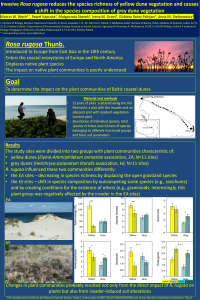
This study aimed to determine the impact of invasive Rosa rugosa Thunb. on the plant communities of Baltic coastal dunes. The study was carried out in 22 sites scattered along the Hel Peninsula (Poland). Each site consisted of a pair of plots: a plot with the invader and an adjacent plot with resident vegetation (control plot). For each plot, botanical data (abundance of individual species, total species richness and richness of species belonging to different functional groups) were collected and basic soil parameters were measured. According to the analysis of the control plot species composition, the study sites can be divided into two groups, with plant communities characteristic of yellow dunes (Elymo-Ammophiletum arenariae association, EA; N=11 sites) and those characteristic of grey dunes (Helichryso-Jasionetum litoralis association, HJ; N=11 sites). R. rugosa influenced these two communities differently. In the EA sites, it displaced many species leading to a significant decrease in species richness. In the HJ sites, it caused a shift in species composition; although it outcompeted some species (e.g., zoochores), it also created conditions for the existence of others (e.g., graminoids; interestingly, this plant group was negatively affected by the invader in the EA sites). Changes in plant communities probably resulted not only from the direct impact of R. rugosa on plants (shading, occupying space) but also from invader-induced soil alternations (increase in the organic layer thickness, increase in pH and the content of some nutrients).
Keywords
community structure
invasive plant species
plant traits
Rosa rugosa
soil properties
successional accelerator
Manuscript
abstract-sciforum-053095.pdf
Poster
Woch_Rosa_poster.pdf
Small mammal diversity and abundance in commercial orchards in relation to habitat and agricultural factors
Genome-wide screening for SNPs associated with stature in diverse cattle breeds