Event submissions
Published

This submission belongs to the session C. Microbials Diversity of the event The 2nd International Electronic Conference on Diversity
Published date
15 Mar, 2022
Academic Editor
'%3e%3cpath%20d='M12.6657%2010.9104C12.4185%2010.325%2012.0599%209.79327%2011.6097%209.34482C11.1609%208.89508%2010.6293%208.5365%2010.0442%208.28888C10.0389%208.28626%2010.0337%208.28495%2010.0285%208.28233C10.8446%207.69279%2011.3752%206.73249%2011.3752%205.64904C11.3752%203.8542%209.92103%202.39999%208.1262%202.39999C6.33136%202.39999%204.87715%203.8542%204.87715%205.64904C4.87715%206.73249%205.40774%207.69279%206.22393%208.28364C6.21869%208.28626%206.21345%208.28757%206.20821%208.29019C5.62129%208.5378%205.09463%208.89284%204.64265%209.34613C4.1929%209.79493%203.83432%2010.3266%203.58671%2010.9117C3.34345%2011.4845%203.21226%2012.0987%203.20023%2012.7209C3.19988%2012.7349%203.20233%2012.7488%203.20744%2012.7619C3.21255%2012.7749%203.22022%2012.7867%203.22998%2012.7968C3.23975%2012.8068%203.25142%2012.8147%203.26431%2012.8202C3.2772%2012.8256%203.29105%2012.8284%203.30504%2012.8284H4.09109C4.14874%2012.8284%204.19459%2012.7825%204.1959%2012.7262C4.2221%2011.7148%204.62823%2010.7676%205.34617%2010.0497C6.08899%209.30683%207.0755%208.89808%208.1262%208.89808C9.17689%208.89808%2010.1634%209.30683%2010.9062%2010.0497C11.6242%2010.7676%2012.0303%2011.7148%2012.0565%2012.7262C12.0578%2012.7838%2012.1037%2012.8284%2012.1613%2012.8284H12.9474C12.9613%2012.8284%2012.9752%2012.8256%2012.9881%2012.8202C13.001%2012.8147%2013.0126%2012.8068%2013.0224%2012.7968C13.0322%2012.7867%2013.0398%2012.7749%2013.0449%2012.7619C13.0501%2012.7488%2013.0525%2012.7349%2013.0522%2012.7209C13.0391%2012.0947%2012.9094%2011.4855%2012.6657%2010.9104ZM8.1262%207.9024C7.52486%207.9024%206.9589%207.6679%206.53312%207.24211C6.10733%206.81633%205.87283%206.25037%205.87283%205.64904C5.87283%205.0477%206.10733%204.48174%206.53312%204.05596C6.9589%203.63018%207.52486%203.39567%208.1262%203.39567C8.72753%203.39567%209.29349%203.63018%209.71927%204.05596C10.1451%204.48174%2010.3796%205.0477%2010.3796%205.64904C10.3796%206.25037%2010.1451%206.81633%209.71927%207.24211C9.29349%207.6679%208.72753%207.9024%208.1262%207.9024Z'%20fill='%235D1EE1'/%3e%3c/g%3e%3c/svg%3e) Ipek Kurtboke
Ipek KurtbokeCitation
Slađana Popović, Marija Pećić, Gordana Subakov Simić, Exploring lampenflora of Resavska Cave, Serbia, in Proceedings of The 2nd International Electronic Conference on Diversity, 15 March–31 March 2022, MDPI: Basel, Switzerland, doi: 10.3390/IECD2022-12425
Share
Email
Facebook
Twitter
LinkedIn
Exploring lampenflora of Resavska Cave, Serbia
'%3e%3cpath%20d='M12.6647%2010.9104C12.4176%2010.325%2012.0589%209.7933%2011.6088%209.34485C11.16%208.89511%2010.6283%208.53653%2010.0432%208.28891C10.038%208.28629%2010.0327%208.28498%2010.0275%208.28236C10.8437%207.69282%2011.3743%206.73252%2011.3743%205.64907C11.3743%203.85423%209.92005%202.40002%208.12522%202.40002C6.33038%202.40002%204.87618%203.85423%204.87618%205.64907C4.87618%206.73252%205.40677%207.69282%206.22296%208.28367C6.21772%208.28629%206.21248%208.2876%206.20724%208.29022C5.62031%208.53783%205.09365%208.89287%204.64167%209.34616C4.19192%209.79496%203.83334%2010.3266%203.58573%2010.9117C3.34247%2011.4846%203.21128%2012.0987%203.19925%2012.721C3.1989%2012.735%203.20135%2012.7489%203.20646%2012.7619C3.21157%2012.7749%203.21924%2012.7868%203.22901%2012.7968C3.23877%2012.8068%203.25045%2012.8148%203.26334%2012.8202C3.27623%2012.8256%203.29007%2012.8284%203.30406%2012.8284H4.09012C4.14776%2012.8284%204.19362%2012.7825%204.19493%2012.7262C4.22113%2011.7148%204.62726%2010.7676%205.34519%2010.0497C6.08802%209.30686%207.07452%208.89811%208.12522%208.89811C9.17592%208.89811%2010.1624%209.30686%2010.9052%2010.0497C11.6232%2010.7676%2012.0293%2011.7148%2012.0555%2012.7262C12.0568%2012.7839%2012.1027%2012.8284%2012.1603%2012.8284H12.9464C12.9604%2012.8284%2012.9742%2012.8256%2012.9871%2012.8202C13%2012.8148%2013.0117%2012.8068%2013.0214%2012.7968C13.0312%2012.7868%2013.0389%2012.7749%2013.044%2012.7619C13.0491%2012.7489%2013.0515%2012.735%2013.0512%2012.721C13.0381%2012.0947%2012.9084%2011.4856%2012.6647%2010.9104ZM8.12522%207.90243C7.52388%207.90243%206.95792%207.66793%206.53214%207.24215C6.10636%206.81636%205.87185%206.2504%205.87185%205.64907C5.87185%205.04773%206.10636%204.48177%206.53214%204.05599C6.95792%203.63021%207.52388%203.3957%208.12522%203.3957C8.72655%203.3957%209.29252%203.63021%209.7183%204.05599C10.1441%204.48177%2010.3786%205.04773%2010.3786%205.64907C10.3786%206.2504%2010.1441%206.81636%209.7183%207.24215C9.29252%207.66793%208.72655%207.90243%208.12522%207.90243Z'%20fill='%235D1EE1'/%3e%3c/g%3e%3c/svg%3e)
Slađana Popović 1
Marija Pećić 1
Gordana Subakov Simić 1
1. University of Belgrade, Faculty of Biology, Institute of Botany and Botanical Garden "Jevremovac", Takovska 43, Belgrade, Serbia
Abstract
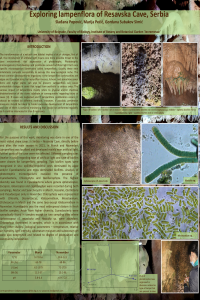
Lampenflora, a complex phototrophic community developing near artificial light in show caves, is recognized as a major concern for cave management and its regular monitoring became necessity. For the purpose of this work, monitoring was done in one of the most visited show caves in Serbia – Resavska Cave, directly before and after the main season in 2021, in March and November. Lampenflora was localized and developed mainly near artificial light, further parts of the cave were not affected. Different sampling sites (twelve in total) regarding type of artificial light and type of biofilm were chosen for lampenflora sampling. Two biofilm types were recognized in situ: epilithic/endolithic ones dominated by algae and/or Cyanobacteria and moss dominated biofilms. Analysis of phototrophic microorganisms revealed the presence of Cyanobacteria, Chlorophyta and Bacillariophyta. The highest diversity was found in Cyanobacteria where genera Aphanocapsa, Eucapsis, Gloeocapsa and Leptolyngbya were recorded during both samplings, Nostoc and Synechocystis in March, Hassalia, Oscillatoria and Pseudocapsa only in November. Chlorophyta were represented with Chlorella, Desmococcus, Klebsormidium, Mesotaenium, Stichococcus in March and the same taxa except Klebsormidium in November. Humidophila was the most widespread diatom in fresh biofilm samples. Aside from higher diversity, Cyanobacteria were sporadically found in samples except on two sampling sites where Aphanocapsa cf. muscicola and Hassalia sp. were abundant. Chlorophyta dominated in samples, which is in accordance with many other studies. Ecological parameters – temperature, relative air humidity, light intensity, substratum moisture and substratum pH were also determined and related to degree of colonization and community composition.
Keywords
show cave
lampenflora
Cyanobacteria and algae
Manuscript
sciforum-055933.pdf
Poster
Resavska poster.pdf
Characterization of the trophic niche for a Rockfish community in southeast Alaska
Conservation Status of Globally Testudines River Terrapins Based on DNA Barcoding