Event submissions
Published
 10.3390/IECD2022-12442 (registering DOI)
 This submission belongs to the session A. Animals Diversity of the event The 2nd International Electronic Conference on Diversity
Published date
17 Mar, 2022
Academic Editor
'%3e%3cpath%20d='M12.6657%2010.9104C12.4185%2010.325%2012.0599%209.79327%2011.6097%209.34482C11.1609%208.89508%2010.6293%208.5365%2010.0442%208.28888C10.0389%208.28626%2010.0337%208.28495%2010.0285%208.28233C10.8446%207.69279%2011.3752%206.73249%2011.3752%205.64904C11.3752%203.8542%209.92103%202.39999%208.1262%202.39999C6.33136%202.39999%204.87715%203.8542%204.87715%205.64904C4.87715%206.73249%205.40774%207.69279%206.22393%208.28364C6.21869%208.28626%206.21345%208.28757%206.20821%208.29019C5.62129%208.5378%205.09463%208.89284%204.64265%209.34613C4.1929%209.79493%203.83432%2010.3266%203.58671%2010.9117C3.34345%2011.4845%203.21226%2012.0987%203.20023%2012.7209C3.19988%2012.7349%203.20233%2012.7488%203.20744%2012.7619C3.21255%2012.7749%203.22022%2012.7867%203.22998%2012.7968C3.23975%2012.8068%203.25142%2012.8147%203.26431%2012.8202C3.2772%2012.8256%203.29105%2012.8284%203.30504%2012.8284H4.09109C4.14874%2012.8284%204.19459%2012.7825%204.1959%2012.7262C4.2221%2011.7148%204.62823%2010.7676%205.34617%2010.0497C6.08899%209.30683%207.0755%208.89808%208.1262%208.89808C9.17689%208.89808%2010.1634%209.30683%2010.9062%2010.0497C11.6242%2010.7676%2012.0303%2011.7148%2012.0565%2012.7262C12.0578%2012.7838%2012.1037%2012.8284%2012.1613%2012.8284H12.9474C12.9613%2012.8284%2012.9752%2012.8256%2012.9881%2012.8202C13.001%2012.8147%2013.0126%2012.8068%2013.0224%2012.7968C13.0322%2012.7867%2013.0398%2012.7749%2013.0449%2012.7619C13.0501%2012.7488%2013.0525%2012.7349%2013.0522%2012.7209C13.0391%2012.0947%2012.9094%2011.4855%2012.6657%2010.9104ZM8.1262%207.9024C7.52486%207.9024%206.9589%207.6679%206.53312%207.24211C6.10733%206.81633%205.87283%206.25037%205.87283%205.64904C5.87283%205.0477%206.10733%204.48174%206.53312%204.05596C6.9589%203.63018%207.52486%203.39567%208.1262%203.39567C8.72753%203.39567%209.29349%203.63018%209.71927%204.05596C10.1451%204.48174%2010.3796%205.0477%2010.3796%205.64904C10.3796%206.25037%2010.1451%206.81633%209.71927%207.24211C9.29349%207.6679%208.72753%207.9024%208.1262%207.9024Z'%20fill='%235D1EE1'/%3e%3c/g%3e%3c/svg%3e) Matthieu Chauvat
Matthieu ChauvatCitation
Daniel Redondo-Gómez, Moisés Gonzálvez, Lidia Rosell, Carlos Martínez-Carrasco, Pablo Jiménez-Nájar, José Antonio Sánchez-Zapata, Marcos Moleón, Carnivore carcasses as a source of hair for vertebrates, in Proceedings of The 2nd International Electronic Conference on Diversity, 15 March–31 March 2022, MDPI: Basel, Switzerland, doi: 10.3390/IECD2022-12442
Share
Email
Facebook
Twitter
LinkedIn
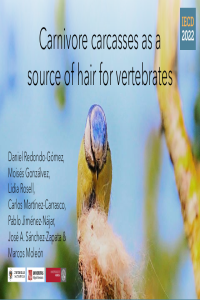
Carnivore carcasses as a source of hair for vertebrates

Daniel Redondo-Gómez 1
'%3e%3cpath%20d='M12.6647%2010.9104C12.4176%2010.325%2012.0589%209.7933%2011.6088%209.34485C11.16%208.89511%2010.6283%208.53653%2010.0432%208.28891C10.038%208.28629%2010.0327%208.28498%2010.0275%208.28236C10.8437%207.69282%2011.3743%206.73252%2011.3743%205.64907C11.3743%203.85423%209.92005%202.40002%208.12522%202.40002C6.33038%202.40002%204.87618%203.85423%204.87618%205.64907C4.87618%206.73252%205.40677%207.69282%206.22296%208.28367C6.21772%208.28629%206.21248%208.2876%206.20724%208.29022C5.62031%208.53783%205.09365%208.89287%204.64167%209.34616C4.19192%209.79496%203.83334%2010.3266%203.58573%2010.9117C3.34247%2011.4846%203.21128%2012.0987%203.19925%2012.721C3.1989%2012.735%203.20135%2012.7489%203.20646%2012.7619C3.21157%2012.7749%203.21924%2012.7868%203.22901%2012.7968C3.23877%2012.8068%203.25045%2012.8148%203.26334%2012.8202C3.27623%2012.8256%203.29007%2012.8284%203.30406%2012.8284H4.09012C4.14776%2012.8284%204.19362%2012.7825%204.19493%2012.7262C4.22113%2011.7148%204.62726%2010.7676%205.34519%2010.0497C6.08802%209.30686%207.07452%208.89811%208.12522%208.89811C9.17592%208.89811%2010.1624%209.30686%2010.9052%2010.0497C11.6232%2010.7676%2012.0293%2011.7148%2012.0555%2012.7262C12.0568%2012.7839%2012.1027%2012.8284%2012.1603%2012.8284H12.9464C12.9604%2012.8284%2012.9742%2012.8256%2012.9871%2012.8202C13%2012.8148%2013.0117%2012.8068%2013.0214%2012.7968C13.0312%2012.7868%2013.0389%2012.7749%2013.044%2012.7619C13.0491%2012.7489%2013.0515%2012.735%2013.0512%2012.721C13.0381%2012.0947%2012.9084%2011.4856%2012.6647%2010.9104ZM8.12522%207.90243C7.52388%207.90243%206.95792%207.66793%206.53214%207.24215C6.10636%206.81636%205.87185%206.2504%205.87185%205.64907C5.87185%205.04773%206.10636%204.48177%206.53214%204.05599C6.95792%203.63021%207.52388%203.3957%208.12522%203.3957C8.72655%203.3957%209.29252%203.63021%209.7183%204.05599C10.1441%204.48177%2010.3786%205.04773%2010.3786%205.64907C10.3786%206.2504%2010.1441%206.81636%209.7183%207.24215C9.29252%207.66793%208.72655%207.90243%208.12522%207.90243Z'%20fill='%235D1EE1'/%3e%3c/g%3e%3c/svg%3e)
Moisés Gonzálvez 2
Lidia Rosell 3

Carlos Martínez-Carrasco 2
Pablo Jiménez-Nájar 3
José Antonio Sánchez-Zapata 4
Marcos Moleón 1
1. Department of Zoology, University of Granada, Spain
2. Department of Animal Health, Faculty of Veterinary Sciences, University of Murcia, Spain
3. University of Murcia, Spain
4. Department of Applied Biology, University Miguel Hernández, Spain
Abstract
Carrion is more than food for scavengers and decomposers, as many non-trophic ecological functions are associated with this resource. For instance, a growing body of research highlights the important role of carcasses in disease dynamics. However, how carrion may provide other materials such as hair, feathers, bones, and skin for purposes other than food (e.g., nest construction) is greatly unknown. Carcasses of carnivorous animals may represent an outstanding source of these materials, as such carcasses persist longer in ecosystems than herbivore carcasses. In this study, we aimed to characterize the hair-taking behaviour of vertebrate species at carnivore carcasses in south-eastern Spain. Between 2017 and 2021, we deployed c. 100 carcasses of five mammalian carnivore species (mainly red foxes Vulpes vulpes) in three Mediterranean study areas between January and May. We monitored their entire decomposition process by using motion-triggered cameras with video recording. We detected hair-taking behaviour by several bird and mammal species, especially the carrion crow Corvus corone, the common raven Corvus corax, the great tit Parus major, the coal tit Periparus ater and the garden dormouse Eliomys quercinus. Hair was taken from different parts of the carcasses, but mostly from the tail. The peaks for this hair-taking behaviour varied throughout the entire study according to the different visitor species, suggesting a relationship with their breeding phenology. Our findings confirm that carcasses from mammalian carnivores are a highly persistent source of hair that is frequently used by several vertebrate species, probably for nest building. This is an example of the fruitful research avenues that may arise from the non-trophic uses of carrion.
Keywords
non-trophic uses of carrion
non-trophic functions of carcasses
hair-taking behaviour
hair use
nest building.
Manuscript
adstract-sciforum-053513.pdf
Poster
IEDC2022.pdf
Study of genetic diversity of Dagestan Mountain cattle based on STR-markers
Essential oil composition of Centaurea finazzeri and C. rupestris from North Macedonia