Event submissions
EventsMOL2NET'22, Conference on Molecular, Biomed., Comput. & Network Science and Engineering, 8th ed.
Published

This submission belongs to the session 01. CHEMBIO.INFO-08: Cheminfo., Chemom., Comput. Chem. & Bioinfo., Congress München, GR-Cambridge, UK-Ch. Hill, USA, 2022. of the event MOL2NET'22, Conference on Molecular, Biomed., Comput. & Network Science and Engineering, 8th ed.
Published date
29 Mar, 2022
Academic Editor
'%3e%3cpath%20d='M12.6657%2010.9104C12.4185%2010.325%2012.0599%209.79327%2011.6097%209.34482C11.1609%208.89508%2010.6293%208.5365%2010.0442%208.28888C10.0389%208.28626%2010.0337%208.28495%2010.0285%208.28233C10.8446%207.69279%2011.3752%206.73249%2011.3752%205.64904C11.3752%203.8542%209.92103%202.39999%208.1262%202.39999C6.33136%202.39999%204.87715%203.8542%204.87715%205.64904C4.87715%206.73249%205.40774%207.69279%206.22393%208.28364C6.21869%208.28626%206.21345%208.28757%206.20821%208.29019C5.62129%208.5378%205.09463%208.89284%204.64265%209.34613C4.1929%209.79493%203.83432%2010.3266%203.58671%2010.9117C3.34345%2011.4845%203.21226%2012.0987%203.20023%2012.7209C3.19988%2012.7349%203.20233%2012.7488%203.20744%2012.7619C3.21255%2012.7749%203.22022%2012.7867%203.22998%2012.7968C3.23975%2012.8068%203.25142%2012.8147%203.26431%2012.8202C3.2772%2012.8256%203.29105%2012.8284%203.30504%2012.8284H4.09109C4.14874%2012.8284%204.19459%2012.7825%204.1959%2012.7262C4.2221%2011.7148%204.62823%2010.7676%205.34617%2010.0497C6.08899%209.30683%207.0755%208.89808%208.1262%208.89808C9.17689%208.89808%2010.1634%209.30683%2010.9062%2010.0497C11.6242%2010.7676%2012.0303%2011.7148%2012.0565%2012.7262C12.0578%2012.7838%2012.1037%2012.8284%2012.1613%2012.8284H12.9474C12.9613%2012.8284%2012.9752%2012.8256%2012.9881%2012.8202C13.001%2012.8147%2013.0126%2012.8068%2013.0224%2012.7968C13.0322%2012.7867%2013.0398%2012.7749%2013.0449%2012.7619C13.0501%2012.7488%2013.0525%2012.7349%2013.0522%2012.7209C13.0391%2012.0947%2012.9094%2011.4855%2012.6657%2010.9104ZM8.1262%207.9024C7.52486%207.9024%206.9589%207.6679%206.53312%207.24211C6.10733%206.81633%205.87283%206.25037%205.87283%205.64904C5.87283%205.0477%206.10733%204.48174%206.53312%204.05596C6.9589%203.63018%207.52486%203.39567%208.1262%203.39567C8.72753%203.39567%209.29349%203.63018%209.71927%204.05596C10.1451%204.48174%2010.3796%205.0477%2010.3796%205.64904C10.3796%206.25037%2010.1451%206.81633%209.71927%207.24211C9.29349%207.6679%208.72753%207.9024%208.1262%207.9024Z'%20fill='%235D1EE1'/%3e%3c/g%3e%3c/svg%3e) Humbert G. Díaz
Humbert G. DíazCitation
Teresa CML Rodrigues, Jessica P De Moura, Igor MA De Araujo, Paulo SDS Pereira, Emille WR Da Silva, Jeremias J Emídio, Marcus Tullius Scotti, Luciana Scotti, Alex FM Monteiro, Prediction of antiviral activity, cytotoxicity risks and molecular docking against HIV of constituents from marine algae, in Proceedings of MOL2NET'22, Conference on Molecular, Biomed., Comput. & Network Science and Engineering, 8th ed., 1 January–15 January 2023, MDPI: Basel, Switzerland, doi: 10.3390/mol2net-08-12455
Share
Email
Facebook
Twitter
LinkedIn
Prediction of antiviral activity, cytotoxicity risks and molecular
docking against HIV of constituents from marine algae
docking against HIV of constituents from marine algae
'%3e%3cpath%20d='M12.6647%2010.9104C12.4176%2010.325%2012.0589%209.7933%2011.6088%209.34485C11.16%208.89511%2010.6283%208.53653%2010.0432%208.28891C10.038%208.28629%2010.0327%208.28498%2010.0275%208.28236C10.8437%207.69282%2011.3743%206.73252%2011.3743%205.64907C11.3743%203.85423%209.92005%202.40002%208.12522%202.40002C6.33038%202.40002%204.87618%203.85423%204.87618%205.64907C4.87618%206.73252%205.40677%207.69282%206.22296%208.28367C6.21772%208.28629%206.21248%208.2876%206.20724%208.29022C5.62031%208.53783%205.09365%208.89287%204.64167%209.34616C4.19192%209.79496%203.83334%2010.3266%203.58573%2010.9117C3.34247%2011.4846%203.21128%2012.0987%203.19925%2012.721C3.1989%2012.735%203.20135%2012.7489%203.20646%2012.7619C3.21157%2012.7749%203.21924%2012.7868%203.22901%2012.7968C3.23877%2012.8068%203.25045%2012.8148%203.26334%2012.8202C3.27623%2012.8256%203.29007%2012.8284%203.30406%2012.8284H4.09012C4.14776%2012.8284%204.19362%2012.7825%204.19493%2012.7262C4.22113%2011.7148%204.62726%2010.7676%205.34519%2010.0497C6.08802%209.30686%207.07452%208.89811%208.12522%208.89811C9.17592%208.89811%2010.1624%209.30686%2010.9052%2010.0497C11.6232%2010.7676%2012.0293%2011.7148%2012.0555%2012.7262C12.0568%2012.7839%2012.1027%2012.8284%2012.1603%2012.8284H12.9464C12.9604%2012.8284%2012.9742%2012.8256%2012.9871%2012.8202C13%2012.8148%2013.0117%2012.8068%2013.0214%2012.7968C13.0312%2012.7868%2013.0389%2012.7749%2013.044%2012.7619C13.0491%2012.7489%2013.0515%2012.735%2013.0512%2012.721C13.0381%2012.0947%2012.9084%2011.4856%2012.6647%2010.9104ZM8.12522%207.90243C7.52388%207.90243%206.95792%207.66793%206.53214%207.24215C6.10636%206.81636%205.87185%206.2504%205.87185%205.64907C5.87185%205.04773%206.10636%204.48177%206.53214%204.05599C6.95792%203.63021%207.52388%203.3957%208.12522%203.3957C8.72655%203.3957%209.29252%203.63021%209.7183%204.05599C10.1441%204.48177%2010.3786%205.04773%2010.3786%205.64907C10.3786%206.2504%2010.1441%206.81636%209.7183%207.24215C9.29252%207.66793%208.72655%207.90243%208.12522%207.90243Z'%20fill='%235D1EE1'/%3e%3c/g%3e%3c/svg%3e)
Teresa CML Rodrigues 1
Jessica P De Moura 1
Igor MA De Araujo 1
Paulo SDS Pereira 1
Emille WR Da Silva 1
Jeremias J Emídio 1

Marcus Tullius Scotti 2

Luciana Scotti 2,3

Alex FM Monteiro 4,5
1. Postgraduate Program in Bioactive Natural and Synthetic Products, Federal University of Paraíba, Castelo Branco - João Pessoa - Brazil
2. Federal University of Paraíba, Health Sci. Center, 50670-910, João Pessoa, PB, Brazil
3. Teaching and Research Management - University Hospital, Federal University of Paraíba, João Pessoa, PB, Brazil
4. Postgraduate Program in Bioactive Natural and Synthetic Products, Federal University of Paraíba, Castelo Branco - João Pessoa - Brazil.
5. Postgraduate Program in Chemistry - Federal Rural University of Pernambuco - UFRPE - Recife - PE.
Abstract
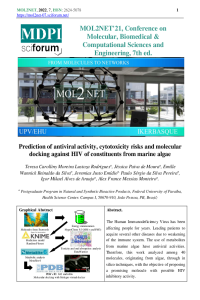
The Human Immunodeficiency Virus has been
affecting people for years. Leading patients to
acquire several other diseases due to weakening
of the immune system. The use of metabolites
from marine algae have antiviral activities.
Therefore, this work analyzed among 40
molecules, originating from algae, through in
silico techniques, with the objective of proposing
a promising molecule with possible HIV
inhibitory activity.
The disease caused by the Human Immunodeficiency Virus (HIV) has infected people for over 50 years. Currently, 37.7 million people live with the virus, among these 150,000 people were infected with
the HIV virus only in the year 2020, in addition 73% of people use drug therapy with retrovirals.
Therefore, it is important to investigate new possible drugs, one of these ways is through computational
techniques.
The oceans have an enormous biodiversity, with biological sources rich in bioactive molecules,
since the pharmaceutical and cosmetic industries seek technological innovations, numerous marine
sources have been the object of study.
Among these are marine algae that are divided into macroscopic and microscopic. Both are rich
in secondary metabolites that have great pharmacological potential. Seaweeds already have several
studies on their broad biological activities such as: antimicrobial, anticancer, antiallergic, antioxidant,
anticoagulant, antidiabetic, antiparasitic, anti-inflammatory and antiviral.
Thus, this work aimed to analyze the possible inhibitory activity of molecules present in
seaweeds in proteins present in HIV.
Keywords
Chemoinformatics
algae
molecular docking
Knime
in sico
Poster
Prediction of antiviral activity, cytotoxicity risks and molecular docking against HIV of constituents from marine algae.docx.pdf
Activity prediction, toxicity and molecular modeling of terpenoids against tuberculosis
Conservation Status of Globally Testudines Terrapins Based on COI Mitochondrial Markers