Event submissions
Published

This submission belongs to the session 10. Posters of the event 1st International Electronic Conference on Horticulturae
Published date
15 Apr, 2022
Academic Editor
'%3e%3cpath%20d='M12.6657%2010.9104C12.4185%2010.325%2012.0599%209.79327%2011.6097%209.34482C11.1609%208.89508%2010.6293%208.5365%2010.0442%208.28888C10.0389%208.28626%2010.0337%208.28495%2010.0285%208.28233C10.8446%207.69279%2011.3752%206.73249%2011.3752%205.64904C11.3752%203.8542%209.92103%202.39999%208.1262%202.39999C6.33136%202.39999%204.87715%203.8542%204.87715%205.64904C4.87715%206.73249%205.40774%207.69279%206.22393%208.28364C6.21869%208.28626%206.21345%208.28757%206.20821%208.29019C5.62129%208.5378%205.09463%208.89284%204.64265%209.34613C4.1929%209.79493%203.83432%2010.3266%203.58671%2010.9117C3.34345%2011.4845%203.21226%2012.0987%203.20023%2012.7209C3.19988%2012.7349%203.20233%2012.7488%203.20744%2012.7619C3.21255%2012.7749%203.22022%2012.7867%203.22998%2012.7968C3.23975%2012.8068%203.25142%2012.8147%203.26431%2012.8202C3.2772%2012.8256%203.29105%2012.8284%203.30504%2012.8284H4.09109C4.14874%2012.8284%204.19459%2012.7825%204.1959%2012.7262C4.2221%2011.7148%204.62823%2010.7676%205.34617%2010.0497C6.08899%209.30683%207.0755%208.89808%208.1262%208.89808C9.17689%208.89808%2010.1634%209.30683%2010.9062%2010.0497C11.6242%2010.7676%2012.0303%2011.7148%2012.0565%2012.7262C12.0578%2012.7838%2012.1037%2012.8284%2012.1613%2012.8284H12.9474C12.9613%2012.8284%2012.9752%2012.8256%2012.9881%2012.8202C13.001%2012.8147%2013.0126%2012.8068%2013.0224%2012.7968C13.0322%2012.7867%2013.0398%2012.7749%2013.0449%2012.7619C13.0501%2012.7488%2013.0525%2012.7349%2013.0522%2012.7209C13.0391%2012.0947%2012.9094%2011.4855%2012.6657%2010.9104ZM8.1262%207.9024C7.52486%207.9024%206.9589%207.6679%206.53312%207.24211C6.10733%206.81633%205.87283%206.25037%205.87283%205.64904C5.87283%205.0477%206.10733%204.48174%206.53312%204.05596C6.9589%203.63018%207.52486%203.39567%208.1262%203.39567C8.72753%203.39567%209.29349%203.63018%209.71927%204.05596C10.1451%204.48174%2010.3796%205.0477%2010.3796%205.64904C10.3796%206.25037%2010.1451%206.81633%209.71927%207.24211C9.29349%207.6679%208.72753%207.9024%208.1262%207.9024Z'%20fill='%235D1EE1'/%3e%3c/g%3e%3c/svg%3e) Yuyang Zhang
Yuyang ZhangCitation
Chenda LAI, Nachhy LY, Veasna TOUCH, Sarith HIN, Pascal PODWOJEWSKI, Pinnara KET, Pascal JOUQUET, Aurore DEGRÉ, Vannak ANN, Evaluating the Effect of Biochar on Nutrient Leaching and Rice Growth in Disturbed and Undisturbed Soil-columns, in Proceedings of 1st International Electronic Conference on Horticulturae, 16 April–30 April 2022, MDPI: Basel, Switzerland, doi: 10.3390/IECHo2022-12497
Share
Email
Facebook
Twitter
LinkedIn
Evaluating the Effect of Biochar on Nutrient Leaching and Rice Growth in Disturbed and Undisturbed Soil-columns

Chenda LAI 1,2
'%3e%3cpath%20d='M12.6647%2010.9104C12.4176%2010.325%2012.0589%209.7933%2011.6088%209.34485C11.16%208.89511%2010.6283%208.53653%2010.0432%208.28891C10.038%208.28629%2010.0327%208.28498%2010.0275%208.28236C10.8437%207.69282%2011.3743%206.73252%2011.3743%205.64907C11.3743%203.85423%209.92005%202.40002%208.12522%202.40002C6.33038%202.40002%204.87618%203.85423%204.87618%205.64907C4.87618%206.73252%205.40677%207.69282%206.22296%208.28367C6.21772%208.28629%206.21248%208.2876%206.20724%208.29022C5.62031%208.53783%205.09365%208.89287%204.64167%209.34616C4.19192%209.79496%203.83334%2010.3266%203.58573%2010.9117C3.34247%2011.4846%203.21128%2012.0987%203.19925%2012.721C3.1989%2012.735%203.20135%2012.7489%203.20646%2012.7619C3.21157%2012.7749%203.21924%2012.7868%203.22901%2012.7968C3.23877%2012.8068%203.25045%2012.8148%203.26334%2012.8202C3.27623%2012.8256%203.29007%2012.8284%203.30406%2012.8284H4.09012C4.14776%2012.8284%204.19362%2012.7825%204.19493%2012.7262C4.22113%2011.7148%204.62726%2010.7676%205.34519%2010.0497C6.08802%209.30686%207.07452%208.89811%208.12522%208.89811C9.17592%208.89811%2010.1624%209.30686%2010.9052%2010.0497C11.6232%2010.7676%2012.0293%2011.7148%2012.0555%2012.7262C12.0568%2012.7839%2012.1027%2012.8284%2012.1603%2012.8284H12.9464C12.9604%2012.8284%2012.9742%2012.8256%2012.9871%2012.8202C13%2012.8148%2013.0117%2012.8068%2013.0214%2012.7968C13.0312%2012.7868%2013.0389%2012.7749%2013.044%2012.7619C13.0491%2012.7489%2013.0515%2012.735%2013.0512%2012.721C13.0381%2012.0947%2012.9084%2011.4856%2012.6647%2010.9104ZM8.12522%207.90243C7.52388%207.90243%206.95792%207.66793%206.53214%207.24215C6.10636%206.81636%205.87185%206.2504%205.87185%205.64907C5.87185%205.04773%206.10636%204.48177%206.53214%204.05599C6.95792%203.63021%207.52388%203.3957%208.12522%203.3957C8.72655%203.3957%209.29252%203.63021%209.7183%204.05599C10.1441%204.48177%2010.3786%205.04773%2010.3786%205.64907C10.3786%206.2504%2010.1441%206.81636%209.7183%207.24215C9.29252%207.66793%208.72655%207.90243%208.12522%207.90243Z'%20fill='%235D1EE1'/%3e%3c/g%3e%3c/svg%3e)
Nachhy LY 3

Veasna TOUCH 4

Sarith HIN 4
Pascal PODWOJEWSKI 5
Pinnara KET 1,3

Pascal JOUQUET 5
Aurore DEGRÉ 2
Vannak ANN 1,3
1. WAE Research Unit, Institute of Technology of Cambodia, Phnom Penh, Cambodia
2. Gembloux Agro-Bio Tech, University of Liège, Gembloux, Belgium
3. Faculty of Hydrology and Water Resources Engineering, Institute of Technology of Cambodia, Phnom Penh, Cambodia
4. Water and Soil Science Division, Cambodia Agriculture and Research Development Institute, Phnom Penh, Cambodia
5. Sorbonne Université, UPEC, CNRS, IRD, INRAE, Institut d'écologie et des sciences de l'environnement, IEES, FEST, Paris, France
Abstract
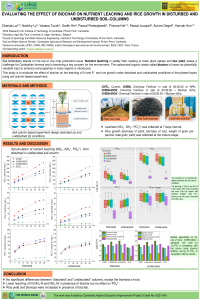
Soil fertilization stands on the top of the rice crop production issue. Nutrient leaching in rice crop production, leading to lower plant uptake and low yield, poses a challenge for Cambodian farmers and is becoming a key concern for the environment. The carbonized organic waste called biochar is known as potentially valuable input to enhance soil properties. It is introduced in many regions. A soil column-based experiment was conducted to evaluate the effect of biochar on the leaching of N and P and rice growth in link with soil structure. Two types of columns were built, using disturbed and undisturbed soil. Four rates of nutrient input including chemical fertilizer, chemical fertilizer +2t/ha of biochar, chemical fertilizer + 4t/ha of biochar, and control were applied to the plantation of rice cultivar (locally named, Sen-Pidor) in both conditions. Leachate (NH4-N, NO3-N, and PO43-) and rice growth were collected at 7-day intervals while the grain yield and biomass of plant were collected at the mature stage. Our primary results showed that the leachate and rice growth were not significantly different between the both conditions. However, the leaching of NH4-N and NO3-N in the column with chemical fertilizer + 4t/ha of biochar was lower than the column with chemical fertilizer while PO43- leaching was the same measured from both rates. Remarkably, the plant height was the highest under the disturbed condition with chemical fertilizer +2t/ha of biochar whereas under the undisturbed condition it was the highest with chemical fertilizer +4t/ha. In addition, biochar amendment at the rate of 4t/ha enhanced rice yield by 32.17% in comparison with the column using chemical fertilizer, and by 52.77% in comparison with the control. Also, biochar amendment at the rate of 4t/ha had a great impact on the biomass of plant compared to the column without biochar contact. Our results indicate that biochar amendment has the potential to minimize N leaching, but not P leaching, while enhancing rice yield and biomass of plant.
Keywords
Column-based experiment
nutrient application
plant height
rice paddy
Manuscript
sciforum-056484.pdf
Poster
Poster_Chenda LAI_IECHO2022.pdf
Germination, Growth and Yield Responses of Eggplant and Okra Grown on Anthill and Termite Mound Soils
Amino acids treatments induce adventitious root formation in two different genotypes of Campanula portenschlagiana