Event submissions
Published
 10.3390/IECHo2022-12505 (registering DOI)
 This submission belongs to the session 8. Fruit Production Systems of the event 1st International Electronic Conference on Horticulturae
Published date
15 Apr, 2022
Academic Editor
'%3e%3cpath%20d='M12.6657%2010.9104C12.4185%2010.325%2012.0599%209.79327%2011.6097%209.34482C11.1609%208.89508%2010.6293%208.5365%2010.0442%208.28888C10.0389%208.28626%2010.0337%208.28495%2010.0285%208.28233C10.8446%207.69279%2011.3752%206.73249%2011.3752%205.64904C11.3752%203.8542%209.92103%202.39999%208.1262%202.39999C6.33136%202.39999%204.87715%203.8542%204.87715%205.64904C4.87715%206.73249%205.40774%207.69279%206.22393%208.28364C6.21869%208.28626%206.21345%208.28757%206.20821%208.29019C5.62129%208.5378%205.09463%208.89284%204.64265%209.34613C4.1929%209.79493%203.83432%2010.3266%203.58671%2010.9117C3.34345%2011.4845%203.21226%2012.0987%203.20023%2012.7209C3.19988%2012.7349%203.20233%2012.7488%203.20744%2012.7619C3.21255%2012.7749%203.22022%2012.7867%203.22998%2012.7968C3.23975%2012.8068%203.25142%2012.8147%203.26431%2012.8202C3.2772%2012.8256%203.29105%2012.8284%203.30504%2012.8284H4.09109C4.14874%2012.8284%204.19459%2012.7825%204.1959%2012.7262C4.2221%2011.7148%204.62823%2010.7676%205.34617%2010.0497C6.08899%209.30683%207.0755%208.89808%208.1262%208.89808C9.17689%208.89808%2010.1634%209.30683%2010.9062%2010.0497C11.6242%2010.7676%2012.0303%2011.7148%2012.0565%2012.7262C12.0578%2012.7838%2012.1037%2012.8284%2012.1613%2012.8284H12.9474C12.9613%2012.8284%2012.9752%2012.8256%2012.9881%2012.8202C13.001%2012.8147%2013.0126%2012.8068%2013.0224%2012.7968C13.0322%2012.7867%2013.0398%2012.7749%2013.0449%2012.7619C13.0501%2012.7488%2013.0525%2012.7349%2013.0522%2012.7209C13.0391%2012.0947%2012.9094%2011.4855%2012.6657%2010.9104ZM8.1262%207.9024C7.52486%207.9024%206.9589%207.6679%206.53312%207.24211C6.10733%206.81633%205.87283%206.25037%205.87283%205.64904C5.87283%205.0477%206.10733%204.48174%206.53312%204.05596C6.9589%203.63018%207.52486%203.39567%208.1262%203.39567C8.72753%203.39567%209.29349%203.63018%209.71927%204.05596C10.1451%204.48174%2010.3796%205.0477%2010.3796%205.64904C10.3796%206.25037%2010.1451%206.81633%209.71927%207.24211C9.29349%207.6679%208.72753%207.9024%208.1262%207.9024Z'%20fill='%235D1EE1'/%3e%3c/g%3e%3c/svg%3e) Esmaeil Fallahi
Esmaeil FallahiCitation
Edward Muntean, Claudiu Ioan Bunea, Tania Mihaiescu, Ion-chromatographic fingerprinting of inorganic ions from bleeding sap in Vitis vinifera, in Proceedings of 1st International Electronic Conference on Horticulturae, 16 April–30 April 2022, MDPI: Basel, Switzerland, doi: 10.3390/IECHo2022-12505
Share
Email
Facebook
Twitter
LinkedIn
Ion-chromatographic fingerprinting of inorganic ions from bleeding sap in Vitis vinifera

Edward Muntean 1,2

Claudiu Ioan Bunea 1

Tania Mihaiescu 1
1. University of Agricultural Sciences and Veterinary Medicine Cluj Napoca, Romania
2. Research & Development Station for Agriculture, Turda, Romania
Abstract
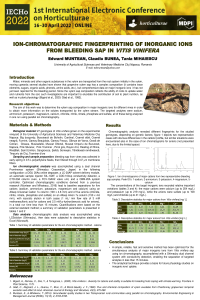
Water, minerals and other organic substances in the xylem are transported from the root system initially in the xylem, moving upward; several studies have shown that grapevine xylem sap has a complex composition (it contains trace elements, sugars, organic acids, phenols, amino acids, etc.), but comprehensive data on has not yet been reported for the bleeding period. Since the xylem sap composition reflects the ability of roots to uptake water and nutrients from soil, such investigations are important to clarify the contribution of soil to plant nutrition, as well as in plant physiology. The aim of this work was to determine the xylem sap composition in inorganic ions for different vines in order to obtain more information on the assimilation of the solutes transported by the xylem stream. Bleeding sap from 33 vines grown on the experimental vineyard of the University of Agricultural Sciences and Veterinary Medicine Cluj Napoca was collected in early spring in polyethylene flasks, then filtered through 0.47 mm membrane filters. Six cations (sodium, ammonium, potassium, magnesium and calcium) and five anions (chloride, nitrite, nitrate, phosphate and sulphate) were determined simultaneously by an optimized ion-chromatographic method on a dual channel Shimadzu instrument equipped with conductivity detection. Chromatographic analysis revealed different fingerprints for the analyzed samples; the major cations were calcium (up to 254 mg/L) and potassium (up to 219 mg/L), while the anions were sulphate (up to 108 mg/L) and chloride (up to 41 mg/L). The analytical technique used in this work, well suited for small samples and low concentrations, provide a basis for physiological studies such as ion uptake.
Keywords
ion-chromatography
Vitis vinifera
bleeding sap
potassium
calcium
Manuscript
IC Muntean poster.pdf
Poster
IC Muntean poster.pdf
Can natural fortification increase Fe and Zn content in organically grown tomatoes?
Shading Net and Grafting Reduce Losses by Environmental Stresses during Vegetables Production and Storage