Event submissions
Published
This submission belongs to the session I. Poster of the event The 3rd International Online Conference on Nanomaterials
Published date
22 Apr, 2022
Academic Editor
'%3e%3cpath%20d='M12.6657%2010.9104C12.4185%2010.325%2012.0599%209.79327%2011.6097%209.34482C11.1609%208.89508%2010.6293%208.5365%2010.0442%208.28888C10.0389%208.28626%2010.0337%208.28495%2010.0285%208.28233C10.8446%207.69279%2011.3752%206.73249%2011.3752%205.64904C11.3752%203.8542%209.92103%202.39999%208.1262%202.39999C6.33136%202.39999%204.87715%203.8542%204.87715%205.64904C4.87715%206.73249%205.40774%207.69279%206.22393%208.28364C6.21869%208.28626%206.21345%208.28757%206.20821%208.29019C5.62129%208.5378%205.09463%208.89284%204.64265%209.34613C4.1929%209.79493%203.83432%2010.3266%203.58671%2010.9117C3.34345%2011.4845%203.21226%2012.0987%203.20023%2012.7209C3.19988%2012.7349%203.20233%2012.7488%203.20744%2012.7619C3.21255%2012.7749%203.22022%2012.7867%203.22998%2012.7968C3.23975%2012.8068%203.25142%2012.8147%203.26431%2012.8202C3.2772%2012.8256%203.29105%2012.8284%203.30504%2012.8284H4.09109C4.14874%2012.8284%204.19459%2012.7825%204.1959%2012.7262C4.2221%2011.7148%204.62823%2010.7676%205.34617%2010.0497C6.08899%209.30683%207.0755%208.89808%208.1262%208.89808C9.17689%208.89808%2010.1634%209.30683%2010.9062%2010.0497C11.6242%2010.7676%2012.0303%2011.7148%2012.0565%2012.7262C12.0578%2012.7838%2012.1037%2012.8284%2012.1613%2012.8284H12.9474C12.9613%2012.8284%2012.9752%2012.8256%2012.9881%2012.8202C13.001%2012.8147%2013.0126%2012.8068%2013.0224%2012.7968C13.0322%2012.7867%2013.0398%2012.7749%2013.0449%2012.7619C13.0501%2012.7488%2013.0525%2012.7349%2013.0522%2012.7209C13.0391%2012.0947%2012.9094%2011.4855%2012.6657%2010.9104ZM8.1262%207.9024C7.52486%207.9024%206.9589%207.6679%206.53312%207.24211C6.10733%206.81633%205.87283%206.25037%205.87283%205.64904C5.87283%205.0477%206.10733%204.48174%206.53312%204.05596C6.9589%203.63018%207.52486%203.39567%208.1262%203.39567C8.72753%203.39567%209.29349%203.63018%209.71927%204.05596C10.1451%204.48174%2010.3796%205.0477%2010.3796%205.64904C10.3796%206.25037%2010.1451%206.81633%209.71927%207.24211C9.29349%207.6679%208.72753%207.9024%208.1262%207.9024Z'%20fill='%235D1EE1'/%3e%3c/g%3e%3c/svg%3e) Eleonore Fröhlich
Eleonore FröhlichCitation
Vladimir A. Shipelin, Fullerenes: Oral Toxicity and Biological Effects, in Proceedings of The 3rd International Online Conference on Nanomaterials, 25 April–10 May 2022, MDPI: Basel, Switzerland
Share
Email
Facebook
Twitter
LinkedIn
Fullerenes: Oral Toxicity and Biological Effects

Vladimir A. Shipelin 1,2,3
1. Federal Research Centre of Nutrition and Biotechnology, Moscow, Russia
2. Academic Department of Innovational Materials and Technologies Chemistry, Plekhanov Russian University
of Economics, Moscow, Russia
3. Peoples' Friendship University of Russia, Moscow, Russia
Abstract
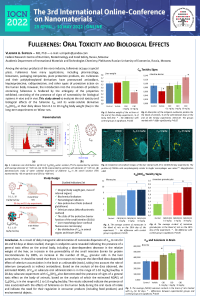
Among the various products of the nano industry, fullerenes occupy a special place. Fullerenes have many applications, including pharmacology, biosensors, packaging composites, plant protection products, etc. Fullerenes and their polyhydroxylated derivatives have pronounced antioxidant, hepatoprotective, radioprotective, and other types of protective action on the human body. However, the introduction into the circulation of products containing fullerenes is hindered by the ambiguity of the properties exhibited, consisting of the presence of signs of nanotoxicity for biological systems in vitro and in vivo. This study aimed to evaluate the oral toxicity of the fullerene C60 and its water-soluble derivative C60(OH)24 at their daily doses from 0.1 to 10 mg/kg body weight (bw) in the long-term experiments on Wistar rats. According to research results, C60 exhibited a general toxic effect in animals, expressed in a dose-dependent decrease in relative liver weight, impairment of barrier function of the small intestine, and an increase in the number of CD106+ granular cells in the liver parenchyma. The NOAEL for C60 on oral subacute administration was at least 1 mg/kg bw/day. Negative effects of C60(OH)24 in animals were manifested starting from a dose of 1 mg/kg bw and consisted in an increase of adrenal mass, changes in the leukocyte blood count, including an increase of monocytes, and immature granulocytes. Based on the results, it can be assumed that the NOAEL of C60(OH)24 for rats in a one-month experiment is at least 0.1 mg/kg bw. Among other biological effects, it is possible to note the dose-dependent increase in the selenium content in the blood, liver, and brain of rats, which consumed C60 for 92 days. Given the role of selenium compounds as indirect-acting antioxidants, there is no reason to interpret the detected effect as unfavorable. Nevertheless, the results of the toxicological assessment of fullerenes indicate the risks associated with their adverse effects on the human body when ingested and point out the necessity for the regulation of these compounds in consumer products and environmental objects.
Keywords
fullerene
C60
C60(OH)24
nanotoxicity
oral toxicity
antioxidant effect
selenium
NOAEL
Manuscript
sciforum-057779.pdf
Poster
sciforum-057779-Poster.pdf
Spectroscopic Studies of Interaction of Iron Oxide Nanoparticles with Ovalbumin Molecules
Optically Controlled Energy Transfer between Two Molecules Near a MoS2 Nanodisk