Event submissions
Published
This submission belongs to the session A. Synthesis, Characterization, and Properties of Nanomaterials of the event The 3rd International Online Conference on Nanomaterials
Published date
22 Apr, 2022
Academic Editor
'%3e%3cpath%20d='M12.6657%2010.9104C12.4185%2010.325%2012.0599%209.79327%2011.6097%209.34482C11.1609%208.89508%2010.6293%208.5365%2010.0442%208.28888C10.0389%208.28626%2010.0337%208.28495%2010.0285%208.28233C10.8446%207.69279%2011.3752%206.73249%2011.3752%205.64904C11.3752%203.8542%209.92103%202.39999%208.1262%202.39999C6.33136%202.39999%204.87715%203.8542%204.87715%205.64904C4.87715%206.73249%205.40774%207.69279%206.22393%208.28364C6.21869%208.28626%206.21345%208.28757%206.20821%208.29019C5.62129%208.5378%205.09463%208.89284%204.64265%209.34613C4.1929%209.79493%203.83432%2010.3266%203.58671%2010.9117C3.34345%2011.4845%203.21226%2012.0987%203.20023%2012.7209C3.19988%2012.7349%203.20233%2012.7488%203.20744%2012.7619C3.21255%2012.7749%203.22022%2012.7867%203.22998%2012.7968C3.23975%2012.8068%203.25142%2012.8147%203.26431%2012.8202C3.2772%2012.8256%203.29105%2012.8284%203.30504%2012.8284H4.09109C4.14874%2012.8284%204.19459%2012.7825%204.1959%2012.7262C4.2221%2011.7148%204.62823%2010.7676%205.34617%2010.0497C6.08899%209.30683%207.0755%208.89808%208.1262%208.89808C9.17689%208.89808%2010.1634%209.30683%2010.9062%2010.0497C11.6242%2010.7676%2012.0303%2011.7148%2012.0565%2012.7262C12.0578%2012.7838%2012.1037%2012.8284%2012.1613%2012.8284H12.9474C12.9613%2012.8284%2012.9752%2012.8256%2012.9881%2012.8202C13.001%2012.8147%2013.0126%2012.8068%2013.0224%2012.7968C13.0322%2012.7867%2013.0398%2012.7749%2013.0449%2012.7619C13.0501%2012.7488%2013.0525%2012.7349%2013.0522%2012.7209C13.0391%2012.0947%2012.9094%2011.4855%2012.6657%2010.9104ZM8.1262%207.9024C7.52486%207.9024%206.9589%207.6679%206.53312%207.24211C6.10733%206.81633%205.87283%206.25037%205.87283%205.64904C5.87283%205.0477%206.10733%204.48174%206.53312%204.05596C6.9589%203.63018%207.52486%203.39567%208.1262%203.39567C8.72753%203.39567%209.29349%203.63018%209.71927%204.05596C10.1451%204.48174%2010.3796%205.0477%2010.3796%205.64904C10.3796%206.25037%2010.1451%206.81633%209.71927%207.24211C9.29349%207.6679%208.72753%207.9024%208.1262%207.9024Z'%20fill='%235D1EE1'/%3e%3c/g%3e%3c/svg%3e) Guanying Chen
Guanying ChenCitation
Maksim Paukov, Anastasia Goldt, Gennadiy Komandin, Alexander Syuy, Dmitriy Yakubovskiy, Sergei Novikov, Alexander Polyakov, Reshef Tenne, Alla Zak, Albert Nasibulin, Aleksei Arsenin, Valentyn Volkov, Maria Burdanova, Comparison of Some Physical Properties of Doped and Pristine Nanotubes Based on Carbon and Tungsten Disulfide, in Proceedings of The 3rd International Online Conference on Nanomaterials, 25 April–10 May 2022, MDPI: Basel, Switzerland
Share
Email
Facebook
Twitter
LinkedIn
Comparison of Some Physical Properties of Doped and Pristine Nanotubes Based on Carbon and Tungsten Disulfide
'%3e%3cpath%20d='M12.6647%2010.9104C12.4176%2010.325%2012.0589%209.7933%2011.6088%209.34485C11.16%208.89511%2010.6283%208.53653%2010.0432%208.28891C10.038%208.28629%2010.0327%208.28498%2010.0275%208.28236C10.8437%207.69282%2011.3743%206.73252%2011.3743%205.64907C11.3743%203.85423%209.92005%202.40002%208.12522%202.40002C6.33038%202.40002%204.87618%203.85423%204.87618%205.64907C4.87618%206.73252%205.40677%207.69282%206.22296%208.28367C6.21772%208.28629%206.21248%208.2876%206.20724%208.29022C5.62031%208.53783%205.09365%208.89287%204.64167%209.34616C4.19192%209.79496%203.83334%2010.3266%203.58573%2010.9117C3.34247%2011.4846%203.21128%2012.0987%203.19925%2012.721C3.1989%2012.735%203.20135%2012.7489%203.20646%2012.7619C3.21157%2012.7749%203.21924%2012.7868%203.22901%2012.7968C3.23877%2012.8068%203.25045%2012.8148%203.26334%2012.8202C3.27623%2012.8256%203.29007%2012.8284%203.30406%2012.8284H4.09012C4.14776%2012.8284%204.19362%2012.7825%204.19493%2012.7262C4.22113%2011.7148%204.62726%2010.7676%205.34519%2010.0497C6.08802%209.30686%207.07452%208.89811%208.12522%208.89811C9.17592%208.89811%2010.1624%209.30686%2010.9052%2010.0497C11.6232%2010.7676%2012.0293%2011.7148%2012.0555%2012.7262C12.0568%2012.7839%2012.1027%2012.8284%2012.1603%2012.8284H12.9464C12.9604%2012.8284%2012.9742%2012.8256%2012.9871%2012.8202C13%2012.8148%2013.0117%2012.8068%2013.0214%2012.7968C13.0312%2012.7868%2013.0389%2012.7749%2013.044%2012.7619C13.0491%2012.7489%2013.0515%2012.735%2013.0512%2012.721C13.0381%2012.0947%2012.9084%2011.4856%2012.6647%2010.9104ZM8.12522%207.90243C7.52388%207.90243%206.95792%207.66793%206.53214%207.24215C6.10636%206.81636%205.87185%206.2504%205.87185%205.64907C5.87185%205.04773%206.10636%204.48177%206.53214%204.05599C6.95792%203.63021%207.52388%203.3957%208.12522%203.3957C8.72655%203.3957%209.29252%203.63021%209.7183%204.05599C10.1441%204.48177%2010.3786%205.04773%2010.3786%205.64907C10.3786%206.2504%2010.1441%206.81636%209.7183%207.24215C9.29252%207.66793%208.72655%207.90243%208.12522%207.90243Z'%20fill='%235D1EE1'/%3e%3c/g%3e%3c/svg%3e)
Maksim Paukov 1
Anastasia Goldt 2
Gennadiy Komandin 3
Alexander Syuy 1
Dmitriy Yakubovskiy 1
Sergei Novikov 1
Alexander Polyakov 4

Reshef Tenne 5

Alla Zak 6

Albert Nasibulin 2,7

Aleksei Arsenin 1,8
Valentyn Volkov 1,8
Maria Burdanova 1,9
1. Center for Photonics and 2D Materials, Moscow Institute of Physics and Technology, Institutskii Pereulok 9, 141700 Dolgoprudny, Russia
2. Skolkovo Institute of Science and Technology, Moscow
3. Prokhorov Institute of General Physics RAS, Moscow
4. Department of Physics, Chalmers University of Technology, 412 96, Gothenburg, Sweden
5. Department of Molecular Chemistry and Materials Science, Weizmann Institute of Science, Rehovot, Israel
6. Holon Institute of Technology, Israel
7. Aalto University, P. O. Box 16100, 00076 Aalto, Finland
8. GrapheneTek, Skolkovo Innovation Center, Moscow, Russia
9. Institute of Solid State Physics RAS, Chernogolovka
Abstract
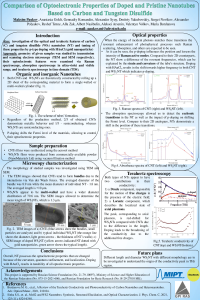
In this work, we present the experimental results on various spectroscopy measurements (including Raman, IR, optical, and terahertz spectroscopies) as well as the data on transmission and scanning electron microscopy of pristine and doped (with HAuCl4) nanotubes (NT) based on carbon (C) and tungsten disulfide (WS2). We observed the peaks of excitonic transitions (semiconducting ES11, ES22, and metallic EM11 transitions with wavelengths 2300, 1240, and 870 nm for CNT and A, B, C, D transitions with wavelengths 670, 550, 500, and 410 nm for WS2NT), Raman active modes (G-band 1585 cm-1 for CNT and E12g 417 cm-1, A1g 351 cm-1 for WS2NT). The behavior of conductivity of the pristine NT in the terahertz range was investigated. With the help of these measurements, the comparison of different pristine NT and their doped analogs was implemented and the shift of the Raman peaks and the changed conductivity behavior for doped nanotubes were found.
Keywords
carbon nanotubes
tungsten disulfide nanotubes
spectroscopy
doping
Manuscript
sciforum-057893.pdf
Poster
Poster_conf.pdf
Impurity Ferromagnetism of Pd-Fe and Pd-Co Alloys: Ab Initio vs. Experiment
Metal-Catechol Network (MCN) Based Bioactive Surface Engineering of Iron Reinforced Hydroxyapatite Nanorods for Bone Tissue Engineering