Event submissions
Published
This submission belongs to the session I. Poster of the event The 3rd International Online Conference on Nanomaterials
Published date
24 Apr, 2022
Academic Editor
'%3e%3cpath%20d='M12.6657%2010.9104C12.4185%2010.325%2012.0599%209.79327%2011.6097%209.34482C11.1609%208.89508%2010.6293%208.5365%2010.0442%208.28888C10.0389%208.28626%2010.0337%208.28495%2010.0285%208.28233C10.8446%207.69279%2011.3752%206.73249%2011.3752%205.64904C11.3752%203.8542%209.92103%202.39999%208.1262%202.39999C6.33136%202.39999%204.87715%203.8542%204.87715%205.64904C4.87715%206.73249%205.40774%207.69279%206.22393%208.28364C6.21869%208.28626%206.21345%208.28757%206.20821%208.29019C5.62129%208.5378%205.09463%208.89284%204.64265%209.34613C4.1929%209.79493%203.83432%2010.3266%203.58671%2010.9117C3.34345%2011.4845%203.21226%2012.0987%203.20023%2012.7209C3.19988%2012.7349%203.20233%2012.7488%203.20744%2012.7619C3.21255%2012.7749%203.22022%2012.7867%203.22998%2012.7968C3.23975%2012.8068%203.25142%2012.8147%203.26431%2012.8202C3.2772%2012.8256%203.29105%2012.8284%203.30504%2012.8284H4.09109C4.14874%2012.8284%204.19459%2012.7825%204.1959%2012.7262C4.2221%2011.7148%204.62823%2010.7676%205.34617%2010.0497C6.08899%209.30683%207.0755%208.89808%208.1262%208.89808C9.17689%208.89808%2010.1634%209.30683%2010.9062%2010.0497C11.6242%2010.7676%2012.0303%2011.7148%2012.0565%2012.7262C12.0578%2012.7838%2012.1037%2012.8284%2012.1613%2012.8284H12.9474C12.9613%2012.8284%2012.9752%2012.8256%2012.9881%2012.8202C13.001%2012.8147%2013.0126%2012.8068%2013.0224%2012.7968C13.0322%2012.7867%2013.0398%2012.7749%2013.0449%2012.7619C13.0501%2012.7488%2013.0525%2012.7349%2013.0522%2012.7209C13.0391%2012.0947%2012.9094%2011.4855%2012.6657%2010.9104ZM8.1262%207.9024C7.52486%207.9024%206.9589%207.6679%206.53312%207.24211C6.10733%206.81633%205.87283%206.25037%205.87283%205.64904C5.87283%205.0477%206.10733%204.48174%206.53312%204.05596C6.9589%203.63018%207.52486%203.39567%208.1262%203.39567C8.72753%203.39567%209.29349%203.63018%209.71927%204.05596C10.1451%204.48174%2010.3796%205.0477%2010.3796%205.64904C10.3796%206.25037%2010.1451%206.81633%209.71927%207.24211C9.29349%207.6679%208.72753%207.9024%208.1262%207.9024Z'%20fill='%235D1EE1'/%3e%3c/g%3e%3c/svg%3e) Eleonore Fröhlich
Eleonore FröhlichCitation
Vladimir A. Shipelin, Ivan V. Gmoshinski, Nikolay А. Riger, Antonina A. Shumakova, Eleonora N. Trushina, Oksana K. Mustafina, Sergey A. Khotimchenko, Carbon Nanomaterials as Promising Carriers of Cytostatic Drugs in Cancer Chemotherapy: Pilot Study, in Proceedings of The 3rd International Online Conference on Nanomaterials, 25 April–10 May 2022, MDPI: Basel, Switzerland
Share
Email
Facebook
Twitter
LinkedIn
Carbon Nanomaterials as Promising Carriers of Cytostatic Drugs in Cancer Chemotherapy: Pilot Study

Vladimir A. Shipelin 1,2,3
'%3e%3cpath%20d='M12.6647%2010.9104C12.4176%2010.325%2012.0589%209.7933%2011.6088%209.34485C11.16%208.89511%2010.6283%208.53653%2010.0432%208.28891C10.038%208.28629%2010.0327%208.28498%2010.0275%208.28236C10.8437%207.69282%2011.3743%206.73252%2011.3743%205.64907C11.3743%203.85423%209.92005%202.40002%208.12522%202.40002C6.33038%202.40002%204.87618%203.85423%204.87618%205.64907C4.87618%206.73252%205.40677%207.69282%206.22296%208.28367C6.21772%208.28629%206.21248%208.2876%206.20724%208.29022C5.62031%208.53783%205.09365%208.89287%204.64167%209.34616C4.19192%209.79496%203.83334%2010.3266%203.58573%2010.9117C3.34247%2011.4846%203.21128%2012.0987%203.19925%2012.721C3.1989%2012.735%203.20135%2012.7489%203.20646%2012.7619C3.21157%2012.7749%203.21924%2012.7868%203.22901%2012.7968C3.23877%2012.8068%203.25045%2012.8148%203.26334%2012.8202C3.27623%2012.8256%203.29007%2012.8284%203.30406%2012.8284H4.09012C4.14776%2012.8284%204.19362%2012.7825%204.19493%2012.7262C4.22113%2011.7148%204.62726%2010.7676%205.34519%2010.0497C6.08802%209.30686%207.07452%208.89811%208.12522%208.89811C9.17592%208.89811%2010.1624%209.30686%2010.9052%2010.0497C11.6232%2010.7676%2012.0293%2011.7148%2012.0555%2012.7262C12.0568%2012.7839%2012.1027%2012.8284%2012.1603%2012.8284H12.9464C12.9604%2012.8284%2012.9742%2012.8256%2012.9871%2012.8202C13%2012.8148%2013.0117%2012.8068%2013.0214%2012.7968C13.0312%2012.7868%2013.0389%2012.7749%2013.044%2012.7619C13.0491%2012.7489%2013.0515%2012.735%2013.0512%2012.721C13.0381%2012.0947%2012.9084%2011.4856%2012.6647%2010.9104ZM8.12522%207.90243C7.52388%207.90243%206.95792%207.66793%206.53214%207.24215C6.10636%206.81636%205.87185%206.2504%205.87185%205.64907C5.87185%205.04773%206.10636%204.48177%206.53214%204.05599C6.95792%203.63021%207.52388%203.3957%208.12522%203.3957C8.72655%203.3957%209.29252%203.63021%209.7183%204.05599C10.1441%204.48177%2010.3786%205.04773%2010.3786%205.64907C10.3786%206.2504%2010.1441%206.81636%209.7183%207.24215C9.29252%207.66793%208.72655%207.90243%208.12522%207.90243Z'%20fill='%235D1EE1'/%3e%3c/g%3e%3c/svg%3e)
Ivan V. Gmoshinski 1
Nikolay А. Riger 1
Antonina A. Shumakova 1
Eleonora N. Trushina 1
Oksana K. Mustafina 1
Sergey A. Khotimchenko 1
1. Federal Research Centre of Nutrition and Biotechnology, Moscow, Russia
2. Academic Department of Innovational Materials and Technologies Chemistry, Plekhanov Russian University
of Economics, Moscow, Russia
3. Peoples' Friendship University of Russia, Moscow, Russia
Abstract
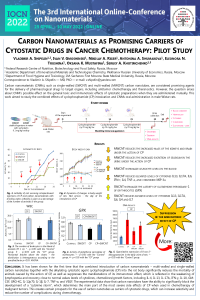
Carbon nanomaterials (CNMs), such as single-walled (SWCNT), multi-walled (MWCNT) carbon nanotubes, and fullerene derivatives, are considered promising agents for the delivery of pharmacological drugs to target organs, including antitumor chemotherapy and theranostics. However, the question arises about CNM’s possible effect on the general toxic and immunotoxic effects of cytostatic preparations when they are administered mutually. This work aimed to study the combined effects of cyclophosphamide (CP) intoxication and CNMs oral administration in male Wistar rats. In two experiments lasting 16 and 35 days MWCNT, SWCNT, or polyhydroxylated fullerenol (PHF60) were administered to control or treated by CP rats, at a dose of 0.1 mg/kg of body weight daily prepared as dispersions in drinking water. The lethality and integral parameters of rats were assessed; the content of erythrocytes and leukocytes, biochemical indicators, levels of cytokines, chemokines, and growth factors were measured. In the first experiment lasting 16 days, the consumption of both MWCNTs and SWCNTs led to an almost 2-fold decrease in mortality caused by the administration of CP. In the second experiment lasting 35 days, a similar decrease in mortality was noted for SWCNTs; the capability of MWCNTs and PHF60 to increase the survival of animals was also pronounced. Administration of MWCNT, SWCNT, and PHF60 to animals reduced the immunotoxic effects of CP, resulting in increased lymphocyte counts and correction of the imbalance between cytokines and chemokines/growth factors, including IL-4, IL-13, IL-17A, IFN-g, IL-18, GM -CSF, GRO-KC, IL-12p70, IL-1b, IL-7, TNF-a, and VEGF. Thus, various CNMs, when administered together with CP, caused a partial abolition of its general toxic and immunotoxic action, which can be explained by available literature data on the ability of CNMs to enhance the mobilization, migration, and adhesion of blood cells and trigger immune responses.
Keywords
drug delivery
cyclophosphamide
carbon nanotubes
fullerenol
rats
survival
cytokines
Manuscript
sciforum-057704-Poster.pdf
Poster
sciforum-057704-Poster.pdf
MAPLE Antimicrobial Coatings Based on Low-Cost Sustainable Natural Resources
High-Capacity, Cycle-Stable Zinc Vanadium Oxide Cathodes Enabled by In-Situ Electrochemical Oxidation for Zinc-Ion Batteries