Event submissions
Published
This submission belongs to the session I. Poster of the event The 3rd International Online Conference on Nanomaterials
Published date
24 Apr, 2022
Academic Editor
'%3e%3cpath%20d='M12.6657%2010.9104C12.4185%2010.325%2012.0599%209.79327%2011.6097%209.34482C11.1609%208.89508%2010.6293%208.5365%2010.0442%208.28888C10.0389%208.28626%2010.0337%208.28495%2010.0285%208.28233C10.8446%207.69279%2011.3752%206.73249%2011.3752%205.64904C11.3752%203.8542%209.92103%202.39999%208.1262%202.39999C6.33136%202.39999%204.87715%203.8542%204.87715%205.64904C4.87715%206.73249%205.40774%207.69279%206.22393%208.28364C6.21869%208.28626%206.21345%208.28757%206.20821%208.29019C5.62129%208.5378%205.09463%208.89284%204.64265%209.34613C4.1929%209.79493%203.83432%2010.3266%203.58671%2010.9117C3.34345%2011.4845%203.21226%2012.0987%203.20023%2012.7209C3.19988%2012.7349%203.20233%2012.7488%203.20744%2012.7619C3.21255%2012.7749%203.22022%2012.7867%203.22998%2012.7968C3.23975%2012.8068%203.25142%2012.8147%203.26431%2012.8202C3.2772%2012.8256%203.29105%2012.8284%203.30504%2012.8284H4.09109C4.14874%2012.8284%204.19459%2012.7825%204.1959%2012.7262C4.2221%2011.7148%204.62823%2010.7676%205.34617%2010.0497C6.08899%209.30683%207.0755%208.89808%208.1262%208.89808C9.17689%208.89808%2010.1634%209.30683%2010.9062%2010.0497C11.6242%2010.7676%2012.0303%2011.7148%2012.0565%2012.7262C12.0578%2012.7838%2012.1037%2012.8284%2012.1613%2012.8284H12.9474C12.9613%2012.8284%2012.9752%2012.8256%2012.9881%2012.8202C13.001%2012.8147%2013.0126%2012.8068%2013.0224%2012.7968C13.0322%2012.7867%2013.0398%2012.7749%2013.0449%2012.7619C13.0501%2012.7488%2013.0525%2012.7349%2013.0522%2012.7209C13.0391%2012.0947%2012.9094%2011.4855%2012.6657%2010.9104ZM8.1262%207.9024C7.52486%207.9024%206.9589%207.6679%206.53312%207.24211C6.10733%206.81633%205.87283%206.25037%205.87283%205.64904C5.87283%205.0477%206.10733%204.48174%206.53312%204.05596C6.9589%203.63018%207.52486%203.39567%208.1262%203.39567C8.72753%203.39567%209.29349%203.63018%209.71927%204.05596C10.1451%204.48174%2010.3796%205.0477%2010.3796%205.64904C10.3796%206.25037%2010.1451%206.81633%209.71927%207.24211C9.29349%207.6679%208.72753%207.9024%208.1262%207.9024Z'%20fill='%235D1EE1'/%3e%3c/g%3e%3c/svg%3e) Antonio Di Bartolomeo
Antonio Di BartolomeoCitation
Katarzyna Olkowska-Pucko, Elena Blundo, Salvatore Cianci, Natalia Zawadzka, Diana Vaclavkova, Piotr Kapuściński, Marek Potemski, Kenji Watanabe, Takashi Taniguchi, Adam Babiński, Antonio Polimeni, Maciej Molas, WSSe Monolayers as a New Darkish Material, in Proceedings of The 3rd International Online Conference on Nanomaterials, 25 April–10 May 2022, MDPI: Basel, Switzerland
Share
Email
Facebook
Twitter
LinkedIn
WSSe Monolayers as a New Darkish Material
'%3e%3cpath%20d='M12.6647%2010.9104C12.4176%2010.325%2012.0589%209.7933%2011.6088%209.34485C11.16%208.89511%2010.6283%208.53653%2010.0432%208.28891C10.038%208.28629%2010.0327%208.28498%2010.0275%208.28236C10.8437%207.69282%2011.3743%206.73252%2011.3743%205.64907C11.3743%203.85423%209.92005%202.40002%208.12522%202.40002C6.33038%202.40002%204.87618%203.85423%204.87618%205.64907C4.87618%206.73252%205.40677%207.69282%206.22296%208.28367C6.21772%208.28629%206.21248%208.2876%206.20724%208.29022C5.62031%208.53783%205.09365%208.89287%204.64167%209.34616C4.19192%209.79496%203.83334%2010.3266%203.58573%2010.9117C3.34247%2011.4846%203.21128%2012.0987%203.19925%2012.721C3.1989%2012.735%203.20135%2012.7489%203.20646%2012.7619C3.21157%2012.7749%203.21924%2012.7868%203.22901%2012.7968C3.23877%2012.8068%203.25045%2012.8148%203.26334%2012.8202C3.27623%2012.8256%203.29007%2012.8284%203.30406%2012.8284H4.09012C4.14776%2012.8284%204.19362%2012.7825%204.19493%2012.7262C4.22113%2011.7148%204.62726%2010.7676%205.34519%2010.0497C6.08802%209.30686%207.07452%208.89811%208.12522%208.89811C9.17592%208.89811%2010.1624%209.30686%2010.9052%2010.0497C11.6232%2010.7676%2012.0293%2011.7148%2012.0555%2012.7262C12.0568%2012.7839%2012.1027%2012.8284%2012.1603%2012.8284H12.9464C12.9604%2012.8284%2012.9742%2012.8256%2012.9871%2012.8202C13%2012.8148%2013.0117%2012.8068%2013.0214%2012.7968C13.0312%2012.7868%2013.0389%2012.7749%2013.044%2012.7619C13.0491%2012.7489%2013.0515%2012.735%2013.0512%2012.721C13.0381%2012.0947%2012.9084%2011.4856%2012.6647%2010.9104ZM8.12522%207.90243C7.52388%207.90243%206.95792%207.66793%206.53214%207.24215C6.10636%206.81636%205.87185%206.2504%205.87185%205.64907C5.87185%205.04773%206.10636%204.48177%206.53214%204.05599C6.95792%203.63021%207.52388%203.3957%208.12522%203.3957C8.72655%203.3957%209.29252%203.63021%209.7183%204.05599C10.1441%204.48177%2010.3786%205.04773%2010.3786%205.64907C10.3786%206.2504%2010.1441%206.81636%209.7183%207.24215C9.29252%207.66793%208.72655%207.90243%208.12522%207.90243Z'%20fill='%235D1EE1'/%3e%3c/g%3e%3c/svg%3e)
Katarzyna Olkowska-Pucko 1
Elena Blundo 2
Salvatore Cianci 2
Natalia Zawadzka 1
Diana Vaclavkova 3
Piotr Kapuściński 3
Marek Potemski 3
Kenji Watanabe 4
Takashi Taniguchi 5
Adam Babiński 1

Antonio Polimeni 2

Maciej Molas 1
1. Institute of Experimental Physics, Faculty of Physics, University of Warsaw, ul. Pasteura 5, 02-093 Warsaw, Poland
2. Physics Department, Sapienza University of Rome, p.le Aldo Moro 2, 00185 Rome, Italy
3. Laboratoire National des Champs Magnétiques Intenses, CNRS-UGA-UPS-INSA-EMFL, 25, avenue des Martyrs, 38042 Grenoble, France
4. Research Center for Functional Materials, National Institute for Materials Science, 1-1 Namiki, Tsukuba 305-0044, Japan
5. International Center for Materials Nanoarchitectonics, National Institute for Materials Science, 1-1 Namiki, Tsukuba 305-0044, Japan
Abstract
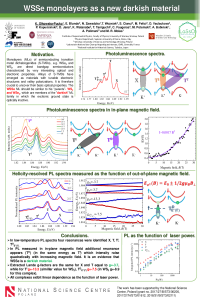
Monolayers of transition metal dichalcogenides (TMD) are direct bandgap semiconductors in which optical and spin properties are dominated by the formation of bound electron-hole pairs, excitons. Alloys of TDMS have emerged as materials with tunable electronic structures, effective masses of carriers, and valley polarization with various alloy compositions. In this work we investigate the low-temperature photoluminescence spectra of WSSe monolayer embedded in hexagonal boron nitride (hBN) layers using external magnetic fields. On this basis we extract g-factors which help us to distinguish excitonic complexes. Additionally, we study PL spectra in the function of laser power and temperature. Based on these experiments we identify emissions due to bright (exciton and trion) transitions and dark (negative trion) transition. WSSe is comparable to WS2 and WSe2 so-called „darkish” materials, in which the excitonic ground state is optically inactive. The energy range of emission lines which correspond to excitionic complexes apparent in WSSe is similar to WS2 and WSe2. These two materials are known for their excellent valley polarisation due to the strong spin−orbit coupling and WSSe is expected to be the same.
Keywords
transition metal dichalcogenides
monolayers
WSSe
excitons
photoluminescence
g-factor
Manuscript
sciforum-058144.pdf
Poster
sciforum-058144.pdf
Simultaneous Realization of High Sulfur Utilization and Lithium Dendrite-Free via 3D Carbon Network Structure Based Nanomaterials toward Advanced Lithium-Sulfur Batteries
Preparation and Electrochemical Properties of Flexible Ni-BTA@CNTs Composite Films