Event submissions
Published
This submission belongs to the session I. Poster of the event The 3rd International Online Conference on Nanomaterials
Published date
24 Apr, 2022
Academic Editor
'%3e%3cpath%20d='M12.6657%2010.9104C12.4185%2010.325%2012.0599%209.79327%2011.6097%209.34482C11.1609%208.89508%2010.6293%208.5365%2010.0442%208.28888C10.0389%208.28626%2010.0337%208.28495%2010.0285%208.28233C10.8446%207.69279%2011.3752%206.73249%2011.3752%205.64904C11.3752%203.8542%209.92103%202.39999%208.1262%202.39999C6.33136%202.39999%204.87715%203.8542%204.87715%205.64904C4.87715%206.73249%205.40774%207.69279%206.22393%208.28364C6.21869%208.28626%206.21345%208.28757%206.20821%208.29019C5.62129%208.5378%205.09463%208.89284%204.64265%209.34613C4.1929%209.79493%203.83432%2010.3266%203.58671%2010.9117C3.34345%2011.4845%203.21226%2012.0987%203.20023%2012.7209C3.19988%2012.7349%203.20233%2012.7488%203.20744%2012.7619C3.21255%2012.7749%203.22022%2012.7867%203.22998%2012.7968C3.23975%2012.8068%203.25142%2012.8147%203.26431%2012.8202C3.2772%2012.8256%203.29105%2012.8284%203.30504%2012.8284H4.09109C4.14874%2012.8284%204.19459%2012.7825%204.1959%2012.7262C4.2221%2011.7148%204.62823%2010.7676%205.34617%2010.0497C6.08899%209.30683%207.0755%208.89808%208.1262%208.89808C9.17689%208.89808%2010.1634%209.30683%2010.9062%2010.0497C11.6242%2010.7676%2012.0303%2011.7148%2012.0565%2012.7262C12.0578%2012.7838%2012.1037%2012.8284%2012.1613%2012.8284H12.9474C12.9613%2012.8284%2012.9752%2012.8256%2012.9881%2012.8202C13.001%2012.8147%2013.0126%2012.8068%2013.0224%2012.7968C13.0322%2012.7867%2013.0398%2012.7749%2013.0449%2012.7619C13.0501%2012.7488%2013.0525%2012.7349%2013.0522%2012.7209C13.0391%2012.0947%2012.9094%2011.4855%2012.6657%2010.9104ZM8.1262%207.9024C7.52486%207.9024%206.9589%207.6679%206.53312%207.24211C6.10733%206.81633%205.87283%206.25037%205.87283%205.64904C5.87283%205.0477%206.10733%204.48174%206.53312%204.05596C6.9589%203.63018%207.52486%203.39567%208.1262%203.39567C8.72753%203.39567%209.29349%203.63018%209.71927%204.05596C10.1451%204.48174%2010.3796%205.0477%2010.3796%205.64904C10.3796%206.25037%2010.1451%206.81633%209.71927%207.24211C9.29349%207.6679%208.72753%207.9024%208.1262%207.9024Z'%20fill='%235D1EE1'/%3e%3c/g%3e%3c/svg%3e) Eleonore Fröhlich
Eleonore FröhlichCitation
Alexandra Dobranici, Aida Șelaru, Elena Olaret, Izabela Stancu, Marieta Costache, Sorina Dinescu, MNPs-Enriched Biomaterials as Promising Candidates for Nervous Tissue Engineering Applications, in Proceedings of The 3rd International Online Conference on Nanomaterials, 25 April–10 May 2022, MDPI: Basel, Switzerland
Share
Email
Facebook
Twitter
LinkedIn
MNPs-Enriched Biomaterials as Promising Candidates for Nervous Tissue Engineering Applications

Alexandra Dobranici 1
'%3e%3cpath%20d='M12.6647%2010.9104C12.4176%2010.325%2012.0589%209.7933%2011.6088%209.34485C11.16%208.89511%2010.6283%208.53653%2010.0432%208.28891C10.038%208.28629%2010.0327%208.28498%2010.0275%208.28236C10.8437%207.69282%2011.3743%206.73252%2011.3743%205.64907C11.3743%203.85423%209.92005%202.40002%208.12522%202.40002C6.33038%202.40002%204.87618%203.85423%204.87618%205.64907C4.87618%206.73252%205.40677%207.69282%206.22296%208.28367C6.21772%208.28629%206.21248%208.2876%206.20724%208.29022C5.62031%208.53783%205.09365%208.89287%204.64167%209.34616C4.19192%209.79496%203.83334%2010.3266%203.58573%2010.9117C3.34247%2011.4846%203.21128%2012.0987%203.19925%2012.721C3.1989%2012.735%203.20135%2012.7489%203.20646%2012.7619C3.21157%2012.7749%203.21924%2012.7868%203.22901%2012.7968C3.23877%2012.8068%203.25045%2012.8148%203.26334%2012.8202C3.27623%2012.8256%203.29007%2012.8284%203.30406%2012.8284H4.09012C4.14776%2012.8284%204.19362%2012.7825%204.19493%2012.7262C4.22113%2011.7148%204.62726%2010.7676%205.34519%2010.0497C6.08802%209.30686%207.07452%208.89811%208.12522%208.89811C9.17592%208.89811%2010.1624%209.30686%2010.9052%2010.0497C11.6232%2010.7676%2012.0293%2011.7148%2012.0555%2012.7262C12.0568%2012.7839%2012.1027%2012.8284%2012.1603%2012.8284H12.9464C12.9604%2012.8284%2012.9742%2012.8256%2012.9871%2012.8202C13%2012.8148%2013.0117%2012.8068%2013.0214%2012.7968C13.0312%2012.7868%2013.0389%2012.7749%2013.044%2012.7619C13.0491%2012.7489%2013.0515%2012.735%2013.0512%2012.721C13.0381%2012.0947%2012.9084%2011.4856%2012.6647%2010.9104ZM8.12522%207.90243C7.52388%207.90243%206.95792%207.66793%206.53214%207.24215C6.10636%206.81636%205.87185%206.2504%205.87185%205.64907C5.87185%205.04773%206.10636%204.48177%206.53214%204.05599C6.95792%203.63021%207.52388%203.3957%208.12522%203.3957C8.72655%203.3957%209.29252%203.63021%209.7183%204.05599C10.1441%204.48177%2010.3786%205.04773%2010.3786%205.64907C10.3786%206.2504%2010.1441%206.81636%209.7183%207.24215C9.29252%207.66793%208.72655%207.90243%208.12522%207.90243Z'%20fill='%235D1EE1'/%3e%3c/g%3e%3c/svg%3e)
Aida Șelaru 1

Elena Olaret 2

Izabela Stancu 2

Marieta Costache 1

Sorina Dinescu 1
1. Department of Biochemistry and Molecular Biology, Faculty of Biology, University of Bucharest, Bucharest, Romania
2. Advanced Polymer Materials Group (APMG), University Politehnica of Bucharest, Bucharest, Romania
Abstract
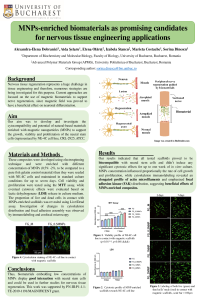
Nervous tissue regeneration represents a huge challenge in tissue engineering and therefore, numerous strategies are being investigated for this purpose. Current approaches are focused on the use of magnetic biomaterials to support nerve regeneration, since magnetic field was proved to have a beneficial effect on neuronal differentiation. Our aim was to develop and investigate the cytocompatibility and potential of natural-based materials enriched with magnetic nanoparticles (MNPs) to support the growth, viability and proliferation of neural stem cells (represented by NE-4C cell line, CRL-2925, ATCC). These composites were developed using electrospinning technique and were enriched with different concentration of MNPs (0.5% -2%, to be compared to a pure fish gelatin control material) then they were seeded with NE-4C cells and maintained in standard culture conditions for up to seven days. Cell viability and proliferation were tested using the MTT assay, while eventual cytotoxic effects were evaluated based on lactic dehydrogenase (LDH) release in culture medium. The proportion of live and dead cells in contact with MNPs-enriched scaffolds was revealed using Live/Dead assay. Investigation of changes in cytoskeleton distribution and focal adhesion assembly was observed by immunolabeling and confocal microscopy. Our results indicated that all tested scaffolds proved to be biocompatible with neural stem cells and didn’t induce any significant cytotoxic effects for up to one week of in vitro culture. MNPs concentration influenced proportionally the rate of cell growth and proliferation, while cytoskeleton immunolabeling revealed an elongated profile of actin microfilaments and emphasized focal adhesion kinase distribution, suggesting beneficial effects of MNPs-enriched composites. Thus, biomaterials embedding low concentrations of MNPs display good interaction with neural stem cells and could be used in further studies for nervous tissue regeneration. This work was supported by PN-III-P1-1.1-TE-2019-1191/MAGNIFICENT grant.
Keywords
magnetic biomaterials
neural stem cells
nervous tissue engineering
Manuscript
sciforum-058216-Poster.pdf
Poster
sciforum-058216-Poster.pdf
Trimetallic Nanocomposites Serving as Potential Fluorescent and Magnetic Resonance Imaging Probes
Deposition Time Effect of Photogrown and Photodecorated Ag Nanoparticles on ZnO Nanocolumns for SERS Substrates