Event submissions
Published
This submission belongs to the session I. Poster of the event The 3rd International Online Conference on Nanomaterials
Published date
24 Apr, 2022
Academic Editor
'%3e%3cpath%20d='M12.6657%2010.9104C12.4185%2010.325%2012.0599%209.79327%2011.6097%209.34482C11.1609%208.89508%2010.6293%208.5365%2010.0442%208.28888C10.0389%208.28626%2010.0337%208.28495%2010.0285%208.28233C10.8446%207.69279%2011.3752%206.73249%2011.3752%205.64904C11.3752%203.8542%209.92103%202.39999%208.1262%202.39999C6.33136%202.39999%204.87715%203.8542%204.87715%205.64904C4.87715%206.73249%205.40774%207.69279%206.22393%208.28364C6.21869%208.28626%206.21345%208.28757%206.20821%208.29019C5.62129%208.5378%205.09463%208.89284%204.64265%209.34613C4.1929%209.79493%203.83432%2010.3266%203.58671%2010.9117C3.34345%2011.4845%203.21226%2012.0987%203.20023%2012.7209C3.19988%2012.7349%203.20233%2012.7488%203.20744%2012.7619C3.21255%2012.7749%203.22022%2012.7867%203.22998%2012.7968C3.23975%2012.8068%203.25142%2012.8147%203.26431%2012.8202C3.2772%2012.8256%203.29105%2012.8284%203.30504%2012.8284H4.09109C4.14874%2012.8284%204.19459%2012.7825%204.1959%2012.7262C4.2221%2011.7148%204.62823%2010.7676%205.34617%2010.0497C6.08899%209.30683%207.0755%208.89808%208.1262%208.89808C9.17689%208.89808%2010.1634%209.30683%2010.9062%2010.0497C11.6242%2010.7676%2012.0303%2011.7148%2012.0565%2012.7262C12.0578%2012.7838%2012.1037%2012.8284%2012.1613%2012.8284H12.9474C12.9613%2012.8284%2012.9752%2012.8256%2012.9881%2012.8202C13.001%2012.8147%2013.0126%2012.8068%2013.0224%2012.7968C13.0322%2012.7867%2013.0398%2012.7749%2013.0449%2012.7619C13.0501%2012.7488%2013.0525%2012.7349%2013.0522%2012.7209C13.0391%2012.0947%2012.9094%2011.4855%2012.6657%2010.9104ZM8.1262%207.9024C7.52486%207.9024%206.9589%207.6679%206.53312%207.24211C6.10733%206.81633%205.87283%206.25037%205.87283%205.64904C5.87283%205.0477%206.10733%204.48174%206.53312%204.05596C6.9589%203.63018%207.52486%203.39567%208.1262%203.39567C8.72753%203.39567%209.29349%203.63018%209.71927%204.05596C10.1451%204.48174%2010.3796%205.0477%2010.3796%205.64904C10.3796%206.25037%2010.1451%206.81633%209.71927%207.24211C9.29349%207.6679%208.72753%207.9024%208.1262%207.9024Z'%20fill='%235D1EE1'/%3e%3c/g%3e%3c/svg%3e) Guanying Chen
Guanying ChenCitation
Maria Guadalupe Soriano-Rosales, Adriana Báez-Rodríguez, Julian Hernández-Torres, Leandro García-González, Manuel García-Hipólito, Luis Zamora-Peredo, Deposition Time Effect of Photogrown and Photodecorated Ag Nanoparticles on ZnO Nanocolumns for SERS Substrates, in Proceedings of The 3rd International Online Conference on Nanomaterials, 25 April–10 May 2022, MDPI: Basel, Switzerland
Share
Email
Facebook
Twitter
LinkedIn
Deposition Time Effect of Photogrown and Photodecorated Ag Nanoparticles on ZnO Nanocolumns for SERS Substrates
'%3e%3cpath%20d='M12.6647%2010.9104C12.4176%2010.325%2012.0589%209.7933%2011.6088%209.34485C11.16%208.89511%2010.6283%208.53653%2010.0432%208.28891C10.038%208.28629%2010.0327%208.28498%2010.0275%208.28236C10.8437%207.69282%2011.3743%206.73252%2011.3743%205.64907C11.3743%203.85423%209.92005%202.40002%208.12522%202.40002C6.33038%202.40002%204.87618%203.85423%204.87618%205.64907C4.87618%206.73252%205.40677%207.69282%206.22296%208.28367C6.21772%208.28629%206.21248%208.2876%206.20724%208.29022C5.62031%208.53783%205.09365%208.89287%204.64167%209.34616C4.19192%209.79496%203.83334%2010.3266%203.58573%2010.9117C3.34247%2011.4846%203.21128%2012.0987%203.19925%2012.721C3.1989%2012.735%203.20135%2012.7489%203.20646%2012.7619C3.21157%2012.7749%203.21924%2012.7868%203.22901%2012.7968C3.23877%2012.8068%203.25045%2012.8148%203.26334%2012.8202C3.27623%2012.8256%203.29007%2012.8284%203.30406%2012.8284H4.09012C4.14776%2012.8284%204.19362%2012.7825%204.19493%2012.7262C4.22113%2011.7148%204.62726%2010.7676%205.34519%2010.0497C6.08802%209.30686%207.07452%208.89811%208.12522%208.89811C9.17592%208.89811%2010.1624%209.30686%2010.9052%2010.0497C11.6232%2010.7676%2012.0293%2011.7148%2012.0555%2012.7262C12.0568%2012.7839%2012.1027%2012.8284%2012.1603%2012.8284H12.9464C12.9604%2012.8284%2012.9742%2012.8256%2012.9871%2012.8202C13%2012.8148%2013.0117%2012.8068%2013.0214%2012.7968C13.0312%2012.7868%2013.0389%2012.7749%2013.044%2012.7619C13.0491%2012.7489%2013.0515%2012.735%2013.0512%2012.721C13.0381%2012.0947%2012.9084%2011.4856%2012.6647%2010.9104ZM8.12522%207.90243C7.52388%207.90243%206.95792%207.66793%206.53214%207.24215C6.10636%206.81636%205.87185%206.2504%205.87185%205.64907C5.87185%205.04773%206.10636%204.48177%206.53214%204.05599C6.95792%203.63021%207.52388%203.3957%208.12522%203.3957C8.72655%203.3957%209.29252%203.63021%209.7183%204.05599C10.1441%204.48177%2010.3786%205.04773%2010.3786%205.64907C10.3786%206.2504%2010.1441%206.81636%209.7183%207.24215C9.29252%207.66793%208.72655%207.90243%208.12522%207.90243Z'%20fill='%235D1EE1'/%3e%3c/g%3e%3c/svg%3e)
Maria Guadalupe Soriano-Rosales 1
Adriana Báez-Rodríguez 1
Julian Hernández-Torres 1
Leandro García-González 1
Manuel García-Hipólito 2
Luis Zamora-Peredo 1
1. Centro de Investigación en Micro y Nanotecnología, Universidad Veracruzana, Boca del Río, México.
2. Instituto de Investigaciones en Materiales, Universidad Nacional Autónoma de México, Ciudad de México, México.
Abstract
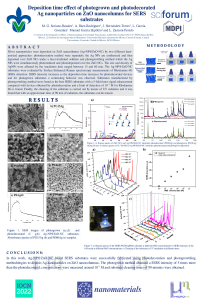
Silver nanoparticles were deposited on ZnO nanocolumns (Ag-NP@ZnO-NC) by two different laser-assisted approaches: photodecoration method were separately the Ag NPs are synthesized and then deposited over ZnO NCs under a laser-irradiated solution and photogrowthing method which the Ag NPs were simultaneously photoreduced and photodeposited over the ZnO NCs. Irradiation time ranged between 15 and 60 min were studied. Surface-Enhanced Raman spectroscopy measurements of Ag-NP@ZnO-NC substrates were evaluated with Rhodamine 6G as an analyte. The size and density of AgNPs were affected the irradiation time.For photodecorated devices, the SERS intensity increases as the deposition time increases and for photogrown substrates, a contrary behavior was observed. Substrates manufactured by photogrowthing method were found as the best SERS substrates with a 5-fold times signal enhancement compared with devices obtained by photodecoration. Under the experimental optimized conditions is obtained with a limit of detection up to 10−6 M for Rhodamine 6G (R6G).
Keywords
Ag Nanoparticles
ZnO Nanocolumns
SERS
photodecoration
photogrowthing
Raman.
Manuscript
sciforum-058225-Poster.pdf
Poster
sciforum-058225-Poster.pdf
MNPs-Enriched Biomaterials as Promising Candidates for Nervous Tissue Engineering Applications
SERS Detection of Methylene Blue and Crystal Violet Using Silver Nanostars