Event submissions
Published
This submission belongs to the session I. Poster of the event The 3rd International Online Conference on Nanomaterials
Published date
10 May, 2022
Academic Editor
'%3e%3cpath%20d='M12.6657%2010.9104C12.4185%2010.325%2012.0599%209.79327%2011.6097%209.34482C11.1609%208.89508%2010.6293%208.5365%2010.0442%208.28888C10.0389%208.28626%2010.0337%208.28495%2010.0285%208.28233C10.8446%207.69279%2011.3752%206.73249%2011.3752%205.64904C11.3752%203.8542%209.92103%202.39999%208.1262%202.39999C6.33136%202.39999%204.87715%203.8542%204.87715%205.64904C4.87715%206.73249%205.40774%207.69279%206.22393%208.28364C6.21869%208.28626%206.21345%208.28757%206.20821%208.29019C5.62129%208.5378%205.09463%208.89284%204.64265%209.34613C4.1929%209.79493%203.83432%2010.3266%203.58671%2010.9117C3.34345%2011.4845%203.21226%2012.0987%203.20023%2012.7209C3.19988%2012.7349%203.20233%2012.7488%203.20744%2012.7619C3.21255%2012.7749%203.22022%2012.7867%203.22998%2012.7968C3.23975%2012.8068%203.25142%2012.8147%203.26431%2012.8202C3.2772%2012.8256%203.29105%2012.8284%203.30504%2012.8284H4.09109C4.14874%2012.8284%204.19459%2012.7825%204.1959%2012.7262C4.2221%2011.7148%204.62823%2010.7676%205.34617%2010.0497C6.08899%209.30683%207.0755%208.89808%208.1262%208.89808C9.17689%208.89808%2010.1634%209.30683%2010.9062%2010.0497C11.6242%2010.7676%2012.0303%2011.7148%2012.0565%2012.7262C12.0578%2012.7838%2012.1037%2012.8284%2012.1613%2012.8284H12.9474C12.9613%2012.8284%2012.9752%2012.8256%2012.9881%2012.8202C13.001%2012.8147%2013.0126%2012.8068%2013.0224%2012.7968C13.0322%2012.7867%2013.0398%2012.7749%2013.0449%2012.7619C13.0501%2012.7488%2013.0525%2012.7349%2013.0522%2012.7209C13.0391%2012.0947%2012.9094%2011.4855%2012.6657%2010.9104ZM8.1262%207.9024C7.52486%207.9024%206.9589%207.6679%206.53312%207.24211C6.10733%206.81633%205.87283%206.25037%205.87283%205.64904C5.87283%205.0477%206.10733%204.48174%206.53312%204.05596C6.9589%203.63018%207.52486%203.39567%208.1262%203.39567C8.72753%203.39567%209.29349%203.63018%209.71927%204.05596C10.1451%204.48174%2010.3796%205.0477%2010.3796%205.64904C10.3796%206.25037%2010.1451%206.81633%209.71927%207.24211C9.29349%207.6679%208.72753%207.9024%208.1262%207.9024Z'%20fill='%235D1EE1'/%3e%3c/g%3e%3c/svg%3e) Andre Skirtach
Andre SkirtachCitation
Joana M. Domingues, Marta O. Teixeira, Marta A. Teixeira, David Freitas, Samira F. da Silva, Shafagh D. Tohidi, Rui D. V. Fernandes, Jorge Padrão, Andrea Zille, Carla Silva, Joana C. Antunes, Helena P. Felgueiras, Essential Oils-Loaded Nanofibrous Mats for an Enhanced Protection against SARS-CoV-2, in Proceedings of The 3rd International Online Conference on Nanomaterials, 25 April–10 May 2022, MDPI: Basel, Switzerland
Share
Email
Facebook
Twitter
LinkedIn
Essential Oils-Loaded Nanofibrous Mats for an Enhanced Protection against SARS-CoV-2
'%3e%3cpath%20d='M12.6647%2010.9104C12.4176%2010.325%2012.0589%209.7933%2011.6088%209.34485C11.16%208.89511%2010.6283%208.53653%2010.0432%208.28891C10.038%208.28629%2010.0327%208.28498%2010.0275%208.28236C10.8437%207.69282%2011.3743%206.73252%2011.3743%205.64907C11.3743%203.85423%209.92005%202.40002%208.12522%202.40002C6.33038%202.40002%204.87618%203.85423%204.87618%205.64907C4.87618%206.73252%205.40677%207.69282%206.22296%208.28367C6.21772%208.28629%206.21248%208.2876%206.20724%208.29022C5.62031%208.53783%205.09365%208.89287%204.64167%209.34616C4.19192%209.79496%203.83334%2010.3266%203.58573%2010.9117C3.34247%2011.4846%203.21128%2012.0987%203.19925%2012.721C3.1989%2012.735%203.20135%2012.7489%203.20646%2012.7619C3.21157%2012.7749%203.21924%2012.7868%203.22901%2012.7968C3.23877%2012.8068%203.25045%2012.8148%203.26334%2012.8202C3.27623%2012.8256%203.29007%2012.8284%203.30406%2012.8284H4.09012C4.14776%2012.8284%204.19362%2012.7825%204.19493%2012.7262C4.22113%2011.7148%204.62726%2010.7676%205.34519%2010.0497C6.08802%209.30686%207.07452%208.89811%208.12522%208.89811C9.17592%208.89811%2010.1624%209.30686%2010.9052%2010.0497C11.6232%2010.7676%2012.0293%2011.7148%2012.0555%2012.7262C12.0568%2012.7839%2012.1027%2012.8284%2012.1603%2012.8284H12.9464C12.9604%2012.8284%2012.9742%2012.8256%2012.9871%2012.8202C13%2012.8148%2013.0117%2012.8068%2013.0214%2012.7968C13.0312%2012.7868%2013.0389%2012.7749%2013.044%2012.7619C13.0491%2012.7489%2013.0515%2012.735%2013.0512%2012.721C13.0381%2012.0947%2012.9084%2011.4856%2012.6647%2010.9104ZM8.12522%207.90243C7.52388%207.90243%206.95792%207.66793%206.53214%207.24215C6.10636%206.81636%205.87185%206.2504%205.87185%205.64907C5.87185%205.04773%206.10636%204.48177%206.53214%204.05599C6.95792%203.63021%207.52388%203.3957%208.12522%203.3957C8.72655%203.3957%209.29252%203.63021%209.7183%204.05599C10.1441%204.48177%2010.3786%205.04773%2010.3786%205.64907C10.3786%206.2504%2010.1441%206.81636%209.7183%207.24215C9.29252%207.66793%208.72655%207.90243%208.12522%207.90243Z'%20fill='%235D1EE1'/%3e%3c/g%3e%3c/svg%3e)
Joana M. Domingues 1
Marta O. Teixeira 1
Marta A. Teixeira 1
David Freitas 2
Samira F. da Silva 1

Shafagh D. Tohidi 3
Rui D. V. Fernandes 1

Jorge Padrão 1

Andrea Zille 1

Carla Silva 2

Joana C. Antunes 1

Helena P. Felgueiras 4
1. Centre for Textile Science and Technology, University of Minho
2. Centre of Biological Engineering, University of Minho
3. Digital Transformation Colab, University of Minho
4. Centre for Textile Science and Technology, University of Minho, Portugal
Abstract
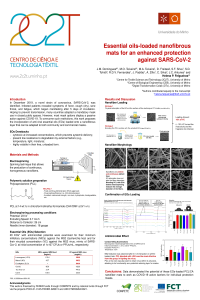
Twenty EOs were examined for the first time against the Escherichia coli MS2 virus (surrogate of SARS-CoV-2). The most effective were the lemongrass (LGO), Niaouli (NO) and eucalyptus (ELO) with a virucidal concentration (VC) of 356.0, 365.2 and 586.0 mg/mL, respectively. PCL was processed via electrospinning, generating uniform, beadless fibrous mats. EOs loading was accomplished via (1) physisorption on pre-existing mats (PCLaEOs), and (2) blending with polymer solution prior to electrospinning (PCLbEOs). In both, 10% v/v VC was used. EOs presence and release was confirmed by UV-visible spectroscopy (≈5257-631 µg) and gas chromatography-mass spectrometry (≈14.3% EOs release over 4 h), respectively. PCLbEOs mats were mechanically and thermal resilient, with LGO promoting the strongest bonds with PCL (PCLbLGO). On the other hand, PCLaNO and PCLaELO were deemed the least cohesive combinations. EOs-loaded mats were identified as superhydrophobic. Air and water-vapor permeabilities were affected by the mats’ porosity (PCL<PCLaEOs<PCLbEOs). Antimicrobial testing revealed the mats’ ability to retain the virus and to inhibit its action. PCLbLGO was the most effective combination against MS2. These mats’ scent was also deemed the most pleasant. Overall, data demonstrated the potential of these EOs-loaded PCL fibrous mats to work as COVID-19 active barriers for individual protection masks. Other applications in individual protection equipment may also be envisaged, including disposable hospital gowns, head and shoe caps, etc.
Keywords
electrospun fibers
antiviral essential oils
physisorption versus blending
SARS-CoV-2 surrogate
viral inhibitors
Manuscript
sciforum-058139-Poster.pdf
Poster
sciforum-058139-Poster.pdf
Optimization of Synthesis of Bovine Serum Albumin-Encapsulated Fluorescent Gold Nanoclusters
Immobilization of Fungal Peroxidase on Paramagnetic Nanoparticles for Synthetic Dye Decolorization