Event submissions
EventsThe 1st International Electronic Conference on Processes: Processes System Innovation
Published

This submission belongs to the session 9. Poster of the event The 1st International Electronic Conference on Processes: Processes System Innovation
Published date
23 May, 2022
Academic Editor
'%3e%3cpath%20d='M12.6657%2010.9104C12.4185%2010.325%2012.0599%209.79327%2011.6097%209.34482C11.1609%208.89508%2010.6293%208.5365%2010.0442%208.28888C10.0389%208.28626%2010.0337%208.28495%2010.0285%208.28233C10.8446%207.69279%2011.3752%206.73249%2011.3752%205.64904C11.3752%203.8542%209.92103%202.39999%208.1262%202.39999C6.33136%202.39999%204.87715%203.8542%204.87715%205.64904C4.87715%206.73249%205.40774%207.69279%206.22393%208.28364C6.21869%208.28626%206.21345%208.28757%206.20821%208.29019C5.62129%208.5378%205.09463%208.89284%204.64265%209.34613C4.1929%209.79493%203.83432%2010.3266%203.58671%2010.9117C3.34345%2011.4845%203.21226%2012.0987%203.20023%2012.7209C3.19988%2012.7349%203.20233%2012.7488%203.20744%2012.7619C3.21255%2012.7749%203.22022%2012.7867%203.22998%2012.7968C3.23975%2012.8068%203.25142%2012.8147%203.26431%2012.8202C3.2772%2012.8256%203.29105%2012.8284%203.30504%2012.8284H4.09109C4.14874%2012.8284%204.19459%2012.7825%204.1959%2012.7262C4.2221%2011.7148%204.62823%2010.7676%205.34617%2010.0497C6.08899%209.30683%207.0755%208.89808%208.1262%208.89808C9.17689%208.89808%2010.1634%209.30683%2010.9062%2010.0497C11.6242%2010.7676%2012.0303%2011.7148%2012.0565%2012.7262C12.0578%2012.7838%2012.1037%2012.8284%2012.1613%2012.8284H12.9474C12.9613%2012.8284%2012.9752%2012.8256%2012.9881%2012.8202C13.001%2012.8147%2013.0126%2012.8068%2013.0224%2012.7968C13.0322%2012.7867%2013.0398%2012.7749%2013.0449%2012.7619C13.0501%2012.7488%2013.0525%2012.7349%2013.0522%2012.7209C13.0391%2012.0947%2012.9094%2011.4855%2012.6657%2010.9104ZM8.1262%207.9024C7.52486%207.9024%206.9589%207.6679%206.53312%207.24211C6.10733%206.81633%205.87283%206.25037%205.87283%205.64904C5.87283%205.0477%206.10733%204.48174%206.53312%204.05596C6.9589%203.63018%207.52486%203.39567%208.1262%203.39567C8.72753%203.39567%209.29349%203.63018%209.71927%204.05596C10.1451%204.48174%2010.3796%205.0477%2010.3796%205.64904C10.3796%206.25037%2010.1451%206.81633%209.71927%207.24211C9.29349%207.6679%208.72753%207.9024%208.1262%207.9024Z'%20fill='%235D1EE1'/%3e%3c/g%3e%3c/svg%3e) Ioannis Spanopoulos
Ioannis SpanopoulosCitation
Ekaterina Kurzina, Irina Stenina, Li1+yTi2-x-yGexAly(PO4)3 NASICON-type electrolytes with enhanced conductivity for solid statelithium-ion batteries, in Proceedings of The 1st International Electronic Conference on Processes: Processes System Innovation, 17 May–31 May 2022, MDPI: Basel, Switzerland, doi: 10.3390/ECP2022-12627
Share
Email
Facebook
Twitter
LinkedIn
Li1+yTi2-x-yGexAly(PO4)3 NASICON-type electrolytes with enhanced conductivity for solid statelithium-ion batteries
'%3e%3cpath%20d='M12.6647%2010.9104C12.4176%2010.325%2012.0589%209.7933%2011.6088%209.34485C11.16%208.89511%2010.6283%208.53653%2010.0432%208.28891C10.038%208.28629%2010.0327%208.28498%2010.0275%208.28236C10.8437%207.69282%2011.3743%206.73252%2011.3743%205.64907C11.3743%203.85423%209.92005%202.40002%208.12522%202.40002C6.33038%202.40002%204.87618%203.85423%204.87618%205.64907C4.87618%206.73252%205.40677%207.69282%206.22296%208.28367C6.21772%208.28629%206.21248%208.2876%206.20724%208.29022C5.62031%208.53783%205.09365%208.89287%204.64167%209.34616C4.19192%209.79496%203.83334%2010.3266%203.58573%2010.9117C3.34247%2011.4846%203.21128%2012.0987%203.19925%2012.721C3.1989%2012.735%203.20135%2012.7489%203.20646%2012.7619C3.21157%2012.7749%203.21924%2012.7868%203.22901%2012.7968C3.23877%2012.8068%203.25045%2012.8148%203.26334%2012.8202C3.27623%2012.8256%203.29007%2012.8284%203.30406%2012.8284H4.09012C4.14776%2012.8284%204.19362%2012.7825%204.19493%2012.7262C4.22113%2011.7148%204.62726%2010.7676%205.34519%2010.0497C6.08802%209.30686%207.07452%208.89811%208.12522%208.89811C9.17592%208.89811%2010.1624%209.30686%2010.9052%2010.0497C11.6232%2010.7676%2012.0293%2011.7148%2012.0555%2012.7262C12.0568%2012.7839%2012.1027%2012.8284%2012.1603%2012.8284H12.9464C12.9604%2012.8284%2012.9742%2012.8256%2012.9871%2012.8202C13%2012.8148%2013.0117%2012.8068%2013.0214%2012.7968C13.0312%2012.7868%2013.0389%2012.7749%2013.044%2012.7619C13.0491%2012.7489%2013.0515%2012.735%2013.0512%2012.721C13.0381%2012.0947%2012.9084%2011.4856%2012.6647%2010.9104ZM8.12522%207.90243C7.52388%207.90243%206.95792%207.66793%206.53214%207.24215C6.10636%206.81636%205.87185%206.2504%205.87185%205.64907C5.87185%205.04773%206.10636%204.48177%206.53214%204.05599C6.95792%203.63021%207.52388%203.3957%208.12522%203.3957C8.72655%203.3957%209.29252%203.63021%209.7183%204.05599C10.1441%204.48177%2010.3786%205.04773%2010.3786%205.64907C10.3786%206.2504%2010.1441%206.81636%209.7183%207.24215C9.29252%207.66793%208.72655%207.90243%208.12522%207.90243Z'%20fill='%235D1EE1'/%3e%3c/g%3e%3c/svg%3e)
Ekaterina Kurzina 1
Irina Stenina 1
1. Institute of general and inorganic chemistry of Russian Academy of Science
Abstract
The use of lithium-ion batteries allows to reliable and efficient storage of electricity.Commercial batteries use flammable liquid organic electrolytes, which have low thermal andelectrochemical stability. Replacing liquid electrolytes with solid ones will solve these problems.NASICON structured electrolytes, in particular LATP (Li1+yTi2-yAly(PO4)3) and LAGP (Li1+yGe2-3yAly(PO4) ), are among the most promising electrolytes for all-solid-state batteries. Partialreplacement of titanium ions by germanium ions can lead to materials that combine the highlithium-ion conductivity of LATP with the high chemical stability of LAGP. The aim of thiswork was to synthesize and study the ionic mobility of Li1+yTi2-x-yGexAly(PO4)3 (x = 0-2, y = 0-0.3) with the NASICON structure.Li1+yTi2-x-yGexAly(PO4)3 (x = 0-2, y = 0-0.3) electrolytes were synthesized by the solid-state method and investigated using X-ray diffraction and scanning electron microscopy,impedance spectroscopy, and NMR spectroscopy. The processes occurring during the solid-statesynthesis of Li1+yTi2-x-yGexAly(PO4)3 have been studied. An increase in conductivity from10-7 S/cm to 4.6.10-6 S/cm at 25°C was found when 10% titanium ions were replaced bygermanium. Additional introduction of aluminum results in increase in lithium conductivity up to1.4.10-4 S/cm (25 °C). Since grain boundaries are of decisive importance for the overall ionicconductivity of the NASICON-structured phosphates, the influence of precursor mechanicaltreatment on the microstructure and ionic conductivity of the prepared materials was studied.The use of mechanical treatment leads to a significant increase in grain size (reducing the grainboundaries and its resistance) and an increase in ionic conductivity (up to 6.4.10-4 S/cm at 25 °C).The obtained materials can be considered as promising solid electrolytes for all-solid-statelithium batteries with high safety and stability.
Keywords
ion conductivity
solid electrolyte
lithium-ion battery.
Manuscript
sciforum-058746-layout.pdf
Poster
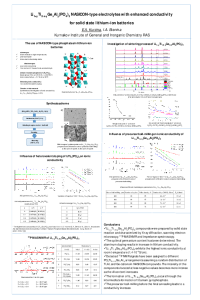
poster Kurzina E.A. Stenina I.A..pdf
Laminar burning velocities of stoichiometric inert-diluted methane-N2O flames
Hybrid membrane materials based on polybenzimidazole and silica with grafted phosphonic groups for fuel cell applications