Event submissions
EventsThe 1st International Electronic Conference on Processes: Processes System Innovation
Published
 10.3390/ECP2022-12655 (registering DOI)
 This submission belongs to the session 9. Poster of the event The 1st International Electronic Conference on Processes: Processes System Innovation
Published date
30 May, 2022
Academic Editor
'%3e%3cpath%20d='M12.6657%2010.9104C12.4185%2010.325%2012.0599%209.79327%2011.6097%209.34482C11.1609%208.89508%2010.6293%208.5365%2010.0442%208.28888C10.0389%208.28626%2010.0337%208.28495%2010.0285%208.28233C10.8446%207.69279%2011.3752%206.73249%2011.3752%205.64904C11.3752%203.8542%209.92103%202.39999%208.1262%202.39999C6.33136%202.39999%204.87715%203.8542%204.87715%205.64904C4.87715%206.73249%205.40774%207.69279%206.22393%208.28364C6.21869%208.28626%206.21345%208.28757%206.20821%208.29019C5.62129%208.5378%205.09463%208.89284%204.64265%209.34613C4.1929%209.79493%203.83432%2010.3266%203.58671%2010.9117C3.34345%2011.4845%203.21226%2012.0987%203.20023%2012.7209C3.19988%2012.7349%203.20233%2012.7488%203.20744%2012.7619C3.21255%2012.7749%203.22022%2012.7867%203.22998%2012.7968C3.23975%2012.8068%203.25142%2012.8147%203.26431%2012.8202C3.2772%2012.8256%203.29105%2012.8284%203.30504%2012.8284H4.09109C4.14874%2012.8284%204.19459%2012.7825%204.1959%2012.7262C4.2221%2011.7148%204.62823%2010.7676%205.34617%2010.0497C6.08899%209.30683%207.0755%208.89808%208.1262%208.89808C9.17689%208.89808%2010.1634%209.30683%2010.9062%2010.0497C11.6242%2010.7676%2012.0303%2011.7148%2012.0565%2012.7262C12.0578%2012.7838%2012.1037%2012.8284%2012.1613%2012.8284H12.9474C12.9613%2012.8284%2012.9752%2012.8256%2012.9881%2012.8202C13.001%2012.8147%2013.0126%2012.8068%2013.0224%2012.7968C13.0322%2012.7867%2013.0398%2012.7749%2013.0449%2012.7619C13.0501%2012.7488%2013.0525%2012.7349%2013.0522%2012.7209C13.0391%2012.0947%2012.9094%2011.4855%2012.6657%2010.9104ZM8.1262%207.9024C7.52486%207.9024%206.9589%207.6679%206.53312%207.24211C6.10733%206.81633%205.87283%206.25037%205.87283%205.64904C5.87283%205.0477%206.10733%204.48174%206.53312%204.05596C6.9589%203.63018%207.52486%203.39567%208.1262%203.39567C8.72753%203.39567%209.29349%203.63018%209.71927%204.05596C10.1451%204.48174%2010.3796%205.0477%2010.3796%205.64904C10.3796%206.25037%2010.1451%206.81633%209.71927%207.24211C9.29349%207.6679%208.72753%207.9024%208.1262%207.9024Z'%20fill='%235D1EE1'/%3e%3c/g%3e%3c/svg%3e) Blaž Likozar
Blaž LikozarCitation
Silvia Dimova, Katerina Zaharieva, Filip Ublekov, Hristo Penchev, Irina Stambolova, In situ sol-gel Polybenzimidazole/Titanium dioxide nanocomposite materials for photocatalytic degradation of Reactive Black 5 azo dye, in Proceedings of The 1st International Electronic Conference on Processes: Processes System Innovation, 17 May–31 May 2022, MDPI: Basel, Switzerland, doi: 10.3390/ECP2022-12655
Share
Email
Facebook
Twitter
LinkedIn
In situ sol-gel Polybenzimidazole/Titanium dioxide nanocomposite materials for photocatalytic degradation of Reactive Black 5 azo dye
'%3e%3cpath%20d='M12.6647%2010.9104C12.4176%2010.325%2012.0589%209.7933%2011.6088%209.34485C11.16%208.89511%2010.6283%208.53653%2010.0432%208.28891C10.038%208.28629%2010.0327%208.28498%2010.0275%208.28236C10.8437%207.69282%2011.3743%206.73252%2011.3743%205.64907C11.3743%203.85423%209.92005%202.40002%208.12522%202.40002C6.33038%202.40002%204.87618%203.85423%204.87618%205.64907C4.87618%206.73252%205.40677%207.69282%206.22296%208.28367C6.21772%208.28629%206.21248%208.2876%206.20724%208.29022C5.62031%208.53783%205.09365%208.89287%204.64167%209.34616C4.19192%209.79496%203.83334%2010.3266%203.58573%2010.9117C3.34247%2011.4846%203.21128%2012.0987%203.19925%2012.721C3.1989%2012.735%203.20135%2012.7489%203.20646%2012.7619C3.21157%2012.7749%203.21924%2012.7868%203.22901%2012.7968C3.23877%2012.8068%203.25045%2012.8148%203.26334%2012.8202C3.27623%2012.8256%203.29007%2012.8284%203.30406%2012.8284H4.09012C4.14776%2012.8284%204.19362%2012.7825%204.19493%2012.7262C4.22113%2011.7148%204.62726%2010.7676%205.34519%2010.0497C6.08802%209.30686%207.07452%208.89811%208.12522%208.89811C9.17592%208.89811%2010.1624%209.30686%2010.9052%2010.0497C11.6232%2010.7676%2012.0293%2011.7148%2012.0555%2012.7262C12.0568%2012.7839%2012.1027%2012.8284%2012.1603%2012.8284H12.9464C12.9604%2012.8284%2012.9742%2012.8256%2012.9871%2012.8202C13%2012.8148%2013.0117%2012.8068%2013.0214%2012.7968C13.0312%2012.7868%2013.0389%2012.7749%2013.044%2012.7619C13.0491%2012.7489%2013.0515%2012.735%2013.0512%2012.721C13.0381%2012.0947%2012.9084%2011.4856%2012.6647%2010.9104ZM8.12522%207.90243C7.52388%207.90243%206.95792%207.66793%206.53214%207.24215C6.10636%206.81636%205.87185%206.2504%205.87185%205.64907C5.87185%205.04773%206.10636%204.48177%206.53214%204.05599C6.95792%203.63021%207.52388%203.3957%208.12522%203.3957C8.72655%203.3957%209.29252%203.63021%209.7183%204.05599C10.1441%204.48177%2010.3786%205.04773%2010.3786%205.64907C10.3786%206.2504%2010.1441%206.81636%209.7183%207.24215C9.29252%207.66793%208.72655%207.90243%208.12522%207.90243Z'%20fill='%235D1EE1'/%3e%3c/g%3e%3c/svg%3e)
Silvia Dimova 1

Katerina Zaharieva 2
Filip Ublekov 1

Hristo Penchev 1
Irina Stambolova 3
1. Institute of Polymers, Bulgarian Academy of Sciences, “Akad. G. Bonchev” St., Bl.103A, Sofia, Bulgaria
2. Institute of Mineralogy and Crystallography “Аkad. I. Kostov”, Bulgarian Academy of Sciences, “Akad. G. Bonchev” St., Bl. 107, Sofia, Bulgaria
3. Institute of General and Inorganic Chemistry, Bulgarian Academy of Sciences, “Akad. G. Bonchev” St., Bl. 11, Sofia, Bulgaria
Abstract
Polymer nanocomposites with incorporated inorganic nanoparticles are interesting materials for study because of their unique properties. Such hybrid nanomaterials find many applications in various fields of technologies. The properties of polymer nanohybrids are combination of polymeric matrix and inorganic nanoparticles [1].
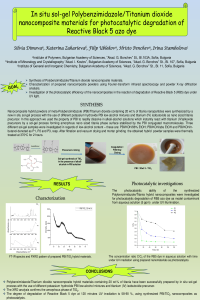
Nanocomposite hybrid powders of meta-Polybenzimidazole/Titanium dioxide containing 20 wt.% of titania were synthesized by a new in situ sol-gel process with the use of different potassium hydroxide PBI low-alcohol mixtures and titanium (IV) isobutoxide precursor. The phase composition and structure of the prepared hybrid polymer nano powders before and after calcination were characterized by powder X-ray diffraction analysis and Fourier-transform infrared spectroscopy. The photocatalytic ability of the obtained Polybenzimidazole/Titania hybrid nanomaterials were investigated for photocatalytic degradation of Reactive Black 5 (RB5) azo dye as model contaminant from aqueous solution under UV illumination. The degree of degradation of Reactive Black 5 dye at 120 minutes UV irradiation is 58-90 %, using synthesized PBI/TiO2 nanocomposites as photocatalysts.
References
[1] C. Cazan, A. Enesca, L. Andronic, Synergic effect of TiO2 filler on the mechanical properties of polymer nanocomposites, Polymers 2021, 13(12), 2017.
Keywords
Nanocomposite hybrid powder
meta-Polybenzimidazole/Titanium dioxide
photocatalyst
Manuscript
058596.pdf
Poster
Poster.pdf
Green biomonitoring systems for air pollution
Sodium tetradecyl sulfate molecule: patent analysis based on chemical compounds search