Event submissions
EventsThe 1st International Electronic Conference on Processes: Processes System Innovation
Published

This submission belongs to the session 9. Poster of the event The 1st International Electronic Conference on Processes: Processes System Innovation
Published date
30 May, 2022
Academic Editor
'%3e%3cpath%20d='M12.6657%2010.9104C12.4185%2010.325%2012.0599%209.79327%2011.6097%209.34482C11.1609%208.89508%2010.6293%208.5365%2010.0442%208.28888C10.0389%208.28626%2010.0337%208.28495%2010.0285%208.28233C10.8446%207.69279%2011.3752%206.73249%2011.3752%205.64904C11.3752%203.8542%209.92103%202.39999%208.1262%202.39999C6.33136%202.39999%204.87715%203.8542%204.87715%205.64904C4.87715%206.73249%205.40774%207.69279%206.22393%208.28364C6.21869%208.28626%206.21345%208.28757%206.20821%208.29019C5.62129%208.5378%205.09463%208.89284%204.64265%209.34613C4.1929%209.79493%203.83432%2010.3266%203.58671%2010.9117C3.34345%2011.4845%203.21226%2012.0987%203.20023%2012.7209C3.19988%2012.7349%203.20233%2012.7488%203.20744%2012.7619C3.21255%2012.7749%203.22022%2012.7867%203.22998%2012.7968C3.23975%2012.8068%203.25142%2012.8147%203.26431%2012.8202C3.2772%2012.8256%203.29105%2012.8284%203.30504%2012.8284H4.09109C4.14874%2012.8284%204.19459%2012.7825%204.1959%2012.7262C4.2221%2011.7148%204.62823%2010.7676%205.34617%2010.0497C6.08899%209.30683%207.0755%208.89808%208.1262%208.89808C9.17689%208.89808%2010.1634%209.30683%2010.9062%2010.0497C11.6242%2010.7676%2012.0303%2011.7148%2012.0565%2012.7262C12.0578%2012.7838%2012.1037%2012.8284%2012.1613%2012.8284H12.9474C12.9613%2012.8284%2012.9752%2012.8256%2012.9881%2012.8202C13.001%2012.8147%2013.0126%2012.8068%2013.0224%2012.7968C13.0322%2012.7867%2013.0398%2012.7749%2013.0449%2012.7619C13.0501%2012.7488%2013.0525%2012.7349%2013.0522%2012.7209C13.0391%2012.0947%2012.9094%2011.4855%2012.6657%2010.9104ZM8.1262%207.9024C7.52486%207.9024%206.9589%207.6679%206.53312%207.24211C6.10733%206.81633%205.87283%206.25037%205.87283%205.64904C5.87283%205.0477%206.10733%204.48174%206.53312%204.05596C6.9589%203.63018%207.52486%203.39567%208.1262%203.39567C8.72753%203.39567%209.29349%203.63018%209.71927%204.05596C10.1451%204.48174%2010.3796%205.0477%2010.3796%205.64904C10.3796%206.25037%2010.1451%206.81633%209.71927%207.24211C9.29349%207.6679%208.72753%207.9024%208.1262%207.9024Z'%20fill='%235D1EE1'/%3e%3c/g%3e%3c/svg%3e) Antoni Sánchez
Antoni SánchezCitation
Daria Voropaeva, Andrey Yaroslavtsev, Nafion solvated by ethylene carbonate, dimethyl carbonate and dimethylacetamide as electrolyte for lithium metal batteries, in Proceedings of The 1st International Electronic Conference on Processes: Processes System Innovation, 17 May–31 May 2022, MDPI: Basel, Switzerland, doi: 10.3390/ECP2022-12667
Share
Email
Facebook
Twitter
LinkedIn
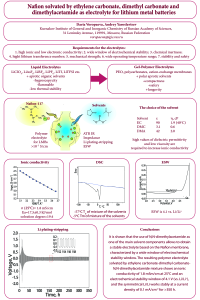
Nafion solvated by ethylene carbonate, dimethyl carbonate and dimethylacetamide as electrolyte for lithium metal batteries

Daria Voropaeva 1

Andrey Yaroslavtsev 1
1. Kurnakov Institute of General and Inorganic Chemistry of Russian Academy of Sciences, 31 Leninsky Avenue, 119991, Moscow, Russian Federation
Abstract
Lithium metal batteries are a promising replacement for lithium-ion batteries due to their ability to achieve high energy densities. However, the unsafe operation of the lithium battery due to the formation and sprouting of dendrites through the separator limits their commercial application. The most important problem limiting the large-scale application of batteries with a lithium anode is the growth of dendrites through a commercial separator. According to space charge theory, low lithium cation transfer numbers lead to dendrite formation, so using single-ion conducting electrolytes is one way to prevent dendrite formation. Nafion membrane was proposed as such an electrolyte, but it was shown that the solvation of these membranes with standard organic carbonates does not provide sufficient ionic conductivity. It was shown that the conductivity of Nafion membrane solvated by dimethylacetamide (DMAc) are significantly higher than those for standard carbonate solvents. However, some works report low chemical stability of DMAc in contact with alkali metals, and the use of mixtures of DMAc with ethylene carbonate increases stability by creating a protective film that prevents the interaction of DMAc with the metal. We obtained a gel-polymer electrolyte based on a Nafion cation-exchange membrane solvated with a ternary mixture of ethylene carbonate - dimethyl carbonate - N,N-dimethylacetamide, which has an ionic conductivity of 1.8 mS/cm at 25°C and an electrochemical stability window of 4.1 V. The symmetrical Li|Li cell was shown to cycle stably at a current density of 0.1 mA/cm2 for >350 h.
Keywords
polymer electrolyte
single-ion conductor
lithium metal battery
N,N-dimethylacetamide
Manuscript
060249.pdf
Poster
poster.pdf
Treatment of municipal activated sludge by ultrasound-Fenton process
Non-Invasive Estimation of Acetates Using Off-Gas Information from Fed-Batch E. Coli Bioprocess