Event submissions
EventsThe 1st International Electronic Conference on Processes: Processes System Innovation
Published
This submission belongs to the session 9. Poster of the event The 1st International Electronic Conference on Processes: Processes System Innovation
Published date
31 May, 2022
Academic Editor
'%3e%3cpath%20d='M12.6657%2010.9104C12.4185%2010.325%2012.0599%209.79327%2011.6097%209.34482C11.1609%208.89508%2010.6293%208.5365%2010.0442%208.28888C10.0389%208.28626%2010.0337%208.28495%2010.0285%208.28233C10.8446%207.69279%2011.3752%206.73249%2011.3752%205.64904C11.3752%203.8542%209.92103%202.39999%208.1262%202.39999C6.33136%202.39999%204.87715%203.8542%204.87715%205.64904C4.87715%206.73249%205.40774%207.69279%206.22393%208.28364C6.21869%208.28626%206.21345%208.28757%206.20821%208.29019C5.62129%208.5378%205.09463%208.89284%204.64265%209.34613C4.1929%209.79493%203.83432%2010.3266%203.58671%2010.9117C3.34345%2011.4845%203.21226%2012.0987%203.20023%2012.7209C3.19988%2012.7349%203.20233%2012.7488%203.20744%2012.7619C3.21255%2012.7749%203.22022%2012.7867%203.22998%2012.7968C3.23975%2012.8068%203.25142%2012.8147%203.26431%2012.8202C3.2772%2012.8256%203.29105%2012.8284%203.30504%2012.8284H4.09109C4.14874%2012.8284%204.19459%2012.7825%204.1959%2012.7262C4.2221%2011.7148%204.62823%2010.7676%205.34617%2010.0497C6.08899%209.30683%207.0755%208.89808%208.1262%208.89808C9.17689%208.89808%2010.1634%209.30683%2010.9062%2010.0497C11.6242%2010.7676%2012.0303%2011.7148%2012.0565%2012.7262C12.0578%2012.7838%2012.1037%2012.8284%2012.1613%2012.8284H12.9474C12.9613%2012.8284%2012.9752%2012.8256%2012.9881%2012.8202C13.001%2012.8147%2013.0126%2012.8068%2013.0224%2012.7968C13.0322%2012.7867%2013.0398%2012.7749%2013.0449%2012.7619C13.0501%2012.7488%2013.0525%2012.7349%2013.0522%2012.7209C13.0391%2012.0947%2012.9094%2011.4855%2012.6657%2010.9104ZM8.1262%207.9024C7.52486%207.9024%206.9589%207.6679%206.53312%207.24211C6.10733%206.81633%205.87283%206.25037%205.87283%205.64904C5.87283%205.0477%206.10733%204.48174%206.53312%204.05596C6.9589%203.63018%207.52486%203.39567%208.1262%203.39567C8.72753%203.39567%209.29349%203.63018%209.71927%204.05596C10.1451%204.48174%2010.3796%205.0477%2010.3796%205.64904C10.3796%206.25037%2010.1451%206.81633%209.71927%207.24211C9.29349%207.6679%208.72753%207.9024%208.1262%207.9024Z'%20fill='%235D1EE1'/%3e%3c/g%3e%3c/svg%3e) Andrey Yaroslavtsev
Andrey YaroslavtsevCitation
Katerina Zaharieva, Silvia Dimova, Venelin Hubenov, Rumyana Eneva, Filip Ublekov, Irina Stambolova, Daniela Stoyanova, Ljubomir Dimitrov, Photocatalytic and antibacterial behavior of composite nanofilms, containing Polylactide (PLA), Polyvinylpyrrolidone (PVP) and Hydrozincite , in Proceedings of The 1st International Electronic Conference on Processes: Processes System Innovation, 17 May–31 May 2022, MDPI: Basel, Switzerland
Share
Email
Facebook
Twitter
LinkedIn
Photocatalytic and antibacterial behavior of composite nanofilms, containing Polylactide (PLA), Polyvinylpyrrolidone (PVP) and Hydrozincite

Katerina Zaharieva 1
'%3e%3cpath%20d='M12.6647%2010.9104C12.4176%2010.325%2012.0589%209.7933%2011.6088%209.34485C11.16%208.89511%2010.6283%208.53653%2010.0432%208.28891C10.038%208.28629%2010.0327%208.28498%2010.0275%208.28236C10.8437%207.69282%2011.3743%206.73252%2011.3743%205.64907C11.3743%203.85423%209.92005%202.40002%208.12522%202.40002C6.33038%202.40002%204.87618%203.85423%204.87618%205.64907C4.87618%206.73252%205.40677%207.69282%206.22296%208.28367C6.21772%208.28629%206.21248%208.2876%206.20724%208.29022C5.62031%208.53783%205.09365%208.89287%204.64167%209.34616C4.19192%209.79496%203.83334%2010.3266%203.58573%2010.9117C3.34247%2011.4846%203.21128%2012.0987%203.19925%2012.721C3.1989%2012.735%203.20135%2012.7489%203.20646%2012.7619C3.21157%2012.7749%203.21924%2012.7868%203.22901%2012.7968C3.23877%2012.8068%203.25045%2012.8148%203.26334%2012.8202C3.27623%2012.8256%203.29007%2012.8284%203.30406%2012.8284H4.09012C4.14776%2012.8284%204.19362%2012.7825%204.19493%2012.7262C4.22113%2011.7148%204.62726%2010.7676%205.34519%2010.0497C6.08802%209.30686%207.07452%208.89811%208.12522%208.89811C9.17592%208.89811%2010.1624%209.30686%2010.9052%2010.0497C11.6232%2010.7676%2012.0293%2011.7148%2012.0555%2012.7262C12.0568%2012.7839%2012.1027%2012.8284%2012.1603%2012.8284H12.9464C12.9604%2012.8284%2012.9742%2012.8256%2012.9871%2012.8202C13%2012.8148%2013.0117%2012.8068%2013.0214%2012.7968C13.0312%2012.7868%2013.0389%2012.7749%2013.044%2012.7619C13.0491%2012.7489%2013.0515%2012.735%2013.0512%2012.721C13.0381%2012.0947%2012.9084%2011.4856%2012.6647%2010.9104ZM8.12522%207.90243C7.52388%207.90243%206.95792%207.66793%206.53214%207.24215C6.10636%206.81636%205.87185%206.2504%205.87185%205.64907C5.87185%205.04773%206.10636%204.48177%206.53214%204.05599C6.95792%203.63021%207.52388%203.3957%208.12522%203.3957C8.72655%203.3957%209.29252%203.63021%209.7183%204.05599C10.1441%204.48177%2010.3786%205.04773%2010.3786%205.64907C10.3786%206.2504%2010.1441%206.81636%209.7183%207.24215C9.29252%207.66793%208.72655%207.90243%208.12522%207.90243Z'%20fill='%235D1EE1'/%3e%3c/g%3e%3c/svg%3e)
Silvia Dimova 2
Venelin Hubenov 3
Rumyana Eneva 3
Filip Ublekov 2
Irina Stambolova 4
Daniela Stoyanova 4
Ljubomir Dimitrov 1
1. Institute of Mineralogy and Crystallography “Аkad. I. Kostov”, Bulgarian Academy of Sciences
2. Institute of Polymers, Bulgarian Academy of Sciences
3. The Stephan Angeloff Institute of Microbiology, Bulgarian Academy of Sciences
4. Institute of General and Inorganic Chemistry, Bulgarian Academy of Sciences
Abstract
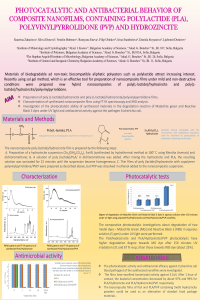
Composite nanofilms based on biopolymers (PLA, PVA etc.) and ZnO are alternative materials for “green” food packaging. The combination of the useful features of the both biopolymer (compostability and biodegradability) and good barrier, antioxidant and antibacterial properties of Zn-containing materials (hydrozincite, HZ) make these materials attractive for different applications [1].
The biocomposite films of PLA and PLA/PVP containing 5wt% hydrozincite powders have been obtained by sol-gel method. The Mentha Arvensis – mediated hydrothermal synthesis was applied to obtain the HZ powders [2].
The photocatalytic activity and antibacterial efficacy against Escherichia coli (food pathogen) of the synthesized nanofilms were investigated. The X-ray diffraction analysis and Fourier-transform infrared spectroscopy were used to determine the phase composition and functional groups.
The comparative photocatalytic investigations about degradation of two model dyes – Malachite Green (MG) and Reactive Black 5 (RB5) in aqueous solution (5 ppm) under UV light were performed. The PLA/Hydrozincite and PLA/Hydrozincite/PVP photocatalysts have higher discoloration degree towards MG dye after 150 minutes UV irradiation (31 and 87 % resp.) than those towards RB5 dye (about 25%). The both nanofilms exhibit high antibacterial effects. The bacterial concentration decreased by about 99% and 97% for PLA/Hydrozincite/PVP and PLA/Hydrozincite nanofilms, respectively after 1 hour of contact.
The obtained composites could be used as an alternative of standart food package materials.
References
[1] A. Marra, C. Silvestre, D. Duraccio, S. Cimmino, Polylactic acid/zinc oxide biocomposite films for food packaging application, International Journal of Biological Macromolecules 88 (2016) 254–262.
[2] D. Stoyanova, I. Stambolova, V. Blaskov, P. Georgieva, M. Shipochka, K. Zaharieva, O. Dimitrov, P. Markov, V. Dyakova, Y. Kostova, R. Mladenova, G. Tzvetkov, N. Boshkova, N. Boshkov, Modified approach using Mentha arvensis in the synthesis of ZnO nanoparticles—textural, structural, and photocatalytic properties, Appl. Sci. 12 (2022) 1096.
Keywords
nanocomposite films
Reactive Black 5 dye
photocatalytic degradation
antibacterial activity
Manuscript
058751.pdf
Poster
Poster.pdf
Reverse electrodialysis stack with new grafted ion-exchange membranes show net power density up to 2 W/m2
Is it possible to stably manage complexes of unstable aggregates?