Event submissions
Published

This submission belongs to the session S1. Antimicrobial Discovery, Development & Optimization of the event The 2nd International Electronic Conference on Antibiotics
Published date
14 Jun, 2022
Academic Editor
'%3e%3cpath%20d='M12.6657%2010.9104C12.4185%2010.325%2012.0599%209.79327%2011.6097%209.34482C11.1609%208.89508%2010.6293%208.5365%2010.0442%208.28888C10.0389%208.28626%2010.0337%208.28495%2010.0285%208.28233C10.8446%207.69279%2011.3752%206.73249%2011.3752%205.64904C11.3752%203.8542%209.92103%202.39999%208.1262%202.39999C6.33136%202.39999%204.87715%203.8542%204.87715%205.64904C4.87715%206.73249%205.40774%207.69279%206.22393%208.28364C6.21869%208.28626%206.21345%208.28757%206.20821%208.29019C5.62129%208.5378%205.09463%208.89284%204.64265%209.34613C4.1929%209.79493%203.83432%2010.3266%203.58671%2010.9117C3.34345%2011.4845%203.21226%2012.0987%203.20023%2012.7209C3.19988%2012.7349%203.20233%2012.7488%203.20744%2012.7619C3.21255%2012.7749%203.22022%2012.7867%203.22998%2012.7968C3.23975%2012.8068%203.25142%2012.8147%203.26431%2012.8202C3.2772%2012.8256%203.29105%2012.8284%203.30504%2012.8284H4.09109C4.14874%2012.8284%204.19459%2012.7825%204.1959%2012.7262C4.2221%2011.7148%204.62823%2010.7676%205.34617%2010.0497C6.08899%209.30683%207.0755%208.89808%208.1262%208.89808C9.17689%208.89808%2010.1634%209.30683%2010.9062%2010.0497C11.6242%2010.7676%2012.0303%2011.7148%2012.0565%2012.7262C12.0578%2012.7838%2012.1037%2012.8284%2012.1613%2012.8284H12.9474C12.9613%2012.8284%2012.9752%2012.8256%2012.9881%2012.8202C13.001%2012.8147%2013.0126%2012.8068%2013.0224%2012.7968C13.0322%2012.7867%2013.0398%2012.7749%2013.0449%2012.7619C13.0501%2012.7488%2013.0525%2012.7349%2013.0522%2012.7209C13.0391%2012.0947%2012.9094%2011.4855%2012.6657%2010.9104ZM8.1262%207.9024C7.52486%207.9024%206.9589%207.6679%206.53312%207.24211C6.10733%206.81633%205.87283%206.25037%205.87283%205.64904C5.87283%205.0477%206.10733%204.48174%206.53312%204.05596C6.9589%203.63018%207.52486%203.39567%208.1262%203.39567C8.72753%203.39567%209.29349%203.63018%209.71927%204.05596C10.1451%204.48174%2010.3796%205.0477%2010.3796%205.64904C10.3796%206.25037%2010.1451%206.81633%209.71927%207.24211C9.29349%207.6679%208.72753%207.9024%208.1262%207.9024Z'%20fill='%235D1EE1'/%3e%3c/g%3e%3c/svg%3e) Manuel Simões
Manuel SimõesCitation
Pataraporn Uaraksakul, Pragatsawat Chanprapai, In vitro antifungal activity of Boesenbergia rotundo Linn. and Syzygium aromaticum L. Merr. & Perry. extracts against Aspergillus flavus, in Proceedings of The 2nd International Electronic Conference on Antibiotics, 15 June–30 June 2022, MDPI: Basel, Switzerland, doi: 10.3390/eca2022-12687
Share
Email
Facebook
Twitter
LinkedIn
In vitro antifungal activity of Boesenbergia rotundo Linn. and Syzygium aromaticum L. Merr. & Perry. extracts against Aspergillus flavus
'%3e%3cpath%20d='M12.6647%2010.9104C12.4176%2010.325%2012.0589%209.7933%2011.6088%209.34485C11.16%208.89511%2010.6283%208.53653%2010.0432%208.28891C10.038%208.28629%2010.0327%208.28498%2010.0275%208.28236C10.8437%207.69282%2011.3743%206.73252%2011.3743%205.64907C11.3743%203.85423%209.92005%202.40002%208.12522%202.40002C6.33038%202.40002%204.87618%203.85423%204.87618%205.64907C4.87618%206.73252%205.40677%207.69282%206.22296%208.28367C6.21772%208.28629%206.21248%208.2876%206.20724%208.29022C5.62031%208.53783%205.09365%208.89287%204.64167%209.34616C4.19192%209.79496%203.83334%2010.3266%203.58573%2010.9117C3.34247%2011.4846%203.21128%2012.0987%203.19925%2012.721C3.1989%2012.735%203.20135%2012.7489%203.20646%2012.7619C3.21157%2012.7749%203.21924%2012.7868%203.22901%2012.7968C3.23877%2012.8068%203.25045%2012.8148%203.26334%2012.8202C3.27623%2012.8256%203.29007%2012.8284%203.30406%2012.8284H4.09012C4.14776%2012.8284%204.19362%2012.7825%204.19493%2012.7262C4.22113%2011.7148%204.62726%2010.7676%205.34519%2010.0497C6.08802%209.30686%207.07452%208.89811%208.12522%208.89811C9.17592%208.89811%2010.1624%209.30686%2010.9052%2010.0497C11.6232%2010.7676%2012.0293%2011.7148%2012.0555%2012.7262C12.0568%2012.7839%2012.1027%2012.8284%2012.1603%2012.8284H12.9464C12.9604%2012.8284%2012.9742%2012.8256%2012.9871%2012.8202C13%2012.8148%2013.0117%2012.8068%2013.0214%2012.7968C13.0312%2012.7868%2013.0389%2012.7749%2013.044%2012.7619C13.0491%2012.7489%2013.0515%2012.735%2013.0512%2012.721C13.0381%2012.0947%2012.9084%2011.4856%2012.6647%2010.9104ZM8.12522%207.90243C7.52388%207.90243%206.95792%207.66793%206.53214%207.24215C6.10636%206.81636%205.87185%206.2504%205.87185%205.64907C5.87185%205.04773%206.10636%204.48177%206.53214%204.05599C6.95792%203.63021%207.52388%203.3957%208.12522%203.3957C8.72655%203.3957%209.29252%203.63021%209.7183%204.05599C10.1441%204.48177%2010.3786%205.04773%2010.3786%205.64907C10.3786%206.2504%2010.1441%206.81636%209.7183%207.24215C9.29252%207.66793%208.72655%207.90243%208.12522%207.90243Z'%20fill='%235D1EE1'/%3e%3c/g%3e%3c/svg%3e)
Pataraporn Uaraksakul 1,2

Pragatsawat Chanprapai 2,3
1. Department of Biology, Faculty of Science and Technology, Bansomdej Rajabhat University, Bangkok 10600, Thailand
2. Program in Biotechnology, Faculty of Science, Chulalongkorn University, Bangkok 10330, Thailand
3. Faculty of Medicine, Bangkokthonburi University, Bangkok 10170, Thailand
Abstract
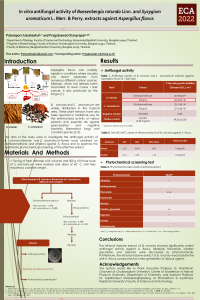
Aspergillus flavus is a common human pathogen that releases mycotoxin into the host and is frequently treated with synthetic fungicides, but the fungicides have serious human health consequences. Natural products derived from higher plant species have long been investigated as a potential means of controlling pathogenic microorganisms. The indigenous vegetables Boesenbergia rotunda and Syzygium aromaticum are widely distributed in the tropical area. These plants have also been reported in traditional uses for the antimicrobial activity. The purpose of the study was to explore the antifungal susceptibility of dichloromethane and ethanol extracts of B. rotunda rhizomes and S. aromaticum flower buds by Soxhlet’s apparatus against A. flavus using the poison food technique. The effective extract was also subjected to preliminary phytochemical screening tests. The experiment used a completely randomized design with triplications. B. rotunda ethanol extract demonstrated significantly higher potential antifungal activity. The values of minimum inhibitory concentration (MIC) and minimum fungicidal concentration (MFC) of B. rotunda ethanol extract were 6.25 and 50 mg/ml, respectively, when tested using the macro-dilution method. According to phytochemical tests, the ethanol extract also contained alkaloids, flavonoids, cardiac glycosides, and saponins. The study suggests that a basic guideline for using this as an effective antifungal compound should be separated from the B. rotunda ethanol extract in the future for topical anti-pathogenic fungus.
Keywords
Aspergillus flavus
Antifungal activity
Boesenbergia rotunda
Syzygium aromaticum
MIC/MFC values
Manuscript
sciforum-057844-2 done_1.pdf
Poster
AE-P PAT-sciforum-057844 done.pdf
In silico screening and in vitro validation of natural-based LuxS inhibitors