Event submissions
Published

This submission belongs to the session P. Poster of the event The 2nd International Electronic Conference on Antibiotics
Published date
15 Jun, 2022
Academic Editor
'%3e%3cpath%20d='M12.6657%2010.9104C12.4185%2010.325%2012.0599%209.79327%2011.6097%209.34482C11.1609%208.89508%2010.6293%208.5365%2010.0442%208.28888C10.0389%208.28626%2010.0337%208.28495%2010.0285%208.28233C10.8446%207.69279%2011.3752%206.73249%2011.3752%205.64904C11.3752%203.8542%209.92103%202.39999%208.1262%202.39999C6.33136%202.39999%204.87715%203.8542%204.87715%205.64904C4.87715%206.73249%205.40774%207.69279%206.22393%208.28364C6.21869%208.28626%206.21345%208.28757%206.20821%208.29019C5.62129%208.5378%205.09463%208.89284%204.64265%209.34613C4.1929%209.79493%203.83432%2010.3266%203.58671%2010.9117C3.34345%2011.4845%203.21226%2012.0987%203.20023%2012.7209C3.19988%2012.7349%203.20233%2012.7488%203.20744%2012.7619C3.21255%2012.7749%203.22022%2012.7867%203.22998%2012.7968C3.23975%2012.8068%203.25142%2012.8147%203.26431%2012.8202C3.2772%2012.8256%203.29105%2012.8284%203.30504%2012.8284H4.09109C4.14874%2012.8284%204.19459%2012.7825%204.1959%2012.7262C4.2221%2011.7148%204.62823%2010.7676%205.34617%2010.0497C6.08899%209.30683%207.0755%208.89808%208.1262%208.89808C9.17689%208.89808%2010.1634%209.30683%2010.9062%2010.0497C11.6242%2010.7676%2012.0303%2011.7148%2012.0565%2012.7262C12.0578%2012.7838%2012.1037%2012.8284%2012.1613%2012.8284H12.9474C12.9613%2012.8284%2012.9752%2012.8256%2012.9881%2012.8202C13.001%2012.8147%2013.0126%2012.8068%2013.0224%2012.7968C13.0322%2012.7867%2013.0398%2012.7749%2013.0449%2012.7619C13.0501%2012.7488%2013.0525%2012.7349%2013.0522%2012.7209C13.0391%2012.0947%2012.9094%2011.4855%2012.6657%2010.9104ZM8.1262%207.9024C7.52486%207.9024%206.9589%207.6679%206.53312%207.24211C6.10733%206.81633%205.87283%206.25037%205.87283%205.64904C5.87283%205.0477%206.10733%204.48174%206.53312%204.05596C6.9589%203.63018%207.52486%203.39567%208.1262%203.39567C8.72753%203.39567%209.29349%203.63018%209.71927%204.05596C10.1451%204.48174%2010.3796%205.0477%2010.3796%205.64904C10.3796%206.25037%2010.1451%206.81633%209.71927%207.24211C9.29349%207.6679%208.72753%207.9024%208.1262%207.9024Z'%20fill='%235D1EE1'/%3e%3c/g%3e%3c/svg%3e) Manuel Simões
Manuel SimõesCitation
Denis Niyazi, Ilina Micheva, Dobromira Savova, Temenuga Stoeva, In vitro activity of ceftazidime-avibactam against ESBL producing and carbapenem-resistant Gram – negative bacteria recovered from blood and fecal samples of patients after hematopoietic stem-cell transplantation, in Proceedings of The 2nd International Electronic Conference on Antibiotics, 15 June–30 June 2022, MDPI: Basel, Switzerland, doi: 10.3390/eca2022-12691
Share
Email
Facebook
Twitter
LinkedIn
In vitro activity of ceftazidime-avibactam against ESBL producing and carbapenem-resistant Gram – negative bacteria recovered from blood and fecal samples of patients after hematopoietic stem-cell transplantation
'%3e%3cpath%20d='M12.6647%2010.9104C12.4176%2010.325%2012.0589%209.7933%2011.6088%209.34485C11.16%208.89511%2010.6283%208.53653%2010.0432%208.28891C10.038%208.28629%2010.0327%208.28498%2010.0275%208.28236C10.8437%207.69282%2011.3743%206.73252%2011.3743%205.64907C11.3743%203.85423%209.92005%202.40002%208.12522%202.40002C6.33038%202.40002%204.87618%203.85423%204.87618%205.64907C4.87618%206.73252%205.40677%207.69282%206.22296%208.28367C6.21772%208.28629%206.21248%208.2876%206.20724%208.29022C5.62031%208.53783%205.09365%208.89287%204.64167%209.34616C4.19192%209.79496%203.83334%2010.3266%203.58573%2010.9117C3.34247%2011.4846%203.21128%2012.0987%203.19925%2012.721C3.1989%2012.735%203.20135%2012.7489%203.20646%2012.7619C3.21157%2012.7749%203.21924%2012.7868%203.22901%2012.7968C3.23877%2012.8068%203.25045%2012.8148%203.26334%2012.8202C3.27623%2012.8256%203.29007%2012.8284%203.30406%2012.8284H4.09012C4.14776%2012.8284%204.19362%2012.7825%204.19493%2012.7262C4.22113%2011.7148%204.62726%2010.7676%205.34519%2010.0497C6.08802%209.30686%207.07452%208.89811%208.12522%208.89811C9.17592%208.89811%2010.1624%209.30686%2010.9052%2010.0497C11.6232%2010.7676%2012.0293%2011.7148%2012.0555%2012.7262C12.0568%2012.7839%2012.1027%2012.8284%2012.1603%2012.8284H12.9464C12.9604%2012.8284%2012.9742%2012.8256%2012.9871%2012.8202C13%2012.8148%2013.0117%2012.8068%2013.0214%2012.7968C13.0312%2012.7868%2013.0389%2012.7749%2013.044%2012.7619C13.0491%2012.7489%2013.0515%2012.735%2013.0512%2012.721C13.0381%2012.0947%2012.9084%2011.4856%2012.6647%2010.9104ZM8.12522%207.90243C7.52388%207.90243%206.95792%207.66793%206.53214%207.24215C6.10636%206.81636%205.87185%206.2504%205.87185%205.64907C5.87185%205.04773%206.10636%204.48177%206.53214%204.05599C6.95792%203.63021%207.52388%203.3957%208.12522%203.3957C8.72655%203.3957%209.29252%203.63021%209.7183%204.05599C10.1441%204.48177%2010.3786%205.04773%2010.3786%205.64907C10.3786%206.2504%2010.1441%206.81636%209.7183%207.24215C9.29252%207.66793%208.72655%207.90243%208.12522%207.90243Z'%20fill='%235D1EE1'/%3e%3c/g%3e%3c/svg%3e)
Denis Niyazi 1,2
Ilina Micheva 1,3
Dobromira Savova 1,2
Temenuga Stoeva 1,2
1. Medical University of Varna
2. Microbiology laboratory, University Hospital “St. Marina”- Varna, Varna, Bulgaria
3. Hematology clinic, University Hospital “St. Marina” – Varna, Varna, Bulgaria
Abstract
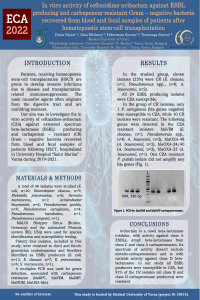
Patients, receiving hematopoietic stem-cell transplantation (HSCT) are prone to develop invasive infections due to disease and transplantation-related immunosuppression. The main causative agents often originate from the digestive tract and are multidrug resistant. Our aim was to investigate the in vitro activity of ceftazidime-avibactam (CZA) against extended spectrum beta-lactamase (ESBL) - producing and carbapenem – resistant (CR) Gram – negative bacteria recovered from blood and fecal samples of patients following HSCT, hospitalized in University Hospital “Saint Marina” - Varna during 2019-2021. A total of 48 isolates (E. coli, n=20; Enterobacter cloacae, n=9; Klebsiella pneumoniae, n=6; Serratia marcescens, n=1; Acinetobacter baumannii, n=2; Pseudomonas putida, n=4; Pseudomonas aeruginosa, n=4; Pseudomonas mendocina, n=1; Pseudomonas composti, n=1) were studied. MALDI Biotyper Sirius (Bruker, Germany) and the automated Phoenix system (BD, USA) were used for species identification and susceptibility testing. Twenty four isolates, included in this study, were resistant to third and fourth generation cephalosporins and therefore identified as ESBL producers (E. coli, n=12; E. cloacae, n=7; K. pneumoniae, n=4; S. marcescens, n=1). A multiplex PCR was used for genes detection, associated with carbapenem resistance. In the studied group, eleven isolates (23%) were CR (E. cloacae, n=1; Pseudomonas spp., n=8; A. baumannii, n=2). All 24 ESBL producing isolates were CZA susceptible. In the group of CR isolates, only 1 P. aeruginosa was susceptible to CZA, while 10 CR isolates were resistant. Genes associated with class B and class D carbapenemases were detected by PCR (blaVIM and blaOXA-like). In conclusion, in our study all ESBL producers were susceptible to CZA, while 91% of the CR isolates (all class B and class D carbapenemase producers) were resistant. CZA is a drug combination that is highly active against ESBL producers but its spectrum of activity is limited against carbapenemase producers. Therefore other novel antimicrobial agents are urgently needed.
Keywords
antibiotics
resistance
ceftazidime-avibactam
stem-cell transplantation
Manuscript
done-sciforum_060033_original_conference-done.pdf
Poster
Poster_fin.pdf
Antibiotic Prescriptions in Pediatric Patients Hospitalized with Pneumonia at a University Hospital
Sequence analysis of levofloxacin resistance-associated genes - gyrA and gyrB in treatment-naïve Helicobacter pylori patients from Malaysia