Event submissions
Published
 10.3390/eca2022-12692 (registering DOI)
 This submission belongs to the session P. Poster of the event The 2nd International Electronic Conference on Antibiotics
Published date
15 Jun, 2022
Academic Editor
'%3e%3cpath%20d='M12.6657%2010.9104C12.4185%2010.325%2012.0599%209.79327%2011.6097%209.34482C11.1609%208.89508%2010.6293%208.5365%2010.0442%208.28888C10.0389%208.28626%2010.0337%208.28495%2010.0285%208.28233C10.8446%207.69279%2011.3752%206.73249%2011.3752%205.64904C11.3752%203.8542%209.92103%202.39999%208.1262%202.39999C6.33136%202.39999%204.87715%203.8542%204.87715%205.64904C4.87715%206.73249%205.40774%207.69279%206.22393%208.28364C6.21869%208.28626%206.21345%208.28757%206.20821%208.29019C5.62129%208.5378%205.09463%208.89284%204.64265%209.34613C4.1929%209.79493%203.83432%2010.3266%203.58671%2010.9117C3.34345%2011.4845%203.21226%2012.0987%203.20023%2012.7209C3.19988%2012.7349%203.20233%2012.7488%203.20744%2012.7619C3.21255%2012.7749%203.22022%2012.7867%203.22998%2012.7968C3.23975%2012.8068%203.25142%2012.8147%203.26431%2012.8202C3.2772%2012.8256%203.29105%2012.8284%203.30504%2012.8284H4.09109C4.14874%2012.8284%204.19459%2012.7825%204.1959%2012.7262C4.2221%2011.7148%204.62823%2010.7676%205.34617%2010.0497C6.08899%209.30683%207.0755%208.89808%208.1262%208.89808C9.17689%208.89808%2010.1634%209.30683%2010.9062%2010.0497C11.6242%2010.7676%2012.0303%2011.7148%2012.0565%2012.7262C12.0578%2012.7838%2012.1037%2012.8284%2012.1613%2012.8284H12.9474C12.9613%2012.8284%2012.9752%2012.8256%2012.9881%2012.8202C13.001%2012.8147%2013.0126%2012.8068%2013.0224%2012.7968C13.0322%2012.7867%2013.0398%2012.7749%2013.0449%2012.7619C13.0501%2012.7488%2013.0525%2012.7349%2013.0522%2012.7209C13.0391%2012.0947%2012.9094%2011.4855%2012.6657%2010.9104ZM8.1262%207.9024C7.52486%207.9024%206.9589%207.6679%206.53312%207.24211C6.10733%206.81633%205.87283%206.25037%205.87283%205.64904C5.87283%205.0477%206.10733%204.48174%206.53312%204.05596C6.9589%203.63018%207.52486%203.39567%208.1262%203.39567C8.72753%203.39567%209.29349%203.63018%209.71927%204.05596C10.1451%204.48174%2010.3796%205.0477%2010.3796%205.64904C10.3796%206.25037%2010.1451%206.81633%209.71927%207.24211C9.29349%207.6679%208.72753%207.9024%208.1262%207.9024Z'%20fill='%235D1EE1'/%3e%3c/g%3e%3c/svg%3e) Manuel Simões
Manuel SimõesCitation
Heng Kang Ng, Khean Lee Goh, Boon Pin Kee, Kek Heng Chua, Suat Moi Puah, Sequence analysis of levofloxacin resistance-associated genes - gyrA and gyrB in treatment-naïve Helicobacter pylori patients from Malaysia, in Proceedings of The 2nd International Electronic Conference on Antibiotics, 15 June–30 June 2022, MDPI: Basel, Switzerland, doi: 10.3390/eca2022-12692
Share
Email
Facebook
Twitter
LinkedIn
Sequence analysis of levofloxacin resistance-associated genes - gyrA and gyrB in treatment-naïve Helicobacter pylori patients from Malaysia
'%3e%3cpath%20d='M12.6647%2010.9104C12.4176%2010.325%2012.0589%209.7933%2011.6088%209.34485C11.16%208.89511%2010.6283%208.53653%2010.0432%208.28891C10.038%208.28629%2010.0327%208.28498%2010.0275%208.28236C10.8437%207.69282%2011.3743%206.73252%2011.3743%205.64907C11.3743%203.85423%209.92005%202.40002%208.12522%202.40002C6.33038%202.40002%204.87618%203.85423%204.87618%205.64907C4.87618%206.73252%205.40677%207.69282%206.22296%208.28367C6.21772%208.28629%206.21248%208.2876%206.20724%208.29022C5.62031%208.53783%205.09365%208.89287%204.64167%209.34616C4.19192%209.79496%203.83334%2010.3266%203.58573%2010.9117C3.34247%2011.4846%203.21128%2012.0987%203.19925%2012.721C3.1989%2012.735%203.20135%2012.7489%203.20646%2012.7619C3.21157%2012.7749%203.21924%2012.7868%203.22901%2012.7968C3.23877%2012.8068%203.25045%2012.8148%203.26334%2012.8202C3.27623%2012.8256%203.29007%2012.8284%203.30406%2012.8284H4.09012C4.14776%2012.8284%204.19362%2012.7825%204.19493%2012.7262C4.22113%2011.7148%204.62726%2010.7676%205.34519%2010.0497C6.08802%209.30686%207.07452%208.89811%208.12522%208.89811C9.17592%208.89811%2010.1624%209.30686%2010.9052%2010.0497C11.6232%2010.7676%2012.0293%2011.7148%2012.0555%2012.7262C12.0568%2012.7839%2012.1027%2012.8284%2012.1603%2012.8284H12.9464C12.9604%2012.8284%2012.9742%2012.8256%2012.9871%2012.8202C13%2012.8148%2013.0117%2012.8068%2013.0214%2012.7968C13.0312%2012.7868%2013.0389%2012.7749%2013.044%2012.7619C13.0491%2012.7489%2013.0515%2012.735%2013.0512%2012.721C13.0381%2012.0947%2012.9084%2011.4856%2012.6647%2010.9104ZM8.12522%207.90243C7.52388%207.90243%206.95792%207.66793%206.53214%207.24215C6.10636%206.81636%205.87185%206.2504%205.87185%205.64907C5.87185%205.04773%206.10636%204.48177%206.53214%204.05599C6.95792%203.63021%207.52388%203.3957%208.12522%203.3957C8.72655%203.3957%209.29252%203.63021%209.7183%204.05599C10.1441%204.48177%2010.3786%205.04773%2010.3786%205.64907C10.3786%206.2504%2010.1441%206.81636%209.7183%207.24215C9.29252%207.66793%208.72655%207.90243%208.12522%207.90243Z'%20fill='%235D1EE1'/%3e%3c/g%3e%3c/svg%3e)
Heng Kang Ng 1
Khean Lee Goh 2
Boon Pin Kee 1
Kek Heng Chua 1

Suat Moi Puah 1
1. Department of Biomedical Science, Faculty of Medicine, University of Malaya, Kuala Lumpur, Malaysia.
2. Department of Medicine, Faculty of Medicine, University of Malaya, Kuala Lumpur, Malaysia.
Abstract
Background
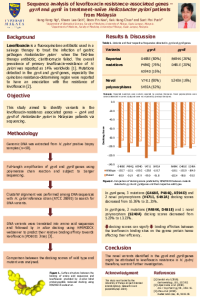
Levofloxacin is used as salvage therapy in gastric pathogen Helicobacter pylori infection due to its resistance towards first-line therapy antibiotics. Worldwide, the overall prevalence of primary levofloxacin-resistant H. pylori was reported at 14%, emerging as a major concern in eradication failure. Mutations in the gyrA and gyrB genes, especially the quinolone resistance-determining region were reported to be associated with levofloxacin resistance. Therefore, this study aims to identify variants in the levofloxacin-resistance associated genes – gyrA and gyrB of H. pylori in Malaysian patients via sequencing.
Methods
A full-length sequencing was performed on gyrA (2484bp) and gyrB (2322bp) using DNA extracted from biopsy samples obtained from 50 treatment-naïve patients infected with H. pylori. The identified DNA variants were translated in-silico and the produced protein sequences were used to predict their relative binding affinity towards levofloxacin using the HPEPDOCK webserver. The molecular docking scores between the wild type and mutant were analysed.
Results and Discussion
In the gyrA gene, three reported mutations (G468E, 80%; P484Q, 76%; A594D, 16%) and two novel polymorphisms (V741I, 80%; S492A, 62%) were identified to have decreased docking scores ranging from 16.36% to 21.25%. For the gyrB gene, two commonly reported mutations (R484K, 26%; D481E, 20%) and a novel polymorphism (S240A, 16%) were reported to have decreased in 13.23%, 5.32% and 10.14% docking scores respectively. Decreased docking scores signify a weaker binding affinity between the levofloxacin and the protein binding sites in mutations compared to the wild type, consequently having a potential impact on the efficacy of levofloxacin treatments.
Conclusion
The novel variants identified in gyrA and gyrB might be attributed to levofloxacin resistance in H. pylori, therefore, warrant for further investigation.
Acknowledgement
This study was funded by the University of Malaya Impact-Oriented Interdisciplinary Research Grant (IIRG029A/B/C-2019).
Keywords
Levofloxacin
Helicobacter pylori
gyrA
gyrB
Malaysia
Antibiotic resistance
Manuscript
fin-sciforum-060071-done.pdf
Poster
sciforum-060071_POSTER (1).pdf
In vitro activity of ceftazidime-avibactam against ESBL producing and carbapenem-resistant Gram – negative bacteria recovered from blood and fecal samples of patients after hematopoietic stem-cell transplantation
Resistance rates to 3rd generation cephalosporins and carbapenems in Serratia marcescens isolates obtained from various clinical samples from two Bulgarian hospitals