Event submissions
Published

This submission belongs to the session P. Poster of the event The 2nd International Electronic Conference on Antibiotics
Published date
15 Jun, 2022
Academic Editor
'%3e%3cpath%20d='M12.6657%2010.9104C12.4185%2010.325%2012.0599%209.79327%2011.6097%209.34482C11.1609%208.89508%2010.6293%208.5365%2010.0442%208.28888C10.0389%208.28626%2010.0337%208.28495%2010.0285%208.28233C10.8446%207.69279%2011.3752%206.73249%2011.3752%205.64904C11.3752%203.8542%209.92103%202.39999%208.1262%202.39999C6.33136%202.39999%204.87715%203.8542%204.87715%205.64904C4.87715%206.73249%205.40774%207.69279%206.22393%208.28364C6.21869%208.28626%206.21345%208.28757%206.20821%208.29019C5.62129%208.5378%205.09463%208.89284%204.64265%209.34613C4.1929%209.79493%203.83432%2010.3266%203.58671%2010.9117C3.34345%2011.4845%203.21226%2012.0987%203.20023%2012.7209C3.19988%2012.7349%203.20233%2012.7488%203.20744%2012.7619C3.21255%2012.7749%203.22022%2012.7867%203.22998%2012.7968C3.23975%2012.8068%203.25142%2012.8147%203.26431%2012.8202C3.2772%2012.8256%203.29105%2012.8284%203.30504%2012.8284H4.09109C4.14874%2012.8284%204.19459%2012.7825%204.1959%2012.7262C4.2221%2011.7148%204.62823%2010.7676%205.34617%2010.0497C6.08899%209.30683%207.0755%208.89808%208.1262%208.89808C9.17689%208.89808%2010.1634%209.30683%2010.9062%2010.0497C11.6242%2010.7676%2012.0303%2011.7148%2012.0565%2012.7262C12.0578%2012.7838%2012.1037%2012.8284%2012.1613%2012.8284H12.9474C12.9613%2012.8284%2012.9752%2012.8256%2012.9881%2012.8202C13.001%2012.8147%2013.0126%2012.8068%2013.0224%2012.7968C13.0322%2012.7867%2013.0398%2012.7749%2013.0449%2012.7619C13.0501%2012.7488%2013.0525%2012.7349%2013.0522%2012.7209C13.0391%2012.0947%2012.9094%2011.4855%2012.6657%2010.9104ZM8.1262%207.9024C7.52486%207.9024%206.9589%207.6679%206.53312%207.24211C6.10733%206.81633%205.87283%206.25037%205.87283%205.64904C5.87283%205.0477%206.10733%204.48174%206.53312%204.05596C6.9589%203.63018%207.52486%203.39567%208.1262%203.39567C8.72753%203.39567%209.29349%203.63018%209.71927%204.05596C10.1451%204.48174%2010.3796%205.0477%2010.3796%205.64904C10.3796%206.25037%2010.1451%206.81633%209.71927%207.24211C9.29349%207.6679%208.72753%207.9024%208.1262%207.9024Z'%20fill='%235D1EE1'/%3e%3c/g%3e%3c/svg%3e) Manuel Simões
Manuel SimõesCitation
Stephanie Dimitrova Radeva, Denis Niyazi, Milena Bojkova, Dobromira Savova, Temenuga Stoeva, Resistance rates to 3rd generation cephalosporins and carbapenems in Serratia marcescens isolates obtained from various clinical samples from two Bulgarian hospitals, in Proceedings of The 2nd International Electronic Conference on Antibiotics, 15 June–30 June 2022, MDPI: Basel, Switzerland, doi: 10.3390/eca2022-12693
Share
Email
Facebook
Twitter
LinkedIn
Resistance rates to 3rd generation cephalosporins and carbapenems in Serratia marcescens isolates obtained from various clinical samples from two Bulgarian hospitals
'%3e%3cpath%20d='M12.6647%2010.9104C12.4176%2010.325%2012.0589%209.7933%2011.6088%209.34485C11.16%208.89511%2010.6283%208.53653%2010.0432%208.28891C10.038%208.28629%2010.0327%208.28498%2010.0275%208.28236C10.8437%207.69282%2011.3743%206.73252%2011.3743%205.64907C11.3743%203.85423%209.92005%202.40002%208.12522%202.40002C6.33038%202.40002%204.87618%203.85423%204.87618%205.64907C4.87618%206.73252%205.40677%207.69282%206.22296%208.28367C6.21772%208.28629%206.21248%208.2876%206.20724%208.29022C5.62031%208.53783%205.09365%208.89287%204.64167%209.34616C4.19192%209.79496%203.83334%2010.3266%203.58573%2010.9117C3.34247%2011.4846%203.21128%2012.0987%203.19925%2012.721C3.1989%2012.735%203.20135%2012.7489%203.20646%2012.7619C3.21157%2012.7749%203.21924%2012.7868%203.22901%2012.7968C3.23877%2012.8068%203.25045%2012.8148%203.26334%2012.8202C3.27623%2012.8256%203.29007%2012.8284%203.30406%2012.8284H4.09012C4.14776%2012.8284%204.19362%2012.7825%204.19493%2012.7262C4.22113%2011.7148%204.62726%2010.7676%205.34519%2010.0497C6.08802%209.30686%207.07452%208.89811%208.12522%208.89811C9.17592%208.89811%2010.1624%209.30686%2010.9052%2010.0497C11.6232%2010.7676%2012.0293%2011.7148%2012.0555%2012.7262C12.0568%2012.7839%2012.1027%2012.8284%2012.1603%2012.8284H12.9464C12.9604%2012.8284%2012.9742%2012.8256%2012.9871%2012.8202C13%2012.8148%2013.0117%2012.8068%2013.0214%2012.7968C13.0312%2012.7868%2013.0389%2012.7749%2013.044%2012.7619C13.0491%2012.7489%2013.0515%2012.735%2013.0512%2012.721C13.0381%2012.0947%2012.9084%2011.4856%2012.6647%2010.9104ZM8.12522%207.90243C7.52388%207.90243%206.95792%207.66793%206.53214%207.24215C6.10636%206.81636%205.87185%206.2504%205.87185%205.64907C5.87185%205.04773%206.10636%204.48177%206.53214%204.05599C6.95792%203.63021%207.52388%203.3957%208.12522%203.3957C8.72655%203.3957%209.29252%203.63021%209.7183%204.05599C10.1441%204.48177%2010.3786%205.04773%2010.3786%205.64907C10.3786%206.2504%2010.1441%206.81636%209.7183%207.24215C9.29252%207.66793%208.72655%207.90243%208.12522%207.90243Z'%20fill='%235D1EE1'/%3e%3c/g%3e%3c/svg%3e)
Stephanie Dimitrova Radeva 1,2
Denis Niyazi 2,3
Milena Bojkova 2,3
Dobromira Savova 2,3
Temenuga Stoeva 2,3
1. Microbiology laboratory, University Hospital “Saint Anna”- Varna, Varna, Bulgaria
2. Varna Medical University, Bulgaria
3. Microbiology laboratory, University Hospital “Saint Marina”- Varna, Varna, Bulgaria
Abstract
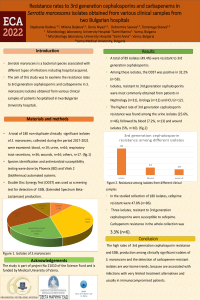
Aim: Serratia marcescens is a bacterial species associated with different types of infections including hospital acquired. The aim of this study was to examine the resistance rates to 3rd generation cephalosporins and carbapenems in S. marcescens isolates obtained from various clinical samples of patients hospitalized in two Bulgarian University hospitals. Materials and methods: A total of 180 non-duplicate clinically significant isolates of S. marcescens, collected during the period 2017-2021 were examined: blood, n=19; urine, n=64; respiratory tract secretions, n=36; wounds, n=44; others, n=17. Species identification and antimicrobial susceptibility testing were done by Phoenix (BD) and Vitek 2 (bioMerieux) automated systems. Double Disc Synergy Test (DDST) was used as screening test for detection of ESBL (Extended Spectrum Beta-Lactamase) production. Results: A total of 89 isolates (49.4%) were resistant to 3rd generation cephalosporins. Among these isolates, the DDST was positive in 32.2% (n=58). Isolates, resistant to 3rd generation cephalosporins were most commonly obtained from patients in Nephrology (n=31), Urology (n=12) аnd ICU (n=12). The highest rate of 3rd generation cephalosporin resistance was found among the urine isolates (25.6%, n=46), followed by blood (7.2%, n=13) and wound isolates (5%, n=10). In the studied collection of 180 isolates, cefepime resistant were 47.8% (n=86). Three isolates, resistant to 3rd generation cephalosporins were susceptible to cefepime. Carbapenem resistance in the whole collection was 3.3% (n=6). Conclusion: The high rates of 3rd generation cephalosporin resistance and ESBL production among clinically significant isolates of S. marcescens and the detection of carbapenem-resistant isolates are worrisome trends, because are associated with infections with very limited treatment alternatives and usually in immunocompromised patients.
Keywords
Antibiotic resistance
Resistance rates
3rd generation cephalosporins
carbapenems
ESBL
S.marcescens
Manuscript
fin-sciforum_060089_original_Abstract_S_Radeva-done.pdf
Poster
poster.pdf
Sequence analysis of levofloxacin resistance-associated genes - gyrA and gyrB in treatment-naïve Helicobacter pylori patients from Malaysia
Antifungal Activity of Novel Hydrophobin from an alkaliphilic fungus Sodiomyces alkalinus