Event submissions
Published
 10.3390/eca2022-12696 (registering DOI)
 This submission belongs to the session P. Poster of the event The 2nd International Electronic Conference on Antibiotics
Published date
15 Jun, 2022
Academic Editor
'%3e%3cpath%20d='M12.6657%2010.9104C12.4185%2010.325%2012.0599%209.79327%2011.6097%209.34482C11.1609%208.89508%2010.6293%208.5365%2010.0442%208.28888C10.0389%208.28626%2010.0337%208.28495%2010.0285%208.28233C10.8446%207.69279%2011.3752%206.73249%2011.3752%205.64904C11.3752%203.8542%209.92103%202.39999%208.1262%202.39999C6.33136%202.39999%204.87715%203.8542%204.87715%205.64904C4.87715%206.73249%205.40774%207.69279%206.22393%208.28364C6.21869%208.28626%206.21345%208.28757%206.20821%208.29019C5.62129%208.5378%205.09463%208.89284%204.64265%209.34613C4.1929%209.79493%203.83432%2010.3266%203.58671%2010.9117C3.34345%2011.4845%203.21226%2012.0987%203.20023%2012.7209C3.19988%2012.7349%203.20233%2012.7488%203.20744%2012.7619C3.21255%2012.7749%203.22022%2012.7867%203.22998%2012.7968C3.23975%2012.8068%203.25142%2012.8147%203.26431%2012.8202C3.2772%2012.8256%203.29105%2012.8284%203.30504%2012.8284H4.09109C4.14874%2012.8284%204.19459%2012.7825%204.1959%2012.7262C4.2221%2011.7148%204.62823%2010.7676%205.34617%2010.0497C6.08899%209.30683%207.0755%208.89808%208.1262%208.89808C9.17689%208.89808%2010.1634%209.30683%2010.9062%2010.0497C11.6242%2010.7676%2012.0303%2011.7148%2012.0565%2012.7262C12.0578%2012.7838%2012.1037%2012.8284%2012.1613%2012.8284H12.9474C12.9613%2012.8284%2012.9752%2012.8256%2012.9881%2012.8202C13.001%2012.8147%2013.0126%2012.8068%2013.0224%2012.7968C13.0322%2012.7867%2013.0398%2012.7749%2013.0449%2012.7619C13.0501%2012.7488%2013.0525%2012.7349%2013.0522%2012.7209C13.0391%2012.0947%2012.9094%2011.4855%2012.6657%2010.9104ZM8.1262%207.9024C7.52486%207.9024%206.9589%207.6679%206.53312%207.24211C6.10733%206.81633%205.87283%206.25037%205.87283%205.64904C5.87283%205.0477%206.10733%204.48174%206.53312%204.05596C6.9589%203.63018%207.52486%203.39567%208.1262%203.39567C8.72753%203.39567%209.29349%203.63018%209.71927%204.05596C10.1451%204.48174%2010.3796%205.0477%2010.3796%205.64904C10.3796%206.25037%2010.1451%206.81633%209.71927%207.24211C9.29349%207.6679%208.72753%207.9024%208.1262%207.9024Z'%20fill='%235D1EE1'/%3e%3c/g%3e%3c/svg%3e) Manuel Simões
Manuel SimõesCitation
Marta O. Teixeira, Carla Silva, Joana C. Antunes, Helena P. Felgueiras, Natural extract-loaded wet-spun fibers encapsulated within a hydrogel matrix for potential uses in the treatment of skin infections, in Proceedings of The 2nd International Electronic Conference on Antibiotics, 15 June–30 June 2022, MDPI: Basel, Switzerland, doi: 10.3390/eca2022-12696
Share
Email
Facebook
Twitter
LinkedIn
Natural extract-loaded wet-spun fibers encapsulated within a hydrogel matrix for potential uses in the treatment of skin infections
'%3e%3cpath%20d='M12.6647%2010.9104C12.4176%2010.325%2012.0589%209.7933%2011.6088%209.34485C11.16%208.89511%2010.6283%208.53653%2010.0432%208.28891C10.038%208.28629%2010.0327%208.28498%2010.0275%208.28236C10.8437%207.69282%2011.3743%206.73252%2011.3743%205.64907C11.3743%203.85423%209.92005%202.40002%208.12522%202.40002C6.33038%202.40002%204.87618%203.85423%204.87618%205.64907C4.87618%206.73252%205.40677%207.69282%206.22296%208.28367C6.21772%208.28629%206.21248%208.2876%206.20724%208.29022C5.62031%208.53783%205.09365%208.89287%204.64167%209.34616C4.19192%209.79496%203.83334%2010.3266%203.58573%2010.9117C3.34247%2011.4846%203.21128%2012.0987%203.19925%2012.721C3.1989%2012.735%203.20135%2012.7489%203.20646%2012.7619C3.21157%2012.7749%203.21924%2012.7868%203.22901%2012.7968C3.23877%2012.8068%203.25045%2012.8148%203.26334%2012.8202C3.27623%2012.8256%203.29007%2012.8284%203.30406%2012.8284H4.09012C4.14776%2012.8284%204.19362%2012.7825%204.19493%2012.7262C4.22113%2011.7148%204.62726%2010.7676%205.34519%2010.0497C6.08802%209.30686%207.07452%208.89811%208.12522%208.89811C9.17592%208.89811%2010.1624%209.30686%2010.9052%2010.0497C11.6232%2010.7676%2012.0293%2011.7148%2012.0555%2012.7262C12.0568%2012.7839%2012.1027%2012.8284%2012.1603%2012.8284H12.9464C12.9604%2012.8284%2012.9742%2012.8256%2012.9871%2012.8202C13%2012.8148%2013.0117%2012.8068%2013.0214%2012.7968C13.0312%2012.7868%2013.0389%2012.7749%2013.044%2012.7619C13.0491%2012.7489%2013.0515%2012.735%2013.0512%2012.721C13.0381%2012.0947%2012.9084%2011.4856%2012.6647%2010.9104ZM8.12522%207.90243C7.52388%207.90243%206.95792%207.66793%206.53214%207.24215C6.10636%206.81636%205.87185%206.2504%205.87185%205.64907C5.87185%205.04773%206.10636%204.48177%206.53214%204.05599C6.95792%203.63021%207.52388%203.3957%208.12522%203.3957C8.72655%203.3957%209.29252%203.63021%209.7183%204.05599C10.1441%204.48177%2010.3786%205.04773%2010.3786%205.64907C10.3786%206.2504%2010.1441%206.81636%209.7183%207.24215C9.29252%207.66793%208.72655%207.90243%208.12522%207.90243Z'%20fill='%235D1EE1'/%3e%3c/g%3e%3c/svg%3e)
Marta O. Teixeira 1

Carla Silva 2

Joana C. Antunes 1

Helena P. Felgueiras 1
1. University of Minho, Campus of Azurém
2. University of Minho, Campus of Gualtar
Abstract
Natural extracts are emerging as potential alternatives to the use of antibiotics to fight infections, by exhibiting excellent antimicrobial profiles. In particular, the biomolecules thymol and eugenol, have been explored in the prevention/treatment of skin infections with effective outcomes. Different fiber-based or hydrogel-based scaffolds have been employed in the treatment of skin infections because of their similarities to the skin structure, specifically the matrix and fibrillar elements, respectively. In this study, we explore these hybrid fiber-hydrogel architectures further, by examining the antimicrobial potentialities of polycaprolactone (PCL) wet-spun fibers functionalized with thymol encased within a poly(vinyl alcohol) (PVA) hydrogel modified with eugenol, against Staphylococcus aureus and Staphylococcus epidermidis. Thymol needed only 0.313 and 0.627 mg/mL to inhibit the growth of these bacteria, respectively. While eugenol, required 5 mg/mL to induce the same effect. PCL fibers (9wt.% in dimethylformamide) were processed by wet-spun at an extrusion rate of 0.1 mL/min directly into a distilled water (dH2O) coagulation bath. Thymol dissolved in dimethyl sulfoxide was combined with the PCL solution at 1,254 mg/mL (2×0.627 mg/mL) to generate modified fibers. All PCL-based fibers presented a uniform and homogeneous appearance, even though thymol’s presence reduced the diameter of the fibers (247.49 to 146.99 µm) and their elongation at break (159.32 to 93.26%). Eugenol-loaded and unloaded PVA hydrogels were prepared at 10wt.% in dH2O) in a coagulation bath of 8% NaOH and 4% Na2SO4. PVA-based hydrogels with a soft, flexible, and malleable structure were generated. The incorporation of eugenol appeared to increase the flexibility of the hydrogel while maintaining its integrity. Incorporation of PCL fibers in the PVA hydrogel, both functionalized with the respective biomolecules, was successful. In general, the potential of these biomolecules and both structures to work synergistically for the treatment of skin infections was demonstrated.
Keywords
Wet-spinning fibers
hydrogel
natural-origin biomolecules
antibacterial activity
Manuscript
sciforum-060112-done.pdf
Poster
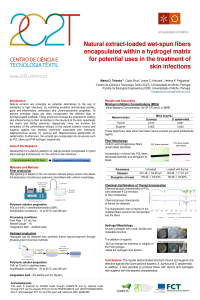
ECA Poster_Marta Teixeira.pdf
Structure-activity relationship for natural tetracenomycin X congeners
The Solid-Phase MicroExtraction as an antibiotic resistance detector in Staphylococcus aureus strains