Event submissions
Published

This submission belongs to the session S1. Antimicrobial Discovery, Development & Optimization of the event The 2nd International Electronic Conference on Antibiotics
Published date
15 Jun, 2022
Academic Editor
'%3e%3cpath%20d='M12.6657%2010.9104C12.4185%2010.325%2012.0599%209.79327%2011.6097%209.34482C11.1609%208.89508%2010.6293%208.5365%2010.0442%208.28888C10.0389%208.28626%2010.0337%208.28495%2010.0285%208.28233C10.8446%207.69279%2011.3752%206.73249%2011.3752%205.64904C11.3752%203.8542%209.92103%202.39999%208.1262%202.39999C6.33136%202.39999%204.87715%203.8542%204.87715%205.64904C4.87715%206.73249%205.40774%207.69279%206.22393%208.28364C6.21869%208.28626%206.21345%208.28757%206.20821%208.29019C5.62129%208.5378%205.09463%208.89284%204.64265%209.34613C4.1929%209.79493%203.83432%2010.3266%203.58671%2010.9117C3.34345%2011.4845%203.21226%2012.0987%203.20023%2012.7209C3.19988%2012.7349%203.20233%2012.7488%203.20744%2012.7619C3.21255%2012.7749%203.22022%2012.7867%203.22998%2012.7968C3.23975%2012.8068%203.25142%2012.8147%203.26431%2012.8202C3.2772%2012.8256%203.29105%2012.8284%203.30504%2012.8284H4.09109C4.14874%2012.8284%204.19459%2012.7825%204.1959%2012.7262C4.2221%2011.7148%204.62823%2010.7676%205.34617%2010.0497C6.08899%209.30683%207.0755%208.89808%208.1262%208.89808C9.17689%208.89808%2010.1634%209.30683%2010.9062%2010.0497C11.6242%2010.7676%2012.0303%2011.7148%2012.0565%2012.7262C12.0578%2012.7838%2012.1037%2012.8284%2012.1613%2012.8284H12.9474C12.9613%2012.8284%2012.9752%2012.8256%2012.9881%2012.8202C13.001%2012.8147%2013.0126%2012.8068%2013.0224%2012.7968C13.0322%2012.7867%2013.0398%2012.7749%2013.0449%2012.7619C13.0501%2012.7488%2013.0525%2012.7349%2013.0522%2012.7209C13.0391%2012.0947%2012.9094%2011.4855%2012.6657%2010.9104ZM8.1262%207.9024C7.52486%207.9024%206.9589%207.6679%206.53312%207.24211C6.10733%206.81633%205.87283%206.25037%205.87283%205.64904C5.87283%205.0477%206.10733%204.48174%206.53312%204.05596C6.9589%203.63018%207.52486%203.39567%208.1262%203.39567C8.72753%203.39567%209.29349%203.63018%209.71927%204.05596C10.1451%204.48174%2010.3796%205.0477%2010.3796%205.64904C10.3796%206.25037%2010.1451%206.81633%209.71927%207.24211C9.29349%207.6679%208.72753%207.9024%208.1262%207.9024Z'%20fill='%235D1EE1'/%3e%3c/g%3e%3c/svg%3e) Manuel Simões
Manuel SimõesCitation
Anna Baranova, Vera Alferova, Yuliya Zakalyukina, Vladimir Korshun, Study of the biodiversity and antibiotic activity of microorganisms isolated from the nasal mucosa of the Mangalica pig., in Proceedings of The 2nd International Electronic Conference on Antibiotics, 15 June–30 June 2022, MDPI: Basel, Switzerland, doi: 10.3390/eca2022-12698
Share
Email
Facebook
Twitter
LinkedIn
Study of the biodiversity and antibiotic activity of microorganisms isolated from the nasal mucosa of the Mangalica pig.
'%3e%3cpath%20d='M12.6647%2010.9104C12.4176%2010.325%2012.0589%209.7933%2011.6088%209.34485C11.16%208.89511%2010.6283%208.53653%2010.0432%208.28891C10.038%208.28629%2010.0327%208.28498%2010.0275%208.28236C10.8437%207.69282%2011.3743%206.73252%2011.3743%205.64907C11.3743%203.85423%209.92005%202.40002%208.12522%202.40002C6.33038%202.40002%204.87618%203.85423%204.87618%205.64907C4.87618%206.73252%205.40677%207.69282%206.22296%208.28367C6.21772%208.28629%206.21248%208.2876%206.20724%208.29022C5.62031%208.53783%205.09365%208.89287%204.64167%209.34616C4.19192%209.79496%203.83334%2010.3266%203.58573%2010.9117C3.34247%2011.4846%203.21128%2012.0987%203.19925%2012.721C3.1989%2012.735%203.20135%2012.7489%203.20646%2012.7619C3.21157%2012.7749%203.21924%2012.7868%203.22901%2012.7968C3.23877%2012.8068%203.25045%2012.8148%203.26334%2012.8202C3.27623%2012.8256%203.29007%2012.8284%203.30406%2012.8284H4.09012C4.14776%2012.8284%204.19362%2012.7825%204.19493%2012.7262C4.22113%2011.7148%204.62726%2010.7676%205.34519%2010.0497C6.08802%209.30686%207.07452%208.89811%208.12522%208.89811C9.17592%208.89811%2010.1624%209.30686%2010.9052%2010.0497C11.6232%2010.7676%2012.0293%2011.7148%2012.0555%2012.7262C12.0568%2012.7839%2012.1027%2012.8284%2012.1603%2012.8284H12.9464C12.9604%2012.8284%2012.9742%2012.8256%2012.9871%2012.8202C13%2012.8148%2013.0117%2012.8068%2013.0214%2012.7968C13.0312%2012.7868%2013.0389%2012.7749%2013.044%2012.7619C13.0491%2012.7489%2013.0515%2012.735%2013.0512%2012.721C13.0381%2012.0947%2012.9084%2011.4856%2012.6647%2010.9104ZM8.12522%207.90243C7.52388%207.90243%206.95792%207.66793%206.53214%207.24215C6.10636%206.81636%205.87185%206.2504%205.87185%205.64907C5.87185%205.04773%206.10636%204.48177%206.53214%204.05599C6.95792%203.63021%207.52388%203.3957%208.12522%203.3957C8.72655%203.3957%209.29252%203.63021%209.7183%204.05599C10.1441%204.48177%2010.3786%205.04773%2010.3786%205.64907C10.3786%206.2504%2010.1441%206.81636%209.7183%207.24215C9.29252%207.66793%208.72655%207.90243%208.12522%207.90243Z'%20fill='%235D1EE1'/%3e%3c/g%3e%3c/svg%3e)
Anna Baranova 1
Vera Alferova 1,2

Yuliya Zakalyukina 3
Vladimir Korshun 1,2
1. Shemyakin-Ovchinnikov Institute of Bioorganic Chemistry, Moscow, Russia
2. Gause Institute of New Antibiotics, Moscow, Russia
3. Lomonosov Moscow State University, Moscow, Russia
Abstract
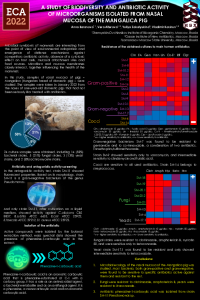
Mammals ubiquitously interact with environmental and symbiotic microbes, and the effects of these interactions on animal physiology are currently the subject of intense interest. Symbionts of mammals are interesting from the point of view of their adaptation to their environment: the emergence of defense mechanisms against competitors - antibiotic activity, the absence of a cytotoxic effect on host cells, competition for mucosal attachment sites and food sources. Microflora and mucous membranes are in close interaction, exerting a mutual influence on the health of a mammal. In this study, samples of the nasal mucosa of pigs – Mangalica (Hungarian breed of domestic pig) were studied. The samples were taken in January 2022 from the noses of one-year-old domestic pigs that had not been seriously ill or treated with antibiotics. Cultures of microorganisms were isolated on SMS agar and Mueller-Hinton agar. The biodiversity of microorganisms, their antibiotic and antagonistic activity were studied. The resistance of the obtained cultures to the main human antibiotics was also tested. Antimicrobial activity of the isolated strains against a number of microorganisms was evaluated. The following test strains were used: a fungus (Aspergillus niger INA 00760), a yeast (Candida albicans CBS 8836), gram-positive bacteria (Bacillus subtilis ATCC 6633, Staphylococcus aureus 29213, Staphylococcus aureus ATCC 25293, Staphylococcus aureus ATCC 43300 (MRSA), Staphylococcus epidermidis ATCC 14990, Enterococcus faecalis ATCC 29212) and gram-negative bacteria (Escherichia coli ATCC 25922, Pseudomonas aeruginosa ATCC 27853). As the result, a strain SM-11 with pronounced antimicrobial properties was selected for further investigation. The active strain was found to produce bright green fluorescent pigment.
Keywords
Antimicrobial activity
antagonistic activity
antibiotic resistance
biodiversity
pig nose
Mangalica
Manuscript
sciforum-060115-done.pdf
Poster
ECA2022_Baranova.pdf
The Solid-Phase MicroExtraction as an antibiotic resistance detector in Staphylococcus aureus strains
Poly(vinyl alcohol)/polycaprolactone co-axial wet-spun fibrous scaffolds loaded with ceftazidime and vancomycin for the eradication of P. aeruginosa and S. aureus bacteria in diabetic foot wounds