Event submissions
Published
 10.3390/eca2022-12700 (registering DOI)
 This submission belongs to the session P. Poster of the event The 2nd International Electronic Conference on Antibiotics
Published date
15 Jun, 2022
Academic Editor
'%3e%3cpath%20d='M12.6657%2010.9104C12.4185%2010.325%2012.0599%209.79327%2011.6097%209.34482C11.1609%208.89508%2010.6293%208.5365%2010.0442%208.28888C10.0389%208.28626%2010.0337%208.28495%2010.0285%208.28233C10.8446%207.69279%2011.3752%206.73249%2011.3752%205.64904C11.3752%203.8542%209.92103%202.39999%208.1262%202.39999C6.33136%202.39999%204.87715%203.8542%204.87715%205.64904C4.87715%206.73249%205.40774%207.69279%206.22393%208.28364C6.21869%208.28626%206.21345%208.28757%206.20821%208.29019C5.62129%208.5378%205.09463%208.89284%204.64265%209.34613C4.1929%209.79493%203.83432%2010.3266%203.58671%2010.9117C3.34345%2011.4845%203.21226%2012.0987%203.20023%2012.7209C3.19988%2012.7349%203.20233%2012.7488%203.20744%2012.7619C3.21255%2012.7749%203.22022%2012.7867%203.22998%2012.7968C3.23975%2012.8068%203.25142%2012.8147%203.26431%2012.8202C3.2772%2012.8256%203.29105%2012.8284%203.30504%2012.8284H4.09109C4.14874%2012.8284%204.19459%2012.7825%204.1959%2012.7262C4.2221%2011.7148%204.62823%2010.7676%205.34617%2010.0497C6.08899%209.30683%207.0755%208.89808%208.1262%208.89808C9.17689%208.89808%2010.1634%209.30683%2010.9062%2010.0497C11.6242%2010.7676%2012.0303%2011.7148%2012.0565%2012.7262C12.0578%2012.7838%2012.1037%2012.8284%2012.1613%2012.8284H12.9474C12.9613%2012.8284%2012.9752%2012.8256%2012.9881%2012.8202C13.001%2012.8147%2013.0126%2012.8068%2013.0224%2012.7968C13.0322%2012.7867%2013.0398%2012.7749%2013.0449%2012.7619C13.0501%2012.7488%2013.0525%2012.7349%2013.0522%2012.7209C13.0391%2012.0947%2012.9094%2011.4855%2012.6657%2010.9104ZM8.1262%207.9024C7.52486%207.9024%206.9589%207.6679%206.53312%207.24211C6.10733%206.81633%205.87283%206.25037%205.87283%205.64904C5.87283%205.0477%206.10733%204.48174%206.53312%204.05596C6.9589%203.63018%207.52486%203.39567%208.1262%203.39567C8.72753%203.39567%209.29349%203.63018%209.71927%204.05596C10.1451%204.48174%2010.3796%205.0477%2010.3796%205.64904C10.3796%206.25037%2010.1451%206.81633%209.71927%207.24211C9.29349%207.6679%208.72753%207.9024%208.1262%207.9024Z'%20fill='%235D1EE1'/%3e%3c/g%3e%3c/svg%3e) Manuel Simões
Manuel SimõesCitation
Suat Moi Puah, Wei Ching Khor, Kyaw Thu Aung, Kar Hui Ong, Tien Tien Vicky Lau, SD Puthucheary, Kek Heng Chua, Antimicrobial Resistance Profiles of Aeromonas hydrophila and Aeromonas caviae Isolated from Clinical and Environment Sources, in Proceedings of The 2nd International Electronic Conference on Antibiotics, 15 June–30 June 2022, MDPI: Basel, Switzerland, doi: 10.3390/eca2022-12700
Share
Email
Facebook
Twitter
LinkedIn
Antimicrobial Resistance Profiles of Aeromonas hydrophila and Aeromonas caviae Isolated from Clinical and Environment Sources

Suat Moi Puah 1
'%3e%3cpath%20d='M12.6647%2010.9104C12.4176%2010.325%2012.0589%209.7933%2011.6088%209.34485C11.16%208.89511%2010.6283%208.53653%2010.0432%208.28891C10.038%208.28629%2010.0327%208.28498%2010.0275%208.28236C10.8437%207.69282%2011.3743%206.73252%2011.3743%205.64907C11.3743%203.85423%209.92005%202.40002%208.12522%202.40002C6.33038%202.40002%204.87618%203.85423%204.87618%205.64907C4.87618%206.73252%205.40677%207.69282%206.22296%208.28367C6.21772%208.28629%206.21248%208.2876%206.20724%208.29022C5.62031%208.53783%205.09365%208.89287%204.64167%209.34616C4.19192%209.79496%203.83334%2010.3266%203.58573%2010.9117C3.34247%2011.4846%203.21128%2012.0987%203.19925%2012.721C3.1989%2012.735%203.20135%2012.7489%203.20646%2012.7619C3.21157%2012.7749%203.21924%2012.7868%203.22901%2012.7968C3.23877%2012.8068%203.25045%2012.8148%203.26334%2012.8202C3.27623%2012.8256%203.29007%2012.8284%203.30406%2012.8284H4.09012C4.14776%2012.8284%204.19362%2012.7825%204.19493%2012.7262C4.22113%2011.7148%204.62726%2010.7676%205.34519%2010.0497C6.08802%209.30686%207.07452%208.89811%208.12522%208.89811C9.17592%208.89811%2010.1624%209.30686%2010.9052%2010.0497C11.6232%2010.7676%2012.0293%2011.7148%2012.0555%2012.7262C12.0568%2012.7839%2012.1027%2012.8284%2012.1603%2012.8284H12.9464C12.9604%2012.8284%2012.9742%2012.8256%2012.9871%2012.8202C13%2012.8148%2013.0117%2012.8068%2013.0214%2012.7968C13.0312%2012.7868%2013.0389%2012.7749%2013.044%2012.7619C13.0491%2012.7489%2013.0515%2012.735%2013.0512%2012.721C13.0381%2012.0947%2012.9084%2011.4856%2012.6647%2010.9104ZM8.12522%207.90243C7.52388%207.90243%206.95792%207.66793%206.53214%207.24215C6.10636%206.81636%205.87185%206.2504%205.87185%205.64907C5.87185%205.04773%206.10636%204.48177%206.53214%204.05599C6.95792%203.63021%207.52388%203.3957%208.12522%203.3957C8.72655%203.3957%209.29252%203.63021%209.7183%204.05599C10.1441%204.48177%2010.3786%205.04773%2010.3786%205.64907C10.3786%206.2504%2010.1441%206.81636%209.7183%207.24215C9.29252%207.66793%208.72655%207.90243%208.12522%207.90243Z'%20fill='%235D1EE1'/%3e%3c/g%3e%3c/svg%3e)
Wei Ching Khor 2
Kyaw Thu Aung 2
Kar Hui Ong 2
Tien Tien Vicky Lau 1
SD Puthucheary 1
Kek Heng Chua 1
1. Department of Biomedical Science, Faculty of Medicine, University of Malaya, Kuala
Lumpur 50603, Malaysia.
2. National Centre for Food Science, Singapore Food Agency, Singapore 718837, Singapore.
Abstract
Introduction
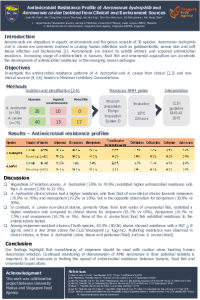
Aeromonads are ubiquitous in aquatic environments and the genus consists of 36 species. Aeromonas hydrophila and A. caviae are commonly involved in causing human infections such as gastroenteritis, severe skin and soft tissue infection and bacteremia [1]. Increasing usage of antimicrobial in humans, food fish and ornamental aquaculture can lead to antimicrobial resistance. In this study, we investigated the antimicrobial resistance patterns of A. hydrophila and A. caviae from clinical [2,3] and non-clinical sources [4,5,6] based on MICs using the dehydrated microdilution panel.
Methods
Thirty-six A. hydrophila (clinical=26, aquatic environments=10) and 70 A. caviae (clinical=40, aquatic environments=13, food fish =17) were subjected to antimicrobial susceptibility testing with 18 antimicrobial agents (Microscan NM44 plates). The plates were incubated at 35°C overnight and MIC values were determined according to CLSI [7].
Results and Discussion
Aeromonas hydrophila and A. caviae were resistant to eight antimicrobial agents (imipenem, meropenem, doripenem, trimethoprim-sulfamethoxazole, cefotaxime, ceftazidime, aztreonam and cefepime) ranging from 2.5% to 76.9%. A. hydrophila clinical strains were resistant at higher than that of water environmental strains towards imipenem (76.9% vs 70%) and meropenem (19.2% vs 10%) but in the opposite direction for doripenem (30.8% vs 50%). In contrast, A. caviae environmental strains primarily recovered from tank water of ornamental fish exhibited a higher resistance rate compared to clinical strains for imipenem (16.7% vs 10%), doripenem (16.7% vs 7.5%) and meropenem (16.7% vs 5%). Among imipenem resistant strains of both species, 83.3% (30/36) strains showed resistance with a MIC > 8 µg/mL which is two times above the CLSI breakpoint (> 4µg/mL). Overall, 2.8% of multidrug-resistant strains were observed in three A. hydrophila (urine, tissue and peritoneal fluid) and one A. caviae (stool).
Conclusion
Our findings highlight that imipenem should be used with caution when treating human Aeromonas infection, the aquatic environment and ornamental fish.
Keywords
Aeromonas caviae
Aeromonas hydrophila
CLSI
Microscan NM44
Manuscript
done-sciforum_060120_original_2022_ECA_conference_Submit-done.pdf
Poster
Poster for ETA2_SUBMIT.pdf
Poly(vinyl alcohol)/polycaprolactone co-axial wet-spun fibrous scaffolds loaded with ceftazidime and vancomycin for the eradication of P. aeruginosa and S. aureus bacteria in diabetic foot wounds
ANTI-BACTERIAL PERSPECTIVE OF NON-ANTIBIOTIC DRUGS